
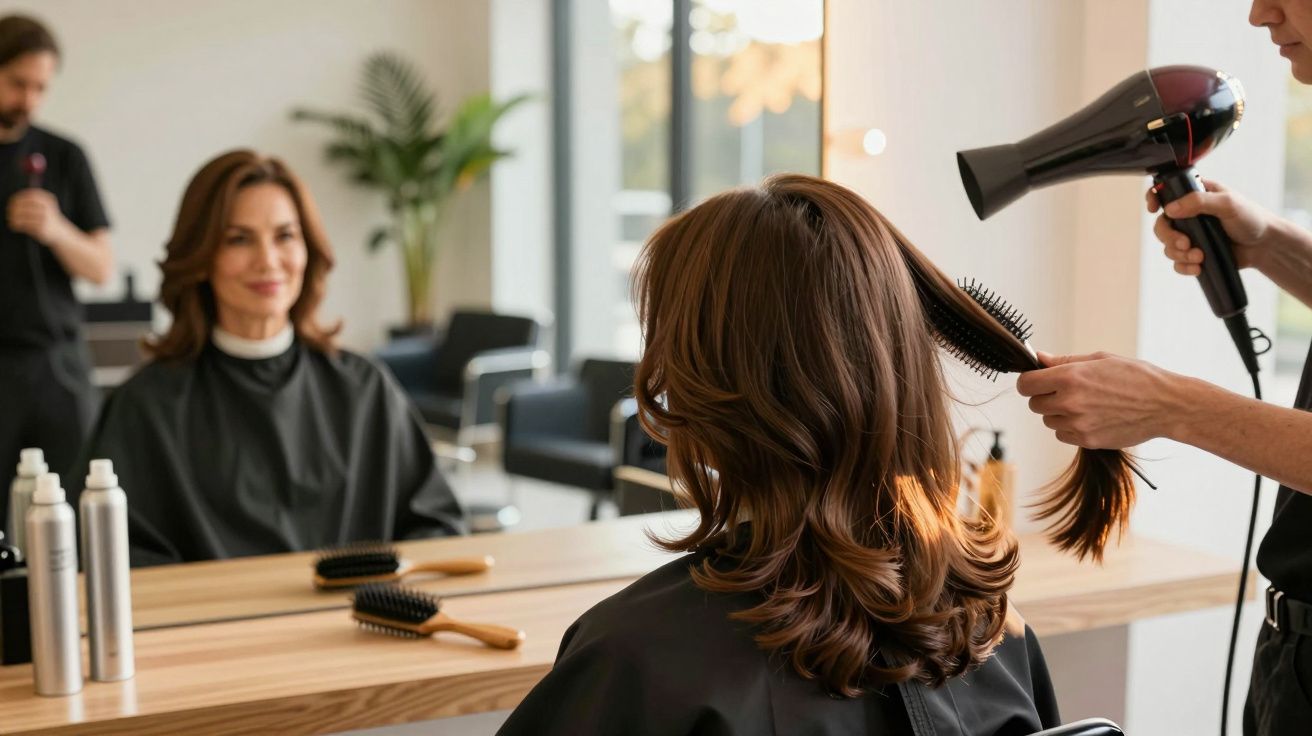
Many women reach a point where they suddenly notice it: the once full-looking hair seems tired, the volume disappears as the day goes on, and even a careful blow-dry barely holds. Rather than endlessly trialling new styling products, hairdressers tend to recommend one clear move: choose the right cut-one that makes fine hair look smarter, not like it’s constantly battling.
Why fine hair after 50 suddenly behaves differently
Over time, the hair’s structure shifts. Hormones fluctuate, blood circulation in the scalp can slow down, and years of small care mistakes add up. The outcome is remarkably similar for many people: each strand becomes thinner, feels less springy, and snaps more easily.
- Blow-dried styles collapse faster
- The roots sit closer to the scalp and can look “stuck down”
- Long lengths visually drag the hair downward
- Thinning at the temples or along the parting becomes more noticeable
A common instinctive reaction is: don’t cut it-every centimetre matters. In reality, that often makes things worse. Long, fine hair tends to hang limply, looks more see-through, and highlights every sparse patch.
Hairdressers stress: it’s not the amount of hair that matters most, but how cleverly the cut and length make use of what you do have.
The best cut idea for fine hair after 50: the Soft Layer Cut
When professional stylists are asked how to make fine hair look denser, livelier and more current, they repeatedly come back to the same approach: a carefully placed layered cut-a thoughtfully executed soft layer cut.
The principle is simple: the hair isn’t chopped to one uniform length. Instead, subtle differences in length are created so the layers support one another. The overall shape appears fuller even though you haven’t magically gained extra hair.
How layers create the illusion of volume
With fine hair, volume tends to appear where more “mass” is gathered. A well-designed layered cut works directly with that idea:
- Lengths are trimmed slightly so they don’t pull everything down
- The top sections are given soft layers that sit over the lower hair
- Transitions are kept smooth, so nothing looks stringy or frayed
- Fragile ends that keep snapping are cut cleanly, which helps reduce split ends
The result is a shape that feels compact yet lively. Hair falls better, looks thicker and has more bounce.
A modern layered cut gathers the hair you already have instead of “losing” it in length-making it a secret weapon for fine hair after 50.
Length matters: too long takes away, the right shorter length gives back
The ideal cut for fine hair after 50 is rarely ultra-long. Most hairdressers prefer a length between the chin and just above the shoulder, where volume is easier to control and maintain.
| Option | Characteristics | Best for |
|---|---|---|
| Layered long bob | Around collarbone length, soft layers, plenty of movement through the ends | Anyone who doesn’t want to give up longer hair entirely |
| Layered bob | Between chin and shoulder, layers around the head, optional fringe | Ideal for fine hair that still has a little lift at the back |
| Short, soft layer cut | Shorter at the nape, longer through the crown, lots of structure | Bolder looks that highlight facial features and feel more youthful |
What these options share: no endlessly long, straight, one-length ends. Instead, you get a controlled shape that concentrates volume and gently lifts the hair.
How the right cut flatters the face after 50
At 50 and beyond, facial features often change too: skin loses a bit of firmness, lines become more visible, and contours soften. The right cut can subtly rebalance this.
- Face-framing layers soften a sharper jawline
- A light fringe can visually blur fine lines on the forehead
- Slightly higher volume at the crown creates a lengthening effect and looks fresher
- Soft waves around the face reduce harshness in the overall expression
A cleverly placed layered cut works for the face as well as the hair-like a gentle moving filter.
Styling: how to get the most out of the best cut
Even the best layer cut depends on how it’s styled. Many women with fine hair fall into a familiar habit: ironing everything flat and sleek. Unfortunately, that only exaggerates the “flat to the scalp” effect.
More waves, less “ironed flat”
Hairdressers clearly favour movement over ruler-straight lines:
- Wavy styling: loose waves created with a curling wand, straighteners or rollers instantly add body
- Soft curls: large, relaxed curls look fuller than tight ringlets
- Undone finish: not every section needs to be perfect-slight messiness reads younger and thicker
The enemy of fine hair remains the ultra-sleek look. It reveals every sparse area, every thin patch, every flat spot.
Blow-dry like a pro: the roots are everything
Direction matters when blow-drying. If you always dry from top to bottom, you essentially press the hair onto the head. A better routine:
- Rough-dry upside down until the roots are almost dry
- Use a round brush to lift sections and dry against the direction of growth
- Finish with a quick blast of cool air to “set” the volume
Volume starts at the roots, not the ends-focus there and you’ll need less hairspray and fewer tricks.
Lightweight products, big impact
Fine hair is easily overwhelmed by rich formulas. Heavy creams, oily serums or intense masks near the roots can make everything collapse almost immediately.
- Mousse: a small amount worked through damp hair adds grip without stickiness
- Texture spray: sea-salt or volumising sprays create hold and a thicker feel
- Root lifter: targeted root sprays gently raise hair at the scalp
Conditioning products are best kept to mid-lengths and ends. At the roots, a light, volumising range is usually enough-keeping the crown airy while the lengths stay glossy.
How often should you trim fine hair after 50?
Fine hair rarely disguises neglected ends. Breakage and split ends make strands look even thinner. That’s why hairdressers often suggest a tidy-up at least every 6 to 8 weeks.
This helps keep:
- layers clearly defined
- ends closed, neat and compact
- the shape fresh and the volume easier to style
Sacrificing a few millimetres regularly often creates more visible fullness than any extra length is worth.
A realistic scenario: from a long ponytail to a smart layer cut
Picture a woman in her mid-50s who has worn a thin, long ponytail for years. The ponytail itself is narrow, the ends look see-through, and the roots seem greasy because she’s been trying to add shine with oils.
She chooses a shoulder-length, soft layered cut with gentle waves. The hairdresser takes off roughly 10 cm, adds fine layers through the crown and around the face, then blow-dries with a round brush and finishes with a light texture spray.
What she sees in the mirror can be surprisingly dramatic: the hair is genuinely shorter, yet looks noticeably fuller. Her face appears more open and awake, and the cheekbones stand out more. It’s a clear example of how strongly the right cut can work on confidence as well as appearance.
Extra essentials: scalp care and everyday habits that support fine hair after 50
A great cut does a lot, but everyday routines can either help it along or undo the effect. If you regularly struggle with flat roots, it’s worth checking your basics.
- Clean scalp, lighter lift: use a gentle shampoo that doesn’t leave heavy residue, and avoid applying conditioner close to the scalp
- Heat protection still matters: fine hair can be fragile-use a lightweight heat protectant before blow-drying or using hot tools
- Sleep and friction: if hair breaks easily, a smoother pillowcase (such as satin) and a loose overnight style can reduce snagging and split ends
Small tweaks like these won’t replace a good soft layer cut, but they can help the style look fresher for longer between salon visits.
Risks and limits: when a hairdresser should look more closely
Not every change in hair after 50 is purely cosmetic. Severe thinning, round bald patches or sudden heavy shedding may have medical causes, such as hormonal imbalance or nutritional deficiencies.
In these situations, a great cut alone isn’t enough. An experienced hairdresser is likely to suggest speaking to a GP or a dermatologist before making dramatic changes. A layer cut can help visually, but it can’t replace a proper diagnosis.
Bonus: colour techniques that make the best cut look even better
Colour has a major influence on how “full” hair appears. Very light, cool shades can make fine hair look transparent. Softer, multi-dimensional colour tends to be more flattering:
- Fine highlights in closely related tones add depth and texture
- Slightly darker roots with lighter ends can make hair look denser at the scalp
- Grey hair can look shinier and smoother with glossing treatments
Combined with a well-placed layered cut, this creates a look that isn’t trying to be 30-just modern, polished and confidently 50-plus.


Comments
No comments yet. Be the first to comment!
Leave a Comment