
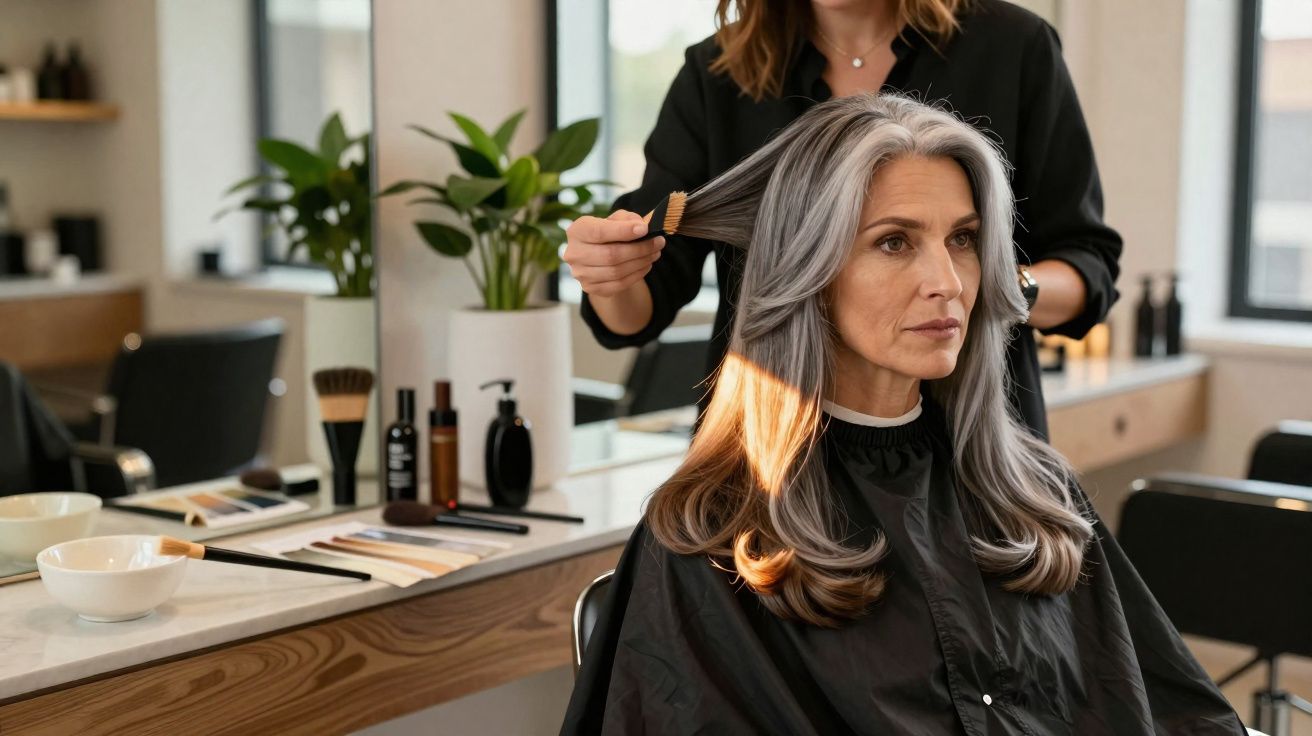
The woman in the chair keeps winding a silver strand around her fingers.
Her hair is a warm chestnut brown, but right at the parting there’s a sharp streak of grey, like a flash of lightning. She laughs, yet her eyes dart up to the mirror in that quick, uneasy way you only recognise if you’ve felt it yourself. Beside her, a younger client scrolls Instagram, pausing on yet another “melting” transformation: roots blurred, greys erased, not a harsh line in sight.
The colourist pulls on gloves and leans closer, speaking quietly. Not about “hiding” age, but about softening contrast - about letting grey read as texture rather than a warning beacon. The foils stay on the trolley. In the bowl is something creamier and more subtle, almost like skincare for hair.
Fifteen minutes later, the grey is still technically there. But your eyes glide past it, as though the hair has forgotten exactly where it turned white.
Why “melting” is quietly replacing balayage in UK salons
Step into a busy salon in Britain right now and you’ll spot the change: fewer crisp balayage ribbons and more blurred roots that look as if they simply grew that way. Colourists call it melting - a technique where shades are fused so seamlessly you can’t tell where one ends and the next begins.
It isn’t shouty. It doesn’t announce “fresh from the salon”. And that understatement is precisely the appeal, particularly for anyone who’s exhausted by chasing the first greys every four weeks.
Where balayage often focuses on lighter lengths with deeper root shadow, root melting prioritises the transition. The grey isn’t completely removed; it’s softened into neighbouring tones, like lowering the contrast on a photo. The boundary between “coloured” and “natural” fades until it’s hard to point to a starting line.
A London colourist told me that five years ago balayage made up about 70% of her Instagram feed. Now it’s melting and grey-blending posts that pull in the comments. Clients in midlife message her screenshots late at night: “Can we do this? I’m done with block roots.”
A 2023 UK survey by a major hair brand reflected the same shift: nearly 60% of women with visible greys didn’t want to “cover” them - they wanted them to be “less obvious”. Different language, different plan. Melting sits neatly in that middle ground.
Take Emma, 46. She used to book root touch-ups every three weeks without fail. Miss one appointment and the grey at her parting felt like a neon arrow. After switching to root melting, she stretches appointments to around ten weeks. Friends tell her she looks “softer”, but they can’t say why. That’s the point.
Grey hair creates stark contrast at the root, especially against darker base shades. Balayage - with brightened ends and deeper roots - can actually make that regrowth band feel more obvious as the hair grows. Melting reverses the logic.
By diffusing colour at the root and threading warmer or cooler tones through the greys, the eye stops seeing a line and starts seeing a gradient. And our brains like gradients: they register as natural, relaxed and low-drama.
There’s also a maintenance mindset at play. High-contrast colour makes every millimetre of regrowth feel like a ticking clock. With a soft melt, your natural grey has a way of blending in as it arrives. The grow-out is less brutal, so you spend less energy worrying about your hair - and more on everything else.
How melting works on grey hair (without frying it)
At heart, melting comes down to three things: choosing compatible tones, softening the root area, and extending the blend through the mid-lengths. A colourist will usually start by assessing how much grey you have and where it sits - at the temples, along the parting, scattered throughout, or in solid patches.
Next comes tone selection. Rather than forcing your grey into a single flat shade, the colourist mixes hues that mirror what’s already happening in your hair. Cool, steely greys tend to suit ashy beiges and mushroom browns. Warmer, golden whites often pair better with honey or caramel notes.
The key moment is the application: colour is brushed or smudged slightly beyond the root - sometimes even worked in with fingers - so there’s no hard edge. Think watercolour, not felt-tip pen. The lengths are often finished with a gloss or toner to pull everything together, rather than being fully recoloured from top to bottom.
At home, the best thing you can do for a melt is not to attack it. Strong clarifying shampoos, very hot water and vigorous scrubbing can strip a delicate blend faster than you’d expect. This is where gentle, sulphate-free shampoos and colour-safe conditioners genuinely make a difference.
Let’s be honest: almost nobody follows the “perfect routine” every day. Still, small adjustments add up - turning the water temperature down slightly, swapping one wash a week for a dry-shampoo day, and using a purple or blue shampoo occasionally if the grey starts to look brassy. Tiny habits help keep the melt believable for longer.
Where people often go wrong is trying to copy a photo instead of working with their reality. Melting that looks dreamy on a 25-year-old with three “baby” greys won’t behave the same on someone who’s 20% silver at the front and 5% at the back. That isn’t failure - it’s simply physics.
A frequent misstep is requesting a very dark base that melts abruptly into very light ends. On hair with significant grey, that contrast pulls the eye straight back to the root. Another is choosing a tone that’s too warm or too cool for your skin. A technically perfect melt in the wrong temperature can leave you looking drained.
And then there’s the part people don’t always say out loud: the emotional side. It matters more than we admit, and it can show up again and again in the chair - the mix of wanting to feel like yourself, wanting to look “kept”, and not wanting your hair to feel like a weekly referendum on ageing.
“Melting isn’t about pretending you’re not going grey,” says Carla, a colourist in Manchester. “It’s about taking control of the story your hair tells. You decide how loud the grey speaks.”
A few practical points to take with you:
- Ask your colourist what maintenance your specific melt will require.
- Bring realistic photos: similar age, similar grey pattern, similar base colour.
- Plan for a transition phase if you’re moving from full grey coverage to melting.
- Protect your hairline from the sun; UV can shift the tone of a grey blend.
- Give the technique at least two appointments to properly settle into your hair.
Before any colour appointment in the UK, remember the boring-but-important bit: a patch test. Even if you’ve coloured your hair for years, allergies can develop over time, and grey-blending services can still involve oxidative dyes or toners. A reputable salon will advise on timing and suitability.
It’s also worth talking honestly about your lifestyle. If you swim often (chlorine), use heated tools daily, or spend a lot of time outdoors, your colourist can tweak the formula and aftercare so your grey melt stays truer for longer - not just on day one, but in week eight.
Grey hair melting and grey-blending: seeing grey as texture, not a problem
There’s something quietly radical about refusing to turn grey hair into a crisis. Melting doesn’t deny that ageing is happening. Instead, it shifts the focus so your face, your expression and your cut come first. The silver becomes background texture - like the grain in a photograph.
One client told me she used to angle her bathroom mirror to avoid catching her temples in harsh morning light. After a subtle melt and a softer fringe, she stopped thinking about them altogether. The greys didn’t disappear; they simply stopped shouting.
Culturally, that matters. We’ve swung from “cover grey at all costs” to “grow it out completely”, as though those are the only two options. Melting lives in the messy middle - which is where most real life sits.
We’re allowed to feel complicated about ageing. We can soften without erasing, and edit without lying. Hair colour is one of the few tools women over 40 are routinely told to weaponise against time. Melting suggests something gentler: perhaps just turn the volume down.
Next time you see a friend and catch yourself thinking, “She looks well-rested,” look again. It might not be a new serum or a week in Greece. It might simply be that her grey has been quietly blurred - and with it, the pressure to keep fighting a battle she never volunteered for.
| Key point | Detail | What it means for you |
|---|---|---|
| Melting blurs the roots | A technique that fuses tones between grey roots and coloured lengths | Less contrast, so grey feels less noticeable day to day |
| Less strict maintenance | Regrowth is less obvious than with classic all-over colour or a harsher balayage | Appointments can be spaced out, with less “demarcation line” stress |
| A softer approach to ageing | Grey is integrated rather than denied | A kinder self-image and a more natural, modern look |
FAQ
- Is melting suitable if I’m more than 50% grey? Yes, but the approach changes. Your colourist may lean on lowlights and translucent toners rather than trying to darken everything, so the result stays soft and believable.
- How long does a grey melt typically last? Most people go about 8–12 weeks before wanting a refresh, depending on growth rate and how much contrast there is with the natural shade.
- Can I switch from full grey coverage to melting in one go? You can begin in a single session, although the most natural results often take two or three appointments as old, harsh dye lines are gently broken up.
- Will melting damage my hair as much as regular colouring? The technique is more about placement than brute strength, so colourists can often use gentler formulas plus plenty of conditioning, which helps keep hair healthier.
- Can I do a grey-melting effect at home? You can soften roots slightly with root sprays or glosses, but a truly seamless blend - especially on mixed grey - is realistically a salon service.




Comments
No comments yet. Be the first to comment!
Leave a Comment