

The woman in the salon chair had the sort of pin-straight hair people quietly screenshot on Instagram: glossy, well-behaved, falling as one sleek panel down her back. But when you looked properly, you could see why she’d booked in. “It just… hangs,” she said, studying herself as if her hair were a curtain with no drape. No bounce, no energy, no movement.
She wasn’t asking for curls, and she definitely wasn’t after the kind of volume that needs its own seat on the bus. She simply wanted her hair to shift when she walked, then settle back neatly-without turning into a fuzzy halo.
Her stylist smiled, lifted the comb and said, almost under her breath, “You don’t need layers everywhere. You just need the right ones.”
That’s where the clever haircut actually starts.
The straight hair movement cut: the subtle shape that wakes up straight hair
With straight hair, movement rarely comes from chopping in lots of obvious, choppy layers. It comes from sculpting a shape that lets the hair breathe as you turn your head. The cut that keeps resurfacing in salons is a soft, face-enhancing, internal-layered cut with gentle, face-framing layers-a classic outline on the outside, with the real work hidden within.
From the front, you notice light, flowing pieces that open the face around the cheekbones and down towards the collarbones. From behind, the hemline stays largely full and clean. The hair swings, but it doesn’t “blow up”. That balance is the whole point.
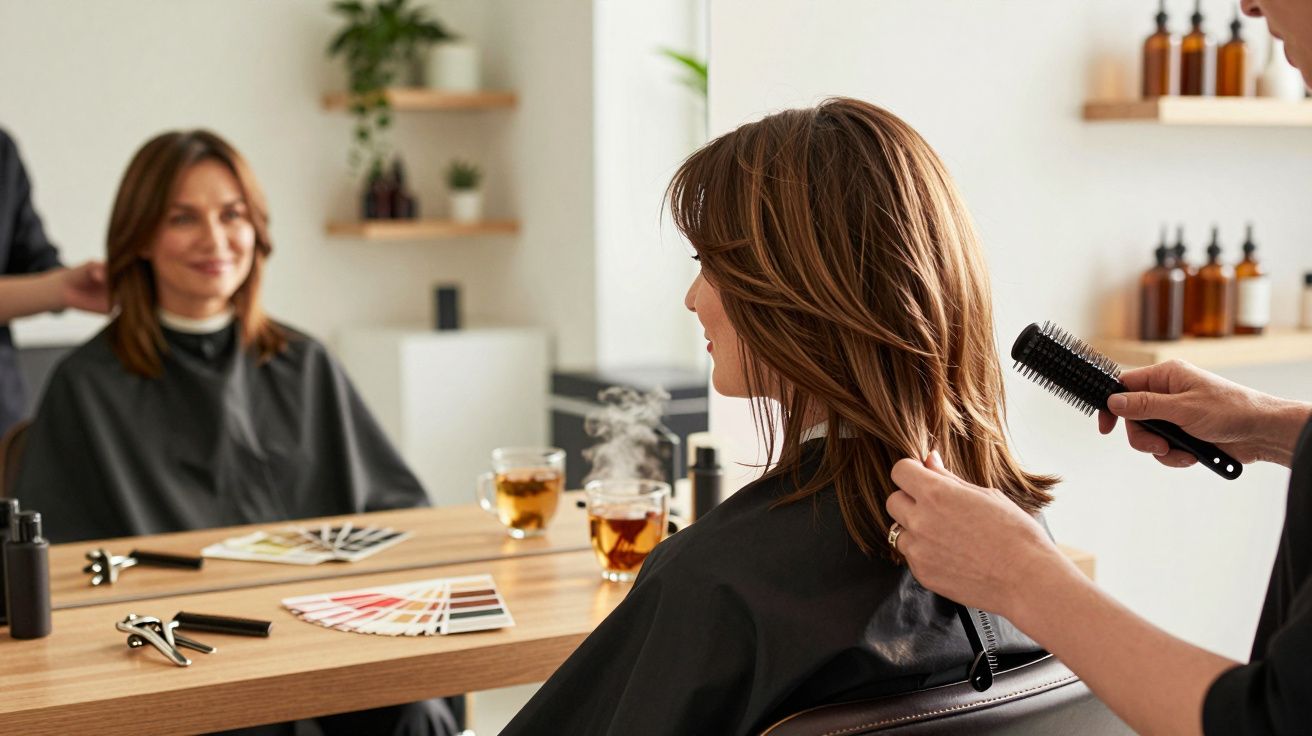
I watched this play out one Tuesday afternoon in a small city salon, where a stylist used almost the same base approach on three different clients.
- The first had weighty, poker-straight hair that fell to her chest. Before the cut, it sat tight against her jaw and made her features look sharper than they truly were. About 20 minutes later, her hair skimmed the shoulders, with long, slim layers beginning at the lips, and her face looked instantly softer and more open.
- The second client had fine straight hair that normally collapsed by lunchtime. Rather than attacking it with aggressive thinning shears, the stylist cut a long, layered curtain fringe, then added barely-there internal layers through the back. When she stood, the hair moved in one controlled wave-almost like fabric-without a fluffy “halo” of broken flyaways.
The reason it works is technical, but not complicated. Straight hair throws back light like a mirror, which means harsh, jagged layers show up immediately and can interrupt the shine. By using long, gentle layers that start below the cheekbones-or even from the collarbone-you introduce motion without ruining that reflective finish.
Most of the weight is removed inside the haircut rather than off the surface, so it still looks dense and polished, but feels lighter to wear. That hidden texturising creates room for the ends to swing, while the outer line stays smooth enough to resist frizz. You get air and shape without the dreaded fluffy triangle effect that so many “layered” cuts accidentally create.
The exact techniques that create movement, not frizz
If you sit down and only ask for “more movement”, you can end up with random layers and instant regret. The difference is in the language. Ask for a blunt or softly rounded perimeter, plus long, seamless face-framing layers, and light internal layering that begins below the cheekbones. That tells your stylist you want structure first, then softness.
Many professionals rely on slide-cutting or point-cutting on dry or semi-dry hair, especially around the face. That way they can see how the strands behave in real life-not just when the hair is soaking wet, combed flat and cooperating. The aim is to create small “channels” of air through the hair, not visible steps.
The biggest mistake people with straight hair make is requesting aggressive thinning or short layers “for volume”. On straight textures, it can go wrong quickly: flyaways, a ragged outline, and frizz that appears the moment humidity hits. Instead of looking soft, the ends can start to look bitten.
If you’ve been there, you’ll recognise the response: you wear it tied up for weeks, willing it to grow. There’s a gentler approach-movement through the front, stability through the back; long layers rather than staircases. And it only works properly if you’re honest about how you style your hair at home. Realistically, hardly anyone repeats a full salon blow-dry every single day.
“Straight hair loves structure,” explains Paris-based hairstylist Léa Martins. “We add movement by removing weight in the right places, not by randomly cutting into it. The haircut should feel almost invisible as it grows-just more alive.”
To ground that idea, these are the key elements stylists often use for movement without frizz on straight hair:
- Long face-framing layers starting at or below the cheekbones.
- A mostly blunt or slightly rounded baseline to keep density.
- Soft internal layers cut inside the shape, not carved into the surface.
- Minimal use of thinning shears, limited to genuinely bulky areas.
- Ends refined with tiny, irregular point-cuts for a light, floating finish.
A useful extra when you’re booking in: bring two reference photos-one of the front/face framing you like, and one of the back/perimeter you want to keep. It helps your stylist protect the “clean line” while still building in subtle movement through internal layering.
Living with the cut: movement on ordinary days
The real test of a haircut isn’t the salon lighting-it’s Wednesday morning on five hours’ sleep, with your phone buzzing and your tea going cold. A movement-friendly cut for straight hair should look right with minimal effort.
Most people who love this style stick to a simple routine: a gentle blow-dry with a paddle brush or a large round brush just on the front pieces, plus a light smoothing cream through mid-lengths and ends. Then you stop. The layers do the work, catching air as you move and dropping back into place.
The relief is genuine when you finally find a shape that doesn’t demand a 40-minute styling ritual. We’ve all had that experience: you walk out of the salon looking unreal, then spend the next few weeks trying-and failing-to recreate it. With this softer, structured cut, you’re not chasing perfection. Some days it swings more, some days less, but it doesn’t suddenly balloon into frizzed chaos.
On damp days, it often helps to swap a heavy serum for a lightweight anti-humidity spray, misted mainly over the outer layer. It’s one small adjustment, not an all-out fight.
There’s a quieter shift, too, in how you carry yourself. Straight hair with movement looks less “done” and more lived-in: strands land naturally on your collar, face-framing layers drift forward when you laugh, then slide back when you tuck them behind your ear. That small choreography subtly changes your silhouette-sharper jawline, brighter eyes, a softer profile.
You don’t have to announce you’ve had your hair cut. People just say, “You look… good. Have you done something?” And you smile, because the right cut is discreet like that-almost secret.
| Key point | Detail | Value for the reader |
|---|---|---|
| Soft face-framing layers | Start below the cheekbones to open the face without losing length | Adds movement and brightness around the face while keeping hair easy to manage |
| Internal layering, not heavy thinning | Weight removed inside the cut rather than shredding the surface | Creates swing and lightness without encouraging frizz or flyaways |
| Blunt or gently rounded perimeter | Clean outline at the ends with only subtle texturising | Maintains density and shine so straight hair looks healthy and polished |
FAQ
- Question 1 What should I tell my hairstylist to get this kind of movement without frizz?
- Question 2 Is this cut suitable for very fine, straight hair?
- Question 3 How often do I need to trim this haircut to keep the shape?
- Question 4 Will this style still work if I sometimes curl or wave my hair?
- Question 5 Can this type of layered cut work on straight, frizz-prone hair in humid climates?



Comments
No comments yet. Be the first to comment!
Leave a Comment