
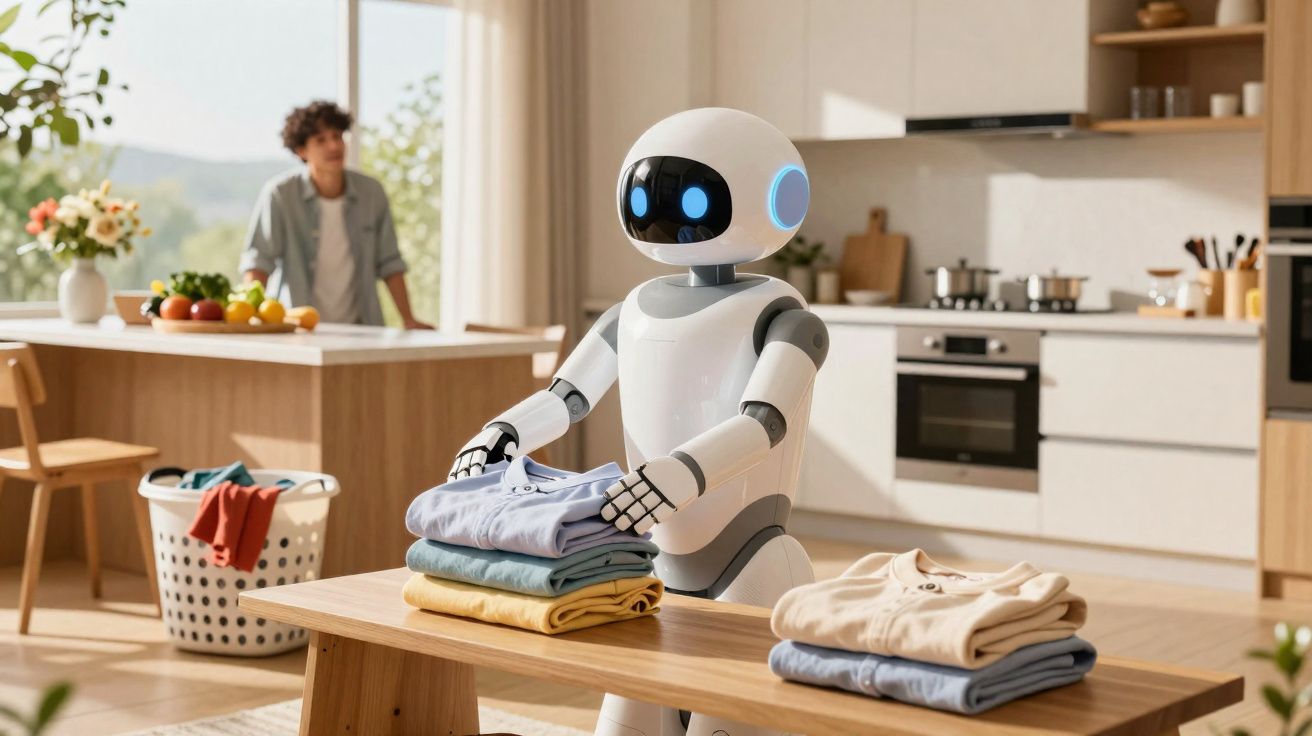
LG has unveiled CLOiD, a household robot designed to roam around the home on its own and take on everyday jobs such as starting a wash cycle, folding dry laundry, or putting together a simple breakfast.
At CES in Las Vegas, the South Korean brand stepped beyond its usual range of smart domestic appliances and presented something closer to a true humanoid helper. Rather than being a single-purpose machine, LG CLOiD is positioned as an autonomous home assistant that can tackle many different tasks by relying on AI.
Design and hardware built for practical household work
CLOiD is built around a torso and head, with a screen serving as its “face”, and it uses a speaker to communicate. It moves from room to room on a wheeled mobile base, allowing it to travel across the house without human guidance.
The robot is equipped with two arms and articulated fingers intended for real-world object handling. According to LG, each arm offers seven degrees of freedom, giving it a range of movement broadly comparable to a human arm. LG also states that each finger has its own independent actuator, which is meant to provide the fine motor control needed for tasks like gripping and manipulating items.
On the sensing and computing side, CLOiD includes an on-board chip acting as its “brain”, plus a set of sensors that gather information about its surroundings.
AI models: Vision Language Model (VLM) and Vision Language Action (VLA)
LG says it is combining two types of AI to translate what the robot perceives into useful behaviour:
- A Vision Language Model (VLM), which turns visual inputs into structured information the system can understand.
- A Vision Language Action (VLA), which converts that interpreted information into physical actions carried out by the robot.
Together, these components are intended to let CLOiD recognise situations in the home and respond by completing relevant tasks without being micromanaged step by step.
One robot, many functions with the LG CLOiD ecosystem
What LG highlights as CLOiD’s key advantage over typical domestic appliances is versatility. Designed to work closely with the wider LG ecosystem, the robot can, for example, start a laundry load while nobody is at home, then handle the folding once drying is complete.
LG also describes a breakfast scenario in which the robot retrieves milk from the fridge and places a breakfast pastry into the oven, helping to prepare the morning meal.
In essence, the concept resembles humanoid platforms such as Tesla’s Optimus or the robots being developed by Figure, but aimed specifically at household use and tightly integrated with LG’s own appliances. LG has not yet shared a release date or pricing.
Practical considerations for a home robot
For a domestic robot to be genuinely useful, everyday realities matter as much as impressive demonstrations. Navigation around furniture, thresholds, and cluttered worktops will influence what tasks can be completed reliably, as will the ability to safely handle hot surfaces, glass containers, and sharp utensils.
There are also important questions around in-home sensing: a robot that uses cameras and multiple sensors will need clear privacy controls, along with transparent options for data storage and permissions-particularly in shared households.
LG’s “Zero Labor Home” ambition
LG frames CLOiD as a potential cornerstone of its longer-term strategy to reduce the burden of chores through connected devices. If the company can bring the robot to market with robust autonomy and safe, consistent performance, CLOiD could become a central part of an appliance lineup intended to remove routine household work.
LG executive Steve Baek, President of LG Home Appliance Solution Company, said the LG CLOiD home robot is intended to understand and interact naturally with the people it supports, delivering more effective help around the home. He added that LG plans to keep pushing towards its Zero Labor Home vision, so customers can spend more time on what matters most.






Comments
No comments yet. Be the first to comment!
Leave a Comment