
The morning feels as though it’s moving faster than your alarm, and you’re already playing catch-up. You reach for your favourite perfume-the bottle you keep for “important days”-and dab or spray it on your wrists, your neck, maybe even your scarf because today needs to smell like confidence. Then, an hour later in the office lift, you lean forward to grab a file and… nothing. Your fragrance has disappeared, as if it signed off before you even arrived. You discreetly sniff your wrist and feel that oddly petty disappointment.
And as you tuck a loose strand of hair behind your ear, you catch a faint trace of yesterday’s scent.
That’s when the real question lands: why does a fragrance that costs half a pay packet vanish quicker than your morning coffee?
Why your perfume disappears from your skin so fast
Applying perfume to skin feels automatic. We’ve watched mums, friends and colleagues press fragrance onto pulse points, trusting that warmth will “activate” the scent and keep it going. Yet for plenty of us, the effect is brief: the aroma blooms, then collapses, and by lunchtime you’re left with a memory rather than a presence.
The twist is that your skin isn’t always the best place for this routine. Sometimes it’s the quiet pickpocket.
Picture a night out: busy bar, a satin shirt, good hair day, and that one fragrance you save for evenings that might turn into stories. You spritz your neck, enjoy the trail for a moment, then forget about it. Two hours later, a friend hugs you and says, “I thought you were going to wear your usual scent.” You did-it just didn’t last. Meanwhile, you know someone else who always smells lovely when she turns her head or walks past: never too much, just consistently there. It’s tempting to assume she’s wearing something “stronger”.
Often, she’s simply applying it more intelligently-not more heavily.
Here’s what’s happening. Most perfume is alcohol plus aromatic oils and molecules that hold on where they can. Dry or sensitive skin behaves like a sponge: it absorbs the liquid, disperses the scent, then lets those molecules evaporate quickly. Add warmth from pulse points, and you can speed up evaporation even more. Hair, by contrast, behaves more like a fine textile: the fibres catch scent and release it gradually. Every movement-turning your head, flicking a fringe-sends small, controlled puffs into the air.
Your hair becomes a gentle diffuser; your skin can be an impatient host.
That’s exactly where the hairbrush trick makes the difference.
The hairbrush trick for perfume: a quieter way to smell good for longer
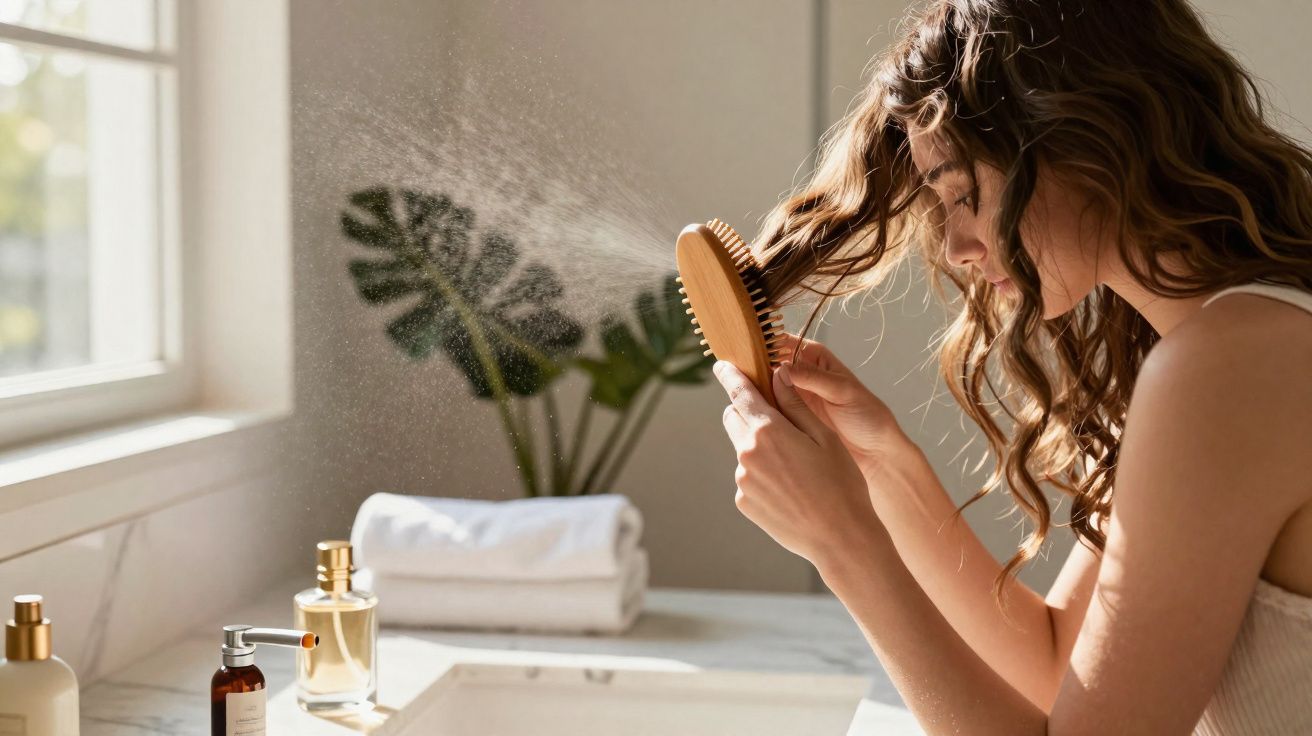
The method is almost embarrassingly simple. Instead of saturating your wrists, spray your perfume onto your hairbrush from about 15–20 cm away. One or two sprays is plenty. Give it a couple of seconds so the sharp alcohol burst can lift off the bristles, then brush through dry hair from mid-lengths to ends.
You’re scenting the strands, not the scalp.
What you get is a soft, halo-like trail that moves with you-noticeable without arriving in the room before you do. Subtle, but unmistakable.
A lot of people stumble upon this by chance: a stylist mists fragrance backstage, some settles on tools, and models step out smelling expensive without knowing the reason. Or you hug a friend on a breezy day and she smells incredible, and she shrugs: “Oh, I just sprayed my brush.” No complicated layering. No secret salon potion. The scent bonds to the hair cuticle-especially if your hair is slightly dry or has texture-and it reappears every time you move.
It’s that familiar moment where someone’s scent lingers in your wake and you quietly wonder what they’re doing differently.
There’s another upside: your skin may genuinely feel better for it. Traditional fragrances (even the pricey ones) rely on alcohol for lift, projection and a fast dry-down. On dehydrated or reactive skin, that can mean tightness, redness, or those tiny dry patches you only notice under certain light. Moving a large part of your routine to the brush reduces direct alcohol contact while still giving you the full sensory payoff.
Less irritation, more presence.
How to perfume your hairbrush without ruining your hair
Begin with a clean, dry brush-plastic or wooden is fine-so long as the bristles aren’t coated in styling residue. Hold your perfume at roughly forearm distance, mist once across the bristles as though you were lightly spraying a houseplant. Pause for 2–3 seconds to let the harsh alcohol edge evaporate. Then brush gently through lengths and ends, keeping away from the roots.
Think of it as combing a veil of scent through your hair, rather than blasting your scalp directly.
A quick caution: extra sprays don’t automatically translate to extra elegance. If you soak the brush, you can leave hair feeling slightly sticky-particularly with rich compositions. Start with one spray and adjust next time depending on the fragrance. Bright citrus or airy florals might justify a second mist; deep ambers/orientals and heavy gourmand scents rarely need it.
And realistically, nobody uses this method every single day. Some mornings you’ll reach for the bottle and spritz your neck on autopilot-fine. The hairbrush trick is best saved for the days you want your scent to last into the evening without punishing your skin.
Gentle, not obsessive.
A Paris-based hairstylist who works with actors and news anchors puts it like this:
“When clients ask how to smell ‘expensive’ without suffocating the room, I tell them to perfume the hair-not the neckline.”
Two extra points that help this work even better: - If you use heat tools, apply fragrance after styling, not before. Heat can change how a perfume smells and can dry the hair fibre further. - If your hair is freshly washed and very silky, the scent may slip away faster. A light leave-in conditioner (fully dry before brushing) can give the fragrance a little more to cling to-without needing more sprays.
Quick rules to keep it polished
- Spray the brush, not the roots: concentrate on mid-lengths and ends so you don’t irritate the scalp or dry it with alcohol.
- Choose lighter formulas for everyday wear: hair tends to suit soft mists, colognes, and floral or musky scents more than ultra-heavy oud “bombs”.
- Alternate with hair-friendly scents: when your hair feels delicate, use a dedicated hair perfume, or dilute a classic perfume with a little water in a small atomiser.
- Don’t combine five scents at once: keep to one fragrance family so shampoo, conditioner and perfume don’t compete.
- Refresh in the evening, not every hour: a single brush-through with a lightly scented tool is more refined than repeatedly spraying your wrists.
Let your scent live where you actually move
Perfume behaves differently depending on placement. On fabric it can grip strongly but feel flat or static. On warm, sweaty skin, it can shift in unexpected directions and fade unevenly. On hair, it travels with your gestures: turning your head, swinging a ponytail, tucking strands behind your ear. That’s why people often notice you when you’re not speaking-when you walk past, bend to pick up your bag, or lean in to read something.
Instead of chasing longevity, you start working with it.
| Key point | Detail | Value for the reader |
|---|---|---|
| Hair holds scent longer | Perfume molecules cling to hair fibres and release with movement | Longer-lasting fragrance without constant reapplication |
| Less alcohol on skin | Spraying the brush reduces direct contact with drying alcohol | Kinder to sensitive or dry skin while keeping your signature scent |
| Controlled intensity | A light mist on the brush creates a subtle, even halo of scent | Smell present and sophisticated, not overpowering or “cloudy” |
FAQ:
- Question 1 Can spraying perfume on my hairbrush damage my hair?
- Question 2 How often can I use this method without overdoing it?
- Question 3 Is it better to use a specific “hair perfume” instead of regular perfume?
- Question 4 Will my pillow or clothes smell too strong if I scent my hair?
- Question 5 What type of brush works best for this trick?


Comments
No comments yet. Be the first to comment!
Leave a Comment