
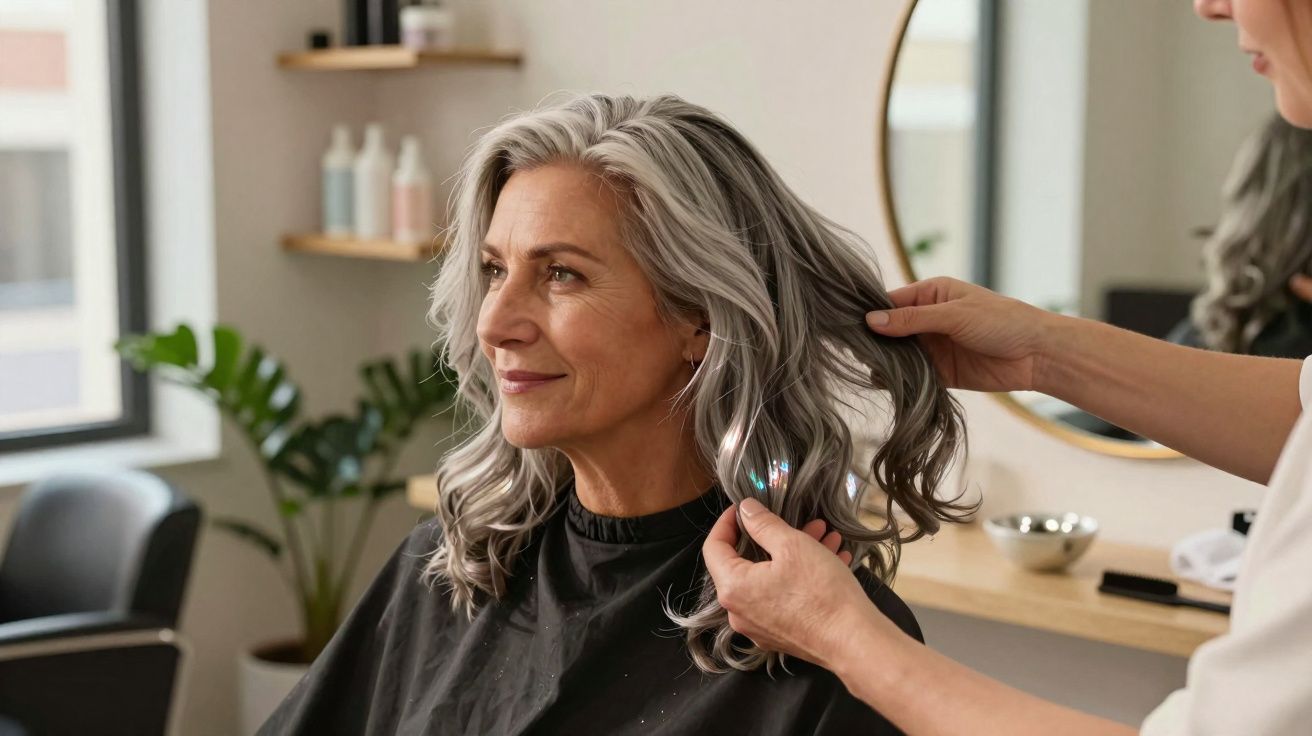
A woman pauses in front of the mirror, hairbrush hovering mid-air. In the bathroom light, the regrowth at her parting catches the glow - not drab, not weary, but unexpectedly bright. She leans in, half-intrigued and half-wary, as though her reflection has decided to reinvent itself overnight.
Her stylist has been mentioning “silver gloss” for weeks: a sheer, light-catching finish that could turn those scattered greys into something intentional - a colour choice rather than a surrender. She isn’t convinced yet. She can still picture the box dyes tucked beneath the basin, the rushed Sunday evenings before Monday meetings, and towels ruined by stray splashes.
Then her phone lights up: grey-haired models, stylish editors, women in their 50s laughing outside cafés with hair that looks like moonlight. Something shifts - tiny, but real.
Perhaps the story is no longer “I’m going grey.”
Perhaps the new story is “I’m glowing silver.”
Grey hair after 50: the moment everything quietly changes
There’s often one particular morning when grey hair stops looking like a handful of rogue strands and starts reading as a proper shade. You spot it in a lift mirror or a shop window and suddenly notice dimension - texture, brightness, contrast. It isn’t simply “ageing”; it has structure.
After 50, the hair fibre itself tends to behave differently. It’s commonly drier, more porous, and less consistent from roots to ends. That’s why the same chestnut or chocolate brown you wore for years can suddenly appear flat - even a little “wig-like”. As more grey pushes through, the constant cover-up can start to feel like a full-time job.
At the same time, social media has normalised a new aesthetic: gleaming “steel” bobs, frosted pixie cuts, long pearl-toned waves. The phrase “silver gloss” keeps appearing - and it looks oddly current. The old fear of going grey bumps up against a modern, luminous alternative.
Take Claire, 56. For years, she chased her former brunette as if it were a version of herself she might retrieve. Every three weeks she was back in the salon, eyes heavy under bright strip lighting, scrolling her phone while a solid dye sat on her scalp. The result wasn’t awful - but it never felt quite right. Too dark. Too dense. Too unlike her.
Her turning point arrived one summer by the sea, when sunlight hit her roots. The grey wasn’t sallow or gloomy; it looked soft, almost icy. Her colourist proposed a gradual transition and a silver gloss toner instead of another full-coverage application. Two hours later she didn’t look “younger” or “older”. She simply looked like Claire - only sharper, clearer, more herself.
And the compliments weren’t, “You don’t look your age.” They were, “Your hair looks incredible.” That difference matters more than we usually admit.
There’s a straightforward reason this works. As skin changes with time - often a little lighter, more translucent, sometimes more lined - heavy, very dark colour around the face can make features appear harder. Grey, by contrast, reflects light. A subtle silver gloss increases that reflection, calms down yellowish casts, and creates the kind of soft-focus effect phones try to imitate with filters.
Stylists often talk about “tone-on-tone respect”. Rather than battling grey, they bring it into harmony. The point isn’t to erase the years; it’s to tune the overall picture. That’s why a well-done silver gloss can feel surprisingly youthful while still embracing age.
It’s less about concealing time and more about learning to work with light - which is brutal when you fight it, and generous when you don’t.
One more piece people don’t always mention: grey hair often changes its feel as much as its colour. It can become wirier in some areas and finer in others. A gloss can boost shine, but the cut matters too - even a few strategic layers or a cleaner shape can make silver look deliberate rather than “just grown out”.
And if you live in a hard-water area, mineral build-up can push silver towards dullness or brassiness. A periodic clarifying wash (used sensibly, not daily) can help the gloss look cleaner and brighter between appointments.
What “silver gloss” really is - and how to ask for it
“Silver gloss” may sound like a make-up shade, but in salon terms it’s usually a semi-permanent or demi-permanent toner with cool, pearly or smoky pigments. It sits over your natural grey, boosts shine, and adjusts the tone gently - without creating a heavy, helmet-like layer of colour.
Typically, you’re at the backwash after a cleanse, and the colourist works a milky (sometimes violet-tinged) gloss through the lengths. After about 10–20 minutes, warm yellow reflections are softened, the natural white looks cleaner, and darker strands blend more seamlessly into the overall pattern.
The crucial point is that the hair keeps its translucency. That’s the appeal. It’s still your grey - just refined. Your silver - just elevated. One glossy veil rather than a decade of full coverage.
A common misstep is walking into a salon and saying, “I want to go grey,” and walking out with a flat, uniform silver that feels more costume than real life.
A stronger way to frame it is: “I want to keep my grey and enhance it with a cool, luminous gloss that blends everything softly.” Bring reference photos that show real texture (not heavy filters): visible regrowth, depth at the nape, lighter pieces around the face, and natural variation.
Most of us know the feeling: you smile at your reflection in the salon even though something’s slightly off. Next time, give your colourist language to work with - “pearl”, “smoky”, “sheer”, “transparent”, “not too opaque”. Good results need vocabulary as well as trust.
And yes - real life gets in the way. Almost nobody maintains this perfectly every day.
We buy violet shampoos and “miracle” masks, and then weeks get busy. That’s why it helps to keep the plan simple: one considered colour decision, then a light-touch routine you can actually stick to.
“Grey hair used to be the thing we corrected,” says Anaïs, a Paris-based colourist who now focuses on silver transitions. “Now it’s the foundation. The gloss simply makes it look intentional - polished and full of life.”
- Use a gentle, sulphate-free shampoo once or twice a week to preserve the gloss and reduce dryness.
- Alternate with a violet- or blue-toned shampoo every 7–10 days to neutralise yellow tones without turning hair lilac.
- Apply a nourishing mask weekly, concentrating on mid-lengths and ends, so silver doesn’t look frizzy or fragile.
- Use a heat-protecting spray or cream before blow-drying or hot tools, especially if your gloss process included any lightening.
- Book a gloss refresh every 6–10 weeks, depending on how quickly your hair loses cool tone and shine.
Silver gloss as a statement: beyond “looking younger”
There’s a particular kind of quiet impact when a woman over 50 walks into a room with luminous silver hair. People can’t immediately place her on the usual timeline. She doesn’t read as “still covering everything up”, nor as “letting it grow out and hoping for the best”. She looks as though she’s curating her age instead of denying it.
For many women, silver gloss becomes a small, personal rebellion against the unspoken rules of “keeping up”. It communicates: I’m not trying to pass for 35. I’m investing in who I am now - and that version has sparkle.
Often, the change spreads into other choices: stronger eyewear, a more confident lipstick, clothing that feels good rather than simply “slimming”. Hair becomes the visible edge of a deeper, quieter recalibration.
| Key point | Detail | Value for the reader |
|---|---|---|
| Silver gloss respects natural grey | Uses translucent, cool-toned products that enhance rather than cover | Creates a modern, luminous finish without harsh regrowth lines |
| Low-pressure maintenance | Refresh every 6–10 weeks, with straightforward home care (gentle shampoo, occasional purple wash) | Cuts down salon fatigue and colour anxiety while keeping hair looking polished |
| Fits changing skin and features | Softens contrast around the face, reflects light, avoids “block” colour | Helps features appear fresher and better defined without chasing youth |
FAQ:
Does silver gloss damage hair like regular dye?
Most silver gloss formulas are semi- or demi-permanent, with low ammonia levels or none at all. They tone and coat more than they deeply alter, so they’re generally kinder - particularly for grey hair that’s already more delicate.How long does a silver gloss usually last?
Typically 4–8 weeks, depending on how often you wash, what products you use, and how porous your hair is. The cool tone and shine tend to fade gradually, rather than leaving a stark regrowth line.Can I do a silver gloss at home?
Home glosses and toners exist, but it’s easy to end up too purple or overly ashy. For a first transition, working with a colourist is usually safer; once the tone is established, you can maintain it with targeted shampoos and masks.What if my grey is uneven - white in some places, darker elsewhere?
This is exactly where silver gloss excels. A colourist can use slightly different formulas in different areas to soften contrast, so your natural pattern looks purposeful rather than patchy.Will silver gloss make me look older?
Perceived age is influenced more by the cut, styling, and overall harmony than by grey itself. A well-shaped bob or layered cut paired with a luminous, cool-toned silver gloss often looks fresher than a flat, very dark dye that fights your natural regrowth.

Comments
No comments yet. Be the first to comment!
Leave a Comment