
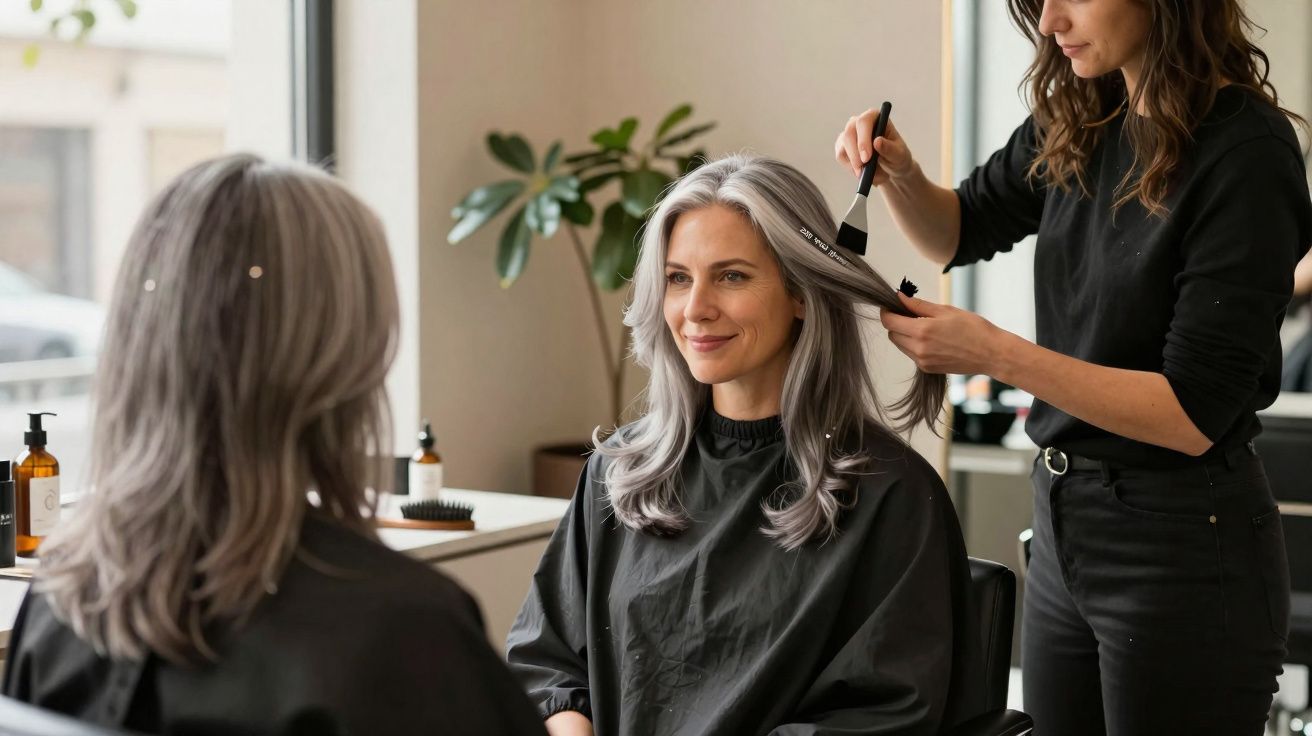
The first white strand rarely announces itself. It turns up one morning at the temple or along the hairline, as if it has always belonged there. By the time you reach 50, a handful of pale hairs can become a noticeable sweep, and the mirror can feel more candid than the people around you. Some women go straight for a full-coverage box or salon colour. Others stop colouring in one go and feel oddly exposed, like stepping into a busy room without make-up. Between those poles is an approach many colourists now recommend quietly from behind the chair: salt and pepper balayage-a way to let grey show, but in a planned, flattering pattern. A way to age without disappearing.
There’s something surprisingly empowering about switching from battling each silver hair to designing around it.
Why going grey after 50 isn’t a loss
Spend a Saturday in a packed salon and you’ll notice a familiar ritual. A woman in her early fifties sits down, unclips her hair, and apologises for her roots before the cape is even fastened. She taps the parting, calls the grey “a disaster”, “a mess”, “my worst enemy”. The stylist, meanwhile, sees a different story: natural highlights, cool sheen, and a base with real potential-if it weren’t being flattened under one solid shade. Most of the time, grey isn’t the problem. The problem is the hard line between dyed lengths and untouched regrowth.
Seasoned colourists describe the same pattern. A client arrives worn out from booking root touch-ups every three weeks, fed up with the time and the cost. In her mind, there are only two choices: commit to permanent dye indefinitely, or stop completely and endure the awkward “zebra stripe” grow-out. Then a third option enters the conversation: salt and pepper balayage, blended carefully so the white strands become part of the overall look. It isn’t a dramatic “silver transformation”. It’s a controlled mix of light and depth that turns what felt like a flaw into something deliberate. Often, that’s the visit where she leaves looking-and standing-slightly taller.
Technically, grey hair is simply hair that has lost much of its pigment. On darker hair, the contrast can look severe, as though a white line has been drawn exactly where you naturally part your hair. All-over colour hides it briefly, but the regrowth line returns-often more obvious each month. Balayage works differently. By painting lighter and darker pieces around the grey, a colourist breaks up that blunt, horizontal “helmet” effect. Instead of seeing a line, the eye sees movement, dimension and texture. The grey starts to read like intentional highlights, not an unwelcome surprise.
How salt and pepper balayage works in real life (and on real hair)
Elise, a colourist I spoke to with 20 years’ experience, put it simply: “After 50, the change isn’t really about colour-it’s about strategy.” She begins at the front rather than the back, because that’s what shows up in every photo, every mirror, and every Zoom call. She maps the grey pattern first: are the temples very white? Is the top lightly dusted, or nearly solid? She then places lighter pieces where the hair is already turning, and keeps more depth where pigment remains. Rather than resisting your natural distribution, she uses balayage to emphasise it.
One of her clients, Maria (56), had worn chestnut brown for years. Her regrowth was around 70% grey at the front, about 40% on the top, and barely present at the nape-a classic “skunk stripe” set-up. Instead of another full-head application, Elise proposed salt and pepper balayage: ultra-fine icy strands around the face, cooler beige through the top, and a deeper smoky brown underneath. After three hours, the stark root line had disappeared. Maria’s grey hadn’t been erased; it had been made purposeful, almost like a soft shimmer. Friends didn’t say, “Have you stopped colouring?” They asked, “Have you done something different? You look well-rested.”
There’s a practical reason this is so flattering for women over 50. Over time, skin tone, eyebrows and eye colour often soften. Very dark, flat colour can start to look severe-more like a block of contrast than a hairstyle with texture. A well-blended salt and pepper balayage eases that contrast: lighter pieces echo the grey, while lowlights restore contour and depth. From a distance, it appears gentler than all-over dye but more polished than letting everything go natural at once. Up close, it reads current and considered, rather than “covered” or “grown out”. You aren’t pretending time hasn’t passed-you’re styling it.
A quick but important extra: plan for texture, shine and scalp comfort
Grey hair can feel coarser or drier as pigment changes, and that can affect how toner sits and how light reflects. A good colourist will factor in porosity, previous dye history and condition, not just the percentage of grey. If your lengths are fragile, a lower-lift plan with more lowlights (rather than aggressive bleaching) can keep the finish glossy instead of wispy.
It’s also worth thinking about the practicalities before you start. In the UK, reputable salons may recommend a skin test (patch test) before certain colour services, especially if you’ve changed products or haven’t coloured for a while. It’s not glamorous, but it can make the whole process safer and calmer-exactly the kind of “strategy” that keeps the long game sustainable.
The ground rules: what professionals actually advise
In day-to-day terms, the technique is surprisingly restrained. Most colourists start by lifting small, irregular sections where your hair is already at its lightest-often the whitest areas. Around the face, that can mean ultra-fine “babylights” that mimic natural sunlight. Through the top, the strokes tend to be a little bolder to create recognisable salt-and-pepper ribbons. Then come the lowlights: slightly deeper, cooler pieces that tie everything back to your natural base. The target isn’t platinum, and it isn’t “Instagram grey”. The aim is a cool, dimensional blend that suits your features and your hair as it is now, not how it behaved a decade ago.
Elise says the most common mistake is trying to accelerate the process. Many women arrive asking to be “fully silver by summer” when they’re only 30–40% grey. That urgency can push the hair into too much bleach, crispy ends, or a tone that clashes with the brows and skin. A better route is gradual. At the first appointment, soften the root line and introduce salt and pepper balayage. At the second, around three to four months later, add a few more light pieces, refine the tone, and perhaps deepen the nape. Over time, the artificial brown recedes and your natural grey takes centre stage. Realistically, not everyone keeps a perfect schedule-but spacing visits like this gives both your hair and your budget room to recover.
“Big colour plans look brilliant on paper,” Elise told me, laughing, “but the colour that lasts is the one you can actually live with. After 50, the best colour is the one that doesn’t become a maintenance prison.”
- Go cooler, not whiter
Ask your colourist for cool, smoky tones instead of icy-white strips. They blend more naturally with grey and avoid harsh, stripey contrast. - Choose fine sections
Thin, well-melted strokes tend to look more youthful than chunky highlights-particularly on fine hair or shorter cuts. - Protect the fibre
Use a gentle purple shampoo no more than once a week, plus a nourishing mask. Over-toning can dry hair out and take away shine. - Treat cut and colour as one plan
A layered bob, a soft shag, or long layers will show off the salt-and-pepper dimension. Blunt, one-length hair can hide the detail. - Commit to the long view
Ask, “What will this look like in six months if I do nothing?” If that answer alarms you, the strategy needs adjusting.
More than colour: seeing yourself differently at 50+
A quiet shift happens when a woman stops describing her grey as “damage” and starts thinking of it as “texture”. The mirror doesn’t necessarily become kinder overnight, but it does become more truthful-and that can be even more valuable. Salt and pepper balayage often acts as a bridge between who you’ve been and who you’re becoming: not a dramatic cut-off, not a refusal, but a gentle handover. You keep some depth that still feels like you, welcome the new light, and accept that your hair now has a different rhythm. You no longer have to live in fear of a 2-millimetre root line.
There’s also a particular confidence in hair that doesn’t apologise for its age but still looks curated. Women who choose this route often notice an unexpected change in the compliments they receive. Instead of “You look so young!”, people begin to say, “You look so you.” That distinction matters. It moves the focus from erasing time to inhabiting it. Perhaps that’s why salt and pepper balayage is suddenly everywhere: not simply because it’s fashionable, but because it offers what many women over 50 want from beauty now-freedom, with a bit of style.
| Key point | Detail | Value for the reader |
|---|---|---|
| Blend, don’t hide | Salt and pepper balayage softens the regrowth line instead of completely covering grey | Less upkeep and a more natural, flattering finish |
| Work with your pattern | Placement follows where grey naturally sits: temples, parting, crown | Colour that suits your face rather than copying a photo |
| Think long-term | Progressive appointments replace constant root touch-ups | Less stress, healthier hair, and a smoother shift towards grey |
FAQ
Question 1: Is salt and pepper balayage suitable if I’m only 30% grey?
Answer 1: Yes-done well, it can look excellent. Your colourist will usually preserve more of your natural (or existing) base and place lighter pieces where you’re already turning grey, so the look evolves gracefully as new growth comes through.Question 2: How often will I need to return to the salon?
Answer 2: Many women can book in every 3–4 months. Because the technique blurs regrowth, it grows out far more softly than traditional root colouring.Question 3: Will this cause more damage than regular dye?
Answer 3: If it’s carried out properly, balayage can be gentler because it doesn’t saturate every strand. The essentials are bond-protecting products and keeping lift levels sensible, particularly on delicate hair.Question 4: What if I decide I want to go fully grey later?
Answer 4: Salt and pepper balayage is an ideal stepping stone. As your natural grey increases, your colourist can gradually reduce the lowlights so you end up almost entirely natural without a harsh dividing line.Question 5: Do I need a different haircut to suit this colour?
Answer 5: You don’t have to change your cut, but soft layering often shows the dimension better. Ask your stylist whether subtle layers-or a refreshed shape-would bring out more movement and shine.





Comments
No comments yet. Be the first to comment!
Leave a Comment