
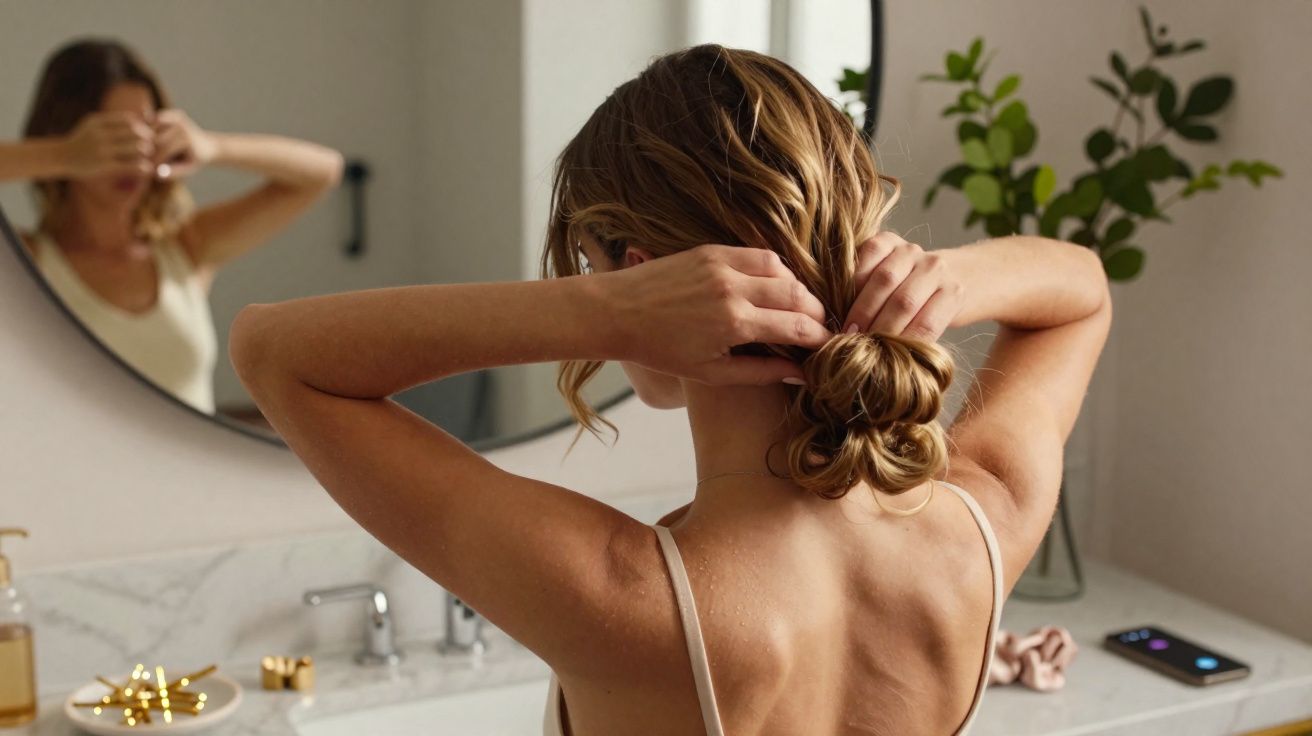
The woman sitting opposite me on the Underground had the kind of hair you can’t help but admire. Her hair was swept up into a relaxed yet polished knot, with a few wispy pieces falling in exactly the right places. No glitter mist. No obvious forest of pins. Just that calm, “I woke up like this” feel you normally only see on Pinterest boards or in the reflection of a café window.
She noticed me looking, gave a quick smile and said, “It took 40 seconds in my bathroom.” Then she stepped off at the next stop, as though she hadn’t just delivered a line that rewired my morning routine.
For the rest of the journey, I examined my own reflection: my ponytail was half deflated, as if it had lived through a minor weather event. One question kept looping in my head.
Could a genuinely chic updo really happen in under a minute?
The real secret behind the “effortless” chic updo
Stand in a coffee queue at 8:30 a.m. and you’ll spot her sooner or later: the woman balancing a laptop bag, an oat latte and her phone, with hair folded into a tidy low bun that looks like a stylist did it on the way out. She isn’t curling, backcombing, or pausing to follow a tutorial. She’s simply putting her hair up with the same ease most people tie a shoelace.
That’s the first truth: the effortless updo that looks like it took ages often doesn’t. Not because it’s inherently simple, but because it’s become automatic. It’s stored in your hands, not your mirror.
And the encouraging part is this: that kind of muscle-memory gesture is learnable.
A friend of mine, Léa, works in PR-the sort of role where looking “put together” feels like an unspoken clause in the contract. For years she spent about 20 minutes each morning battling straighteners, curling tongs, and enough hairspray to reinforce a small building.
Then one day, running late for a client meeting, she had exactly 50 seconds before her taxi arrived. Styling wasn’t happening. She grabbed a thick elastic, twisted her hair into a low ponytail, pulled the loop halfway through, wrapped the ends around the base, shoved in two pins, and went.
Her client opened the door, looked her up and down, and said, “Wow-you always do the best minimalist bun.” What began as a 50‑second accident turned into her daily signature.
What shifted wasn’t her hair; it was her benchmark. She stopped chasing salon-level perfection and started aiming for “clean shape, soft texture, zero stress”-an aesthetic that doesn’t collapse because of a small bump or a stray flyaway.
Hair responds better to commitment than complexity. Repeat the same simple motion and your strands begin to fall into familiar routes: the same twist, the same curve, the same tuck points. Your fingers learn exactly where to tighten, where to loosen, and where to hide the ends. The “chic” part isn’t difficulty-it’s the quiet confidence of a style that doesn’t look overworked.
One more thing most people don’t realise: the goal isn’t to make your hair look as though it never moved. It’s to make it look as though it moved on purpose. That’s why the best everyday updos always have a tiny bit of softness.
The under‑a‑minute updo: the exact move
This is the move that shows up again and again-backstage, in office loos, and on busy station platforms.
Start with dry hair in any texture. Give it a rough pass with your fingers or a wide‑tooth comb; you’re not aiming for “sleek”, just detangled. Gather your hair at the nape of your neck as though you’re making a low ponytail. Keep it comfortable-no headache-inducing tension.
Twist the length loosely, letting it turn the way it naturally wants to. As it begins to coil back on itself, guide that coil into a small bun sitting against your neck (or slightly to one side). Hold it in place with one hand.
With the other hand, slide in 2–4 bobby pins (kirby grips), crossing them like tiny scissors so they lock the bun in. Then do a quick finishing pass: a gentle tug at the crown for softness and a fingertip smooth along the sides. Finished.
Most people don’t fail on the bun itself-they get stuck on the myths surrounding it. They assume they need freshly washed hair, a line-up of products, and upper-arm strength. Realistically, no one maintains that level of effort every single day. Some mornings you’re doing well if your hair is even properly dry.
Slightly lived‑in hair is actually helpful. A bit of texture gives grip and makes the style stay put-especially if your hair is naturally silky. The real enemy of the under‑a‑minute updo is overthinking it.
That’s when people pull too tight, cram in too many pins, or panic the second a piece escapes. The result can look stiff-almost apologetic-instead of deliberate.
“The moment I stopped trying to hide every flyaway, my updos started looking expensive,” a hairstylist told me backstage at a small fashion show in Paris. “Elegance is usually a neat base with one detail left slightly undone.”
Four small tweaks that make the one‑minute updo look intentional
Use one good elastic
A thick, snag‑free band holds far better than three flimsy ones competing for space.Pin the base, not the ends
Place pins where the bun meets your scalp-that’s the anchor that keeps everything balanced.Leave one small strand out
A single loose piece around the face softens the look and prevents that “helmet” effect.Finish with your hands, not a brush
A quick smoothing motion with your palms creates a modern, lived‑in finish that feels more “today” than “school prom”.
If you want the habit to stick, keep your tools consistent: use the same elastic and the same pin style for a fortnight. When you remove variables, your hands learn faster-and your one‑minute updo becomes genuinely repeatable.
Also worth noting: comfort matters. If you feel pins digging in or the bun feels heavy, adjust the placement lower at the nape and use fewer pins crossed more securely. A chic updo should feel stable, not restrictive.
Owning the one‑minute ritual
After you’ve done the motion a few times, something clicks. You stop standing there, replaying instructions in your head. You start twisting, pinning and refining almost on autopilot-like looping a scarf before you head out.
That’s where the real shift happens. The chic updo stops being a “special occasion” decision and becomes a reflex: a tiny ritual you can rely on when your alarm fails, your hair refuses to cooperate, or your day demands more than you expected.
We all know that moment right before leaving the house, when you look at yourself and think, I just need one thing that feels under control.
The more you repeat this simple bun, the more it moulds to your life. On Mondays it tends to sit a little tighter and cleaner with a blazer. On Saturdays you loosen a few pieces and it reads almost romantic. On truly stubborn hair days, it neatly tucks away ends you don’t have the energy to negotiate with.
The trick isn’t owning a drawer full of tools-it’s mastering one small movement so well you can do it while your coffee cools or your taxi is waiting outside. That quiet fluency is what most people interpret as style.
You may notice something else, too. Strangers ask if you “did something” with your hair. Friends want a quick demo in the restaurant loo. A colleague leans over and murmurs, “How long does that take you?”
You’ll shrug and say, “Less than a minute,” and it’ll be true. The one‑minute updo stops being reserved for weddings and interviews and slips into school runs, late-night supermarket trips, and video calls when you’d rather not advertise your dry shampoo routine. From the outside it looks like effort. From the inside it’s just 40 quiet seconds with your own reflection.
Key takeaways
| Key point | Detail | Value for the reader |
|---|---|---|
| Simple base gesture | A low twist at the nape secured with crossed pins | Repeatable in under a minute, even when you’re rushing |
| Accepting imperfection | Keeping texture and a few loose strands visible | Less pressure, and the finish looks modern rather than fussy |
| Ritual over products | Relying on repetition and muscle memory instead of tools | Builds confidence and a reliable everyday signature look |
FAQ
Question 1: My hair is very fine and slippery. Will a one‑minute updo actually stay in?
Answer 1: Yes-provided you add a little texture. Work a small amount of dry shampoo or texturising spray through the lengths first, then twist. Choose smaller, higher‑grip bobby pins (kirby grips) and cross them at the base of the bun so they lock together. You’re not aiming for a huge bun; you want a secure coil that still feels steady when you gently shake your head.Question 2: What if my hair is really thick or curly?
Answer 2: Gather it slightly lower and split it quickly into two sections. Twist each section on its own, then wrap them around each other to form the bun. Pin in a loose circle around the base. Thick or curly hair often holds shapes brilliantly once you stop fighting the volume and let the natural texture give the bun its structure.Question 3: Do I need freshly washed hair for it to look chic?
Answer 3: Not at all. Day‑two-or even day‑three-hair often works better because it has more grip. If your roots feel oily, press a little powder or dry shampoo into the scalp, work it through with your fingers, then twist. The contrast between fresher roots and slightly lived‑in lengths can look quietly intentional.Question 4: How can I stop my bun from looking too “formal”?
Answer 4: Loosen it slightly after pinning. Gently lift a small amount at the crown for softness and release one fine strand near your ear. Avoid a glossy hairspray finish; instead, smooth only the outer halo with your hands. That touch of movement is what separates everyday chic from red‑carpet rigidity.Question 5: Is there a way to dress up the one‑minute updo for an evening out?
Answer 5: Yes-add one small accessory rather than changing the whole technique. A slim gold pin, a velvet ribbon tied around the base, or a single decorative clip at the side instantly shifts the mood. You keep the same under‑a‑minute structure; the detail does the talking.



Comments
No comments yet. Be the first to comment!
Leave a Comment