
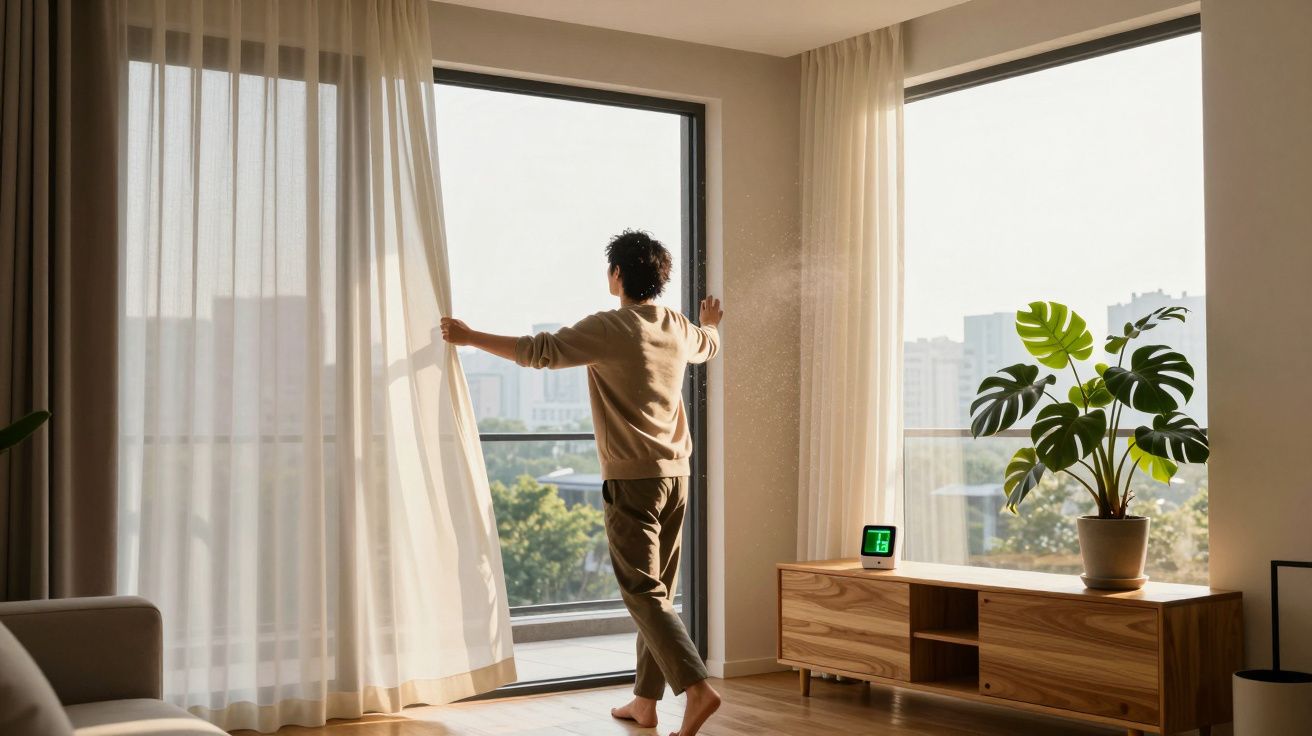
‘House burping’ is the latest habit to take over people’s feeds: quick videos of someone throwing open every window and door and declaring they’re “burping” their home to banish stale, germ-laden air.
Behind the jokey label sits a genuine question. Does house burping actually make a home healthier, or does it simply replace indoor microbes with outdoor air pollution?
What looks like a new trend online is, in parts of Europe, everyday routine. In Germany, regular “airing out” and “shock ventilation” have long meant opening windows wide for a few minutes to let fresh air rush through - even in mid-winter. Some German tenancy agreements even spell out the expectation of routine airing, largely to reduce damp and prevent mould.
Why house burping can improve indoor air
The basic science is straightforward: indoor air steadily accumulates what we produce and use at home. Moisture from showers and cooking builds up; smoke and fine particles come from hobs, ovens and candles; chemicals are released from cleaning sprays and some furnishings; and people constantly add microscopic particles and viruses simply by breathing, speaking and coughing.
In earlier research my colleagues and I carried out, we found a wide range of illnesses associated with indoor air pollution. These pollutants can concentrate over time, particularly in well-insulated homes that trap warmth - and trap contamination along with it. When you “burp” a house, the rapid inflow of outside air dilutes this cocktail and pushes a sizeable portion out.
This matters most for infections that spread through the air. During the COVID pandemic, public health bodies repeatedly highlighted that improved ventilation - including something as simple as opening windows - could reduce the chance of catching the virus indoors.
Evidence from a classroom study illustrates why: opening all windows and doors cut carbon dioxide levels by about 60% and reduced a simulated “viral load” by more than 97% over an eight-hour school day. The area with higher infection risk shrank to roughly 15% of the room.
Pets are part of this picture too. They breathe the same indoor air and can be early indicators of a problem. Veterinary research links poorer indoor air with lung irritation in dogs and cats, particularly closer to the floor where particles settle - a reminder that stale air affects the whole household, not just the humans.
The downside: outdoor pollution can come in with the fresh air
Fresh air is not always clean air. Fine particles from traffic and industry, along with gases such as nitrogen dioxide, harm the heart, lungs and brain, and are now recognised as major drivers of illness and premature death. In many urban areas, a large share of the fine particles measured inside homes and schools actually originate outdoors and seep in through gaps, vents - and, inevitably, open windows.
Your location determines how favourable the trade-off is. Properties near busy A-roads, main routes or motorways typically have higher indoor levels of traffic-related particles and nitrogen dioxide, especially when windows facing the road are opened.
One study of inner-city schools found a clear pattern: the nearer a school was to major roads, the higher the measured levels inside classrooms of traffic-related PM2.5 (tiny pollution particles small enough to penetrate deep into the lungs), nitrogen dioxide and black carbon.
That means flinging open roadside windows at rush hour can pull in a concentrated burst of exhaust, tyre wear and brake dust right when traffic emissions are peaking. For people living with asthma, heart disease or chronic respiratory conditions, this additional exposure can wipe out some of the benefits gained from better ventilation.
The outlook is often better in greener, quieter neighbourhoods. Where homes and schools sit further from main roads and are surrounded by more trees and green space, indoor levels of traffic-related particles tend to be lower. Vegetation can help trap some particles and disrupt the movement of pollution plumes drifting from nearby traffic.
The right time to burp: house burping and shock ventilation
Timing makes a real difference. In many towns and cities, outdoor pollution is highest during morning and evening commuting periods, and often lower late at night or around the middle of the day. Short bursts of house burping outside those peaks - or shortly after rainfall, which can temporarily wash some particles out of the air - may offer a better balance between reducing infection risk and limiting pollution exposure.
It’s also worth remembering that stale indoor air affects more than breathing. Studies have linked higher concentrations of fine particles and elevated carbon dioxide with poorer attention, slower thinking, and increased risks of anxiety and depression. A stuffy home can quietly erode mood and mental sharpness for everyone inside.
How you do it influences comfort and energy use. With German-style shock ventilation, you open windows fully for a brief period, exchanging air quickly without chilling walls and furniture as much as leaving a window slightly ajar all day. Cross-ventilation - opening windows on opposite sides of the home - typically moves air faster and improves the exchange.
Treating COPD (a chronic lung disease) linked to poor indoor air can cost thousands each year in medicines and hospital care, and once diagnosed it often becomes a lifelong burden. By comparison, opening windows for five minutes in winter usually costs only pence in lost heat. A small, planned ventilation habit now can be far cheaper than major medical bills later.
Practical ways to make house burping safer and more effective
For most households, a sensible middle ground is achievable. House burping is more likely to help when it is done briefly, away from heavy-traffic periods, and using windows on the quieter side of the property or those facing green space.
Two additional steps can strengthen the benefits:
- Monitor what you can’t easily sense. A basic carbon dioxide monitor can reveal when a room is under-ventilated, especially in bedrooms overnight or living rooms during gatherings. This helps you ventilate based on need rather than guesswork.
- Reduce indoor sources at the same time. Using extractor fans while cooking and showering, avoiding burning candles indoors, and choosing lower-emission cleaning products all cut the pollution you’re trying to expel in the first place.
For people who live beside very busy roads or who are particularly vulnerable (for example, with severe asthma or heart disease), pairing short, well-timed window opening with other measures may be prudent. Depending on the home, that could include using kitchen and bathroom extraction more consistently, keeping trickle vents clear where fitted, or considering a suitable air purifier for the rooms used most.
A trend with a point
So yes: the social-media craze is onto something, even if the name is designed to raise a smile. A home that never “burps” is more likely to accumulate higher levels of indoor pollution and a greater build-up of exhaled air - especially during virus season.
Give your home a brief reset at the right moment: open the windows wide, let the stale air out, and allow a clean burst of outside air in. Your lungs, your brain and your pets may all benefit.
Vikram Niranjan, Assistant Professor in Public Health, School of Medicine, Health Research Institute, University of Limerick
This article is republished from The Conversation under a Creative Commons licence. Read the original article.




Comments
No comments yet. Be the first to comment!
Leave a Comment