
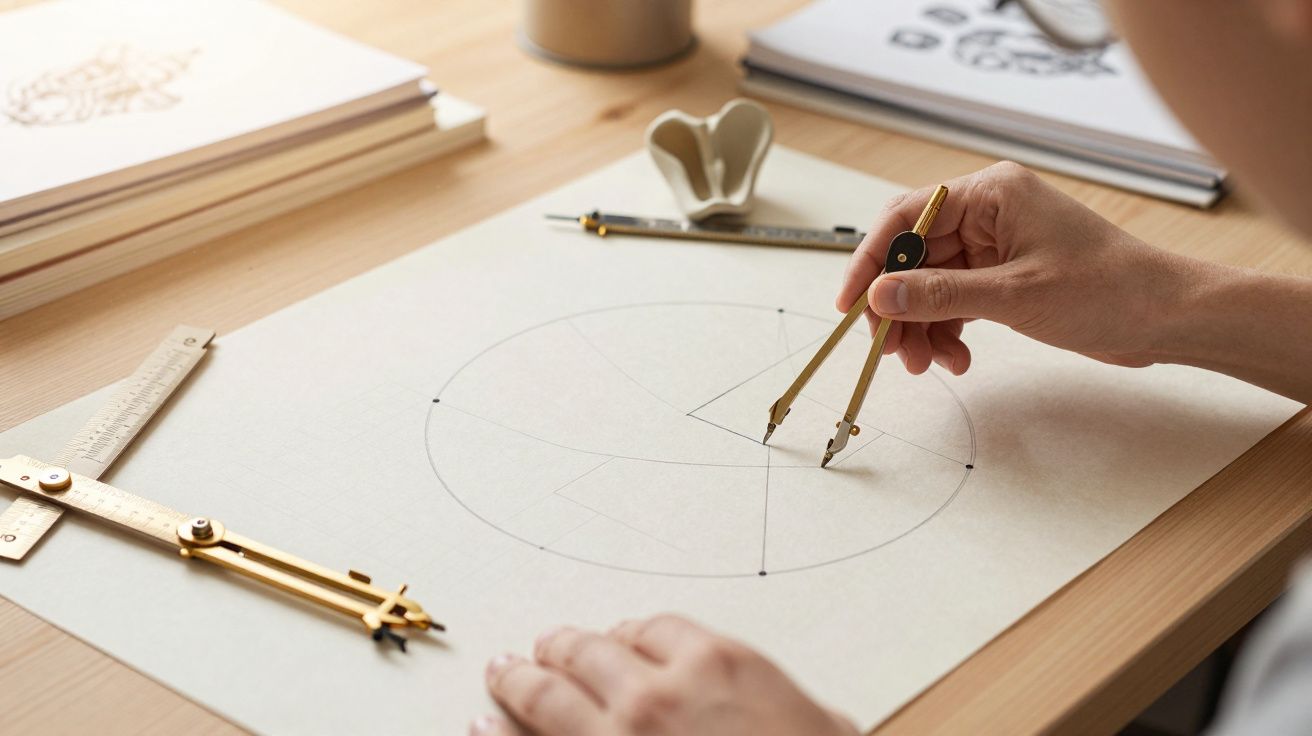
For more than five centuries, Leonardo da Vinci’s Vitruvian Man has been admired as a Renaissance masterpiece-yet new research argues that the drawing also conceals a very precise mathematical solution.
A recent study proposes that the Vitruvian Man is not merely an elegant sketch, but the result of a strict geometric construction built on a largely forgotten measurement framework organised around the number 120.
A 2,000-year-old geometric challenge inside Vitruvius’s circle and square
Long before Leonardo, the Roman architect Vitruvius wrote in the 1st century BCE that a well-proportioned human body could be set neatly inside both a circle and a square. In his description, the navel should be the centre of the circle, while the person’s height should equal their arm span, establishing the dimensions of the square.
That neat claim creates a stubborn puzzle. If the navel is fixed as the circle’s centre, the centre of the square cannot occupy the same point without the figure being stretched or compressed. For centuries, the apparent contradiction was treated as an inspiring idea rather than a solvable drafting problem.
Medieval artists often handled the issue symbolically rather than with geometry. It was not until the 15th century that engineers and technical draftsmen began grappling with the construction in earnest. Drawings attributed to Taccola and Francesco di Giorgio Martini show bodies straining to satisfy Vitruvius’s rules, with limbs that appear awkwardly placed or rigid-revealing just how difficult the task is.
Leonardo da Vinci’s solution to Vitruvius: shifting the circle’s centre to the pubis
Around 1490, Leonardo returned to Vitruvius’s challenge with a more exacting aim. He was not content to illustrate an ancient passage; he set out to resolve the contradiction within it.
Work by Jean-Charles Pomerol (emeritus professor at Sorbonne University) and independent Leonardo specialist Nathalie Popis argues that Leonardo’s breakthrough rests on a quiet but decisive change: he lowers the centre of the circle from the navel to the pubis.
By moving the centre to the pubis, Leonardo alters the geometry of the entire construction while keeping the anatomy convincing.
In the well-known configuration with arms extended and legs spread, the man adopts a so-called dynamic posture. In such a stance, the body’s balance changes and the centre of gravity drops towards the pelvis. Placing the circle’s centre at the pubis makes the figure feel mechanically stable-closer to how a real body distributes weight when the limbs open outwards.
In the other pose-the one corresponding to the square-the figure stands upright with legs together and arms level. Here, height equals arm span, matching Vitruvius’s description. Leonardo, who took measurements from living people and studied human remains, understood that this relationship is broadly true in nature even if individuals vary.
Two postures, one construction: geometry that moves with the body
Pomerol and Popis maintain that the two superimposed postures are not a visual flourish. They represent a deliberate method: one stance satisfies the square, while the other satisfies the circle. Taken together, they solve the Vitruvian riddle without forcing the body into implausible proportions.
This approach turns the Vitruvian Man into more than a static diagram. It captures how the body shifts as arms and legs move, how load transfers through joints, and how equilibrium changes with posture.
The drawing is not an occult emblem; it is a compressed study of gravity, balance and human movement.
Leonardo’s decision also aligns with principles associated with Archimedes, particularly ideas about balance and centres of mass. In modern language, the sheet can be read as an early lesson in biomechanics embedded inside a single geometric figure.
The secret grid of the Vitruvian Man: why the number 120 matters
The study goes further than circles, squares and centres. It argues that Leonardo structured the entire figure on a concealed measuring grid based on 120.
The choice is practical as well as elegant. 120 is a “highly composite” number: it divides cleanly by 2, 3, 4, 5, 6, 8, 10 and 12. That makes it extremely convenient for expressing proportions as simple fractions-particularly valuable when drawing with pen and ink rather than calculating with decimals.
Each major segment of the Vitruvian body can be written as a straightforward fraction of 120, creating a tightly organised web of proportions.
According to Pomerol and Popis, Leonardo assigns 120 units to the man’s full height, then partitions that total into lengths corresponding to observed anatomy, including:
- Pubis to top of head: 60 units
- Hand length: 13 units
- Foot length: 17 units
Individually these figures may appear arbitrary. In combination, they form a consistent grid that links vertical and horizontal measures. The forearm corresponds proportionally with the foot; the torso is divided according to clear fractional relationships; and every part refers back to the same underlying unit.
A link to older calculation traditions (base-60 and beyond)
This numerical logic echoes much older habits of calculation. Ancient scholars frequently worked with base-60 systems-an inheritance that still shapes daily life when we divide an hour into 60 minutes or a circle into 360 degrees. As double 60, and as the product of the first five integers (1×2×3×4×5), 120 sits naturally within that tradition.
For Pythagorean thinkers, such numbers were more than convenient: they hinted at an underlying order in nature. The study suggests that Leonardo, deeply read in classical sources, revived this outlook-but grounded it in measured bodies rather than purely abstract harmony.
| Body element | Proportional value (out of 120) | Implied idea |
|---|---|---|
| Total height | 120 | The master reference for every other measure |
| Pubis to top of head | 60 | Half the total height, anchoring the torso |
| Hand | 13 | A smaller unit that still links structurally to other limbs |
| Foot | 17 | Supports balance and mirrors the forearm’s proportional role |
The researchers’ argument is that this framework does not contort the body to suit “pretty” arithmetic. Instead, Leonardo begins with observation, then selects a number system flexible enough to describe what he sees with repeatable ratios.
A rare fusion of ancient mathematics and hands-on anatomy in Leonardo da Vinci
Leonardo’s notebooks reveal just how thoroughly he absorbed Greek mathematics: Euclidean geometry, Pythagorean number philosophy, and Archimedean mechanics all shape his thinking.
Yet he also does something striking for his era: he tests inherited theory against direct observation. Between 1506 and 1513, he carried out systematic dissections, measuring bones, recording muscle attachments, and tracing how weight travels through the skeleton.
For Leonardo, authority was not sufficient; any claim about proportion had to survive the test of blade and ruler.
Viewed through this study’s lens, the Vitruvian Man sits precisely at that intersection. The axes, angles and centres are laid out with mathematical discipline, while the torso, limbs and joints show close attention to real anatomy.
From Renaissance icon to scientific diagram of proportion
Pomerol and Popis argue that the drawing should not be reduced to a cultural emblem of the Renaissance or a vague slogan about “humanity at the centre of the universe”. Instead, it functions as a compact scientific diagram: an attempt to show, in one image, how numbers, geometry and living bodies can be made consistent.
Crucially, the use of two postures-one for the square and one for the circle-shows Leonardo treating Vitruvius’s text as a starting point rather than an unbreakable script. He adjusts the construction to preserve physical plausibility, not to satisfy a rigid reading.
Why the Vitruvian Man still matters: design, biomechanics and teaching geometry
For modern readers who work with the body-designers, physiotherapists, 3D modellers, sports scientists-this interpretation offers a useful reminder: proportions are rarely random. Strong models often rely on simple, repeatable ratios, much like Leonardo’s proposed 120-unit scheme.
Consider a virtual character built for a video game or simulation. Rather than estimating each limb by eye, a designer can select a base unit (such as total height) and define the hand, forearm and foot as stable fractions. The end result tends to look more natural because the relationships remain consistent across the whole figure, echoing the logic attributed to the Vitruvian construction.
The same approach can support classroom teaching. Using the Vitruvian Man as a case study, pupils can explore circles, squares, centres of gravity and ratios, then test their ideas through sketching or simple digital tools. It turns an iconic image into a practical laboratory for concepts that often feel abstract on the board.
A further, modern implication concerns measurement standards and interoperability. Whether in ergonomics, product design or medical illustration, shared proportional frameworks make it easier to compare datasets, scale models and communicate assumptions-particularly when teams work across disciplines. A “master unit” system (as proposed here with 120) is not just historical curiosity; it mirrors how contemporary standards strive to keep complex designs coherent.
It is also worth noting a limitation: any proportional scheme is an approximation. Human bodies vary by age, sex, ancestry and individual development. The value of Leonardo’s construction-if the study is correct-would lie not in claiming a single perfect body, but in creating a robust geometric method that stays believable while remaining mathematically manageable.
Suggested reading and related stories
- Why men over 30 quietly choose this simple haircut while everyone else chases trends
- How cats show affection: when they do this, you’re their favourite human
- Black hole outburst named “Jetty McJetface” is among the most energetic objects in the universe
- This everyday mistake makes cleaning take longer than necessary
- Virginia Democrats fast-track a new congressional map for four more seats
- Day will turn to night as the century’s longest solar eclipse divides scientists, believers and doomsday prophets
- The French Navy gains a drone that removes the Achilles’ heel of shipborne mini-UAS operation and promises more useful flights where space and crew are limited
- A young Korean mathematician cracks one of the century’s toughest geometry puzzles
Key notions behind the Vitruvian riddle (circle, square and proportion)
Several concepts underpin the new interpretation:
- Proportion: the relationship between parts of a whole, often written as simple ratios such as 1:2 or 5:8.
- Centre of gravity: the point at which a body’s weight can be considered to act; limb movement shifts this point.
- Highly divisible numbers: integers such as 60 or 120 that split into many equal parts cleanly, making them useful for measurement systems.
- Dynamic posture: a stance in which limbs move off the main axes, forcing the geometry to adapt to motion.
On this reading, the Vitruvian Man is not simply a Renaissance fantasy of ideal perfection. It is also a careful attempt to deliver a precise geometric answer to a 2,000-year-old problem-constructed, quite literally, one unit out of 120 at a time.






Comments
No comments yet. Be the first to comment!
Leave a Comment