
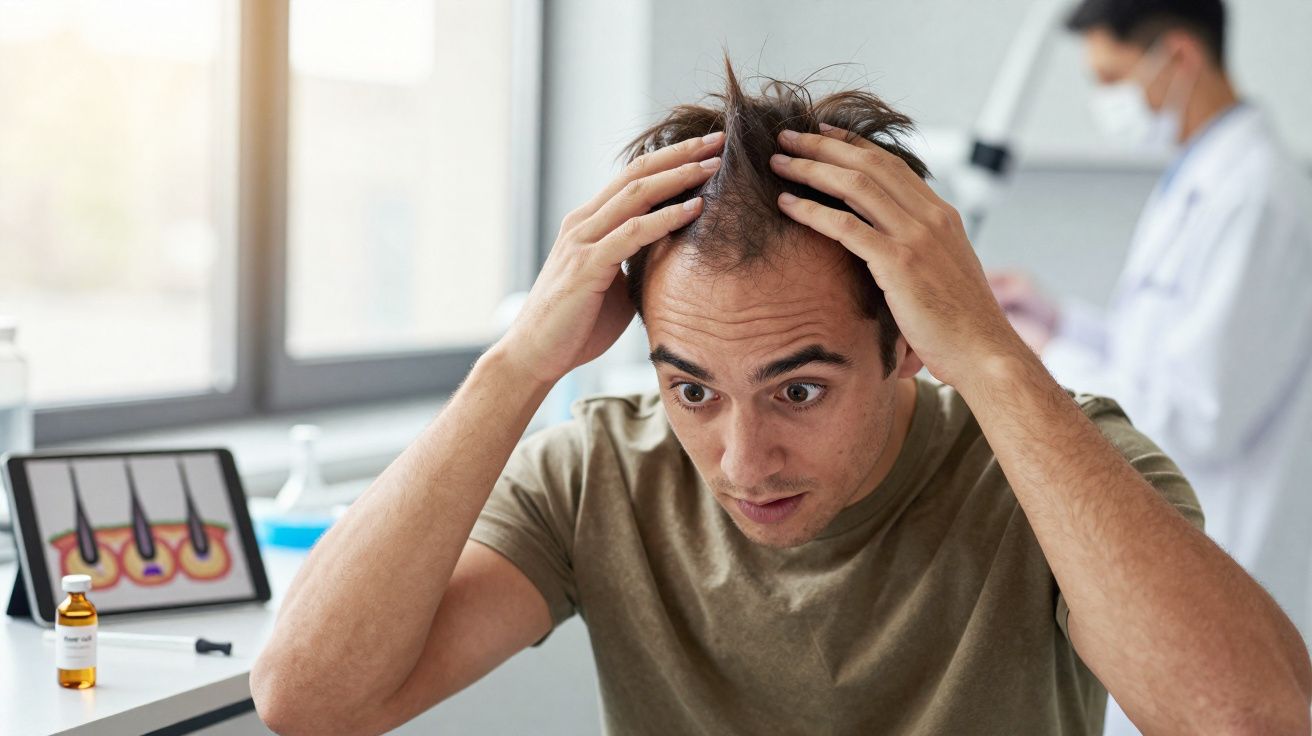
New work on baldness offers an encouraging lead: researchers have shown that hair growth can be restarted in mice in roughly 20 days by activating fat cells surrounding hair follicles, rather than by directly targeting the follicles themselves.
Why National Taiwan University researchers looked at skin irritation and hair growth
The study, led by a team at National Taiwan University, builds on a long-recognised observation in biology and medicine: skin irritation and injury can sometimes be followed by unexpected increases in hair growth. The researchers set out to explain why this happens and whether the same biology could be channelled into a practical approach for hair loss.
As systems biologist Kang-Yu Tai and colleagues describe in their paper, most mammals rely on a thick coat of hair as a first line of defence. If the outer skin layer (the epidermis) is irritated or damaged, it makes sense-biologically-that the body might respond by rebuilding that protective hair barrier.
Although humans no longer have dense hair coverage across much of the body, clinical reports of irritation- or injury-associated excessive hair growth (hypertrichosis) indicate that this regenerative capacity has not disappeared entirely.
What the experiments did
To investigate the chain of events, the team shaved mice and then produced mild skin injuries using either chemical irritants or heat. They then compared regrowth in the affected patches with regrowth in unaffected skin, using several microscopic imaging techniques to observe what was happening around the follicles.
Inflammation, macrophages and adipocytes: the trigger for regrowth
The irritated skin became inflamed, and the researchers observed an immune response that brought macrophages to the injured area. Those macrophages then communicated with nearby adipocytes (that is, fat cells), prompting them to release specific fatty acids.
According to the study, the released fatty acids were taken up by hair stem cells, which then received the signal needed to restart the growth programme.
In the authors’ words, adipocyte activation sits downstream of immune-driven local inflammation in the sequence of cellular events that follow skin injury.
Testing a serum of fatty acids without causing injury
After mapping the pathway, the team tested whether the injury step could be skipped. They applied a topical serum made from the same fatty acids directly to mouse skin. This, too, led to hair regrowth in around 20 days, suggesting the chemical cues can be sufficient even without deliberately damaging the skin.
An important limitation for human baldness
A crucial caveat is that the effect was limited to follicles in a resting phase-follicles that are effectively paused while waiting for a new signal. That matters because baldness on the human scalp is tied to shifts in the timing and balance of the hair cycle across individual follicles, rather than a simple “shave-and-regrow” scenario like the one used in mice.
What this could mean for hair loss treatment
Targeting hair stem cells to “reawaken” growth is attractive as a hair loss strategy because it could be relatively straightforward, convenient and fast-acting-while still having constraints on where and when it would work, depending on the state of the follicles.
The researchers say they are moving towards clinical trials to assess whether the biology observed in mice can translate into a therapy for humans.
What remains unclear about immune signalling and fatty acid release
The team also notes that the underlying immunology is not yet fully mapped. One open question is what precisely governs the macrophage-to-adipocyte signalling that prompts the release of fatty acids during skin irritation.
Because these fatty acids occur naturally and have an established safety record in other contexts, the authors argue they may hold notable promise for future hair loss treatments.
Additional considerations: delivery, tolerance and real-world use
Even if a serum approach proves effective, real-world application would need to balance stimulation with skin tolerance. A formulation that reliably delivers fatty acids to the neighbourhood of hair follicles without provoking unwanted inflammation or dermatitis would be essential-particularly for repeated use on the scalp.
It is also likely that any eventual treatment would need to account for the diversity of hair-cycle states across the scalp at any given time. In practice, this could mean combining approaches that influence follicle cycling with strategies that support hair stem cells, rather than expecting uniform results from a single trigger.
The research has been published in Cell Metabolism.






Comments
No comments yet. Be the first to comment!
Leave a Comment