
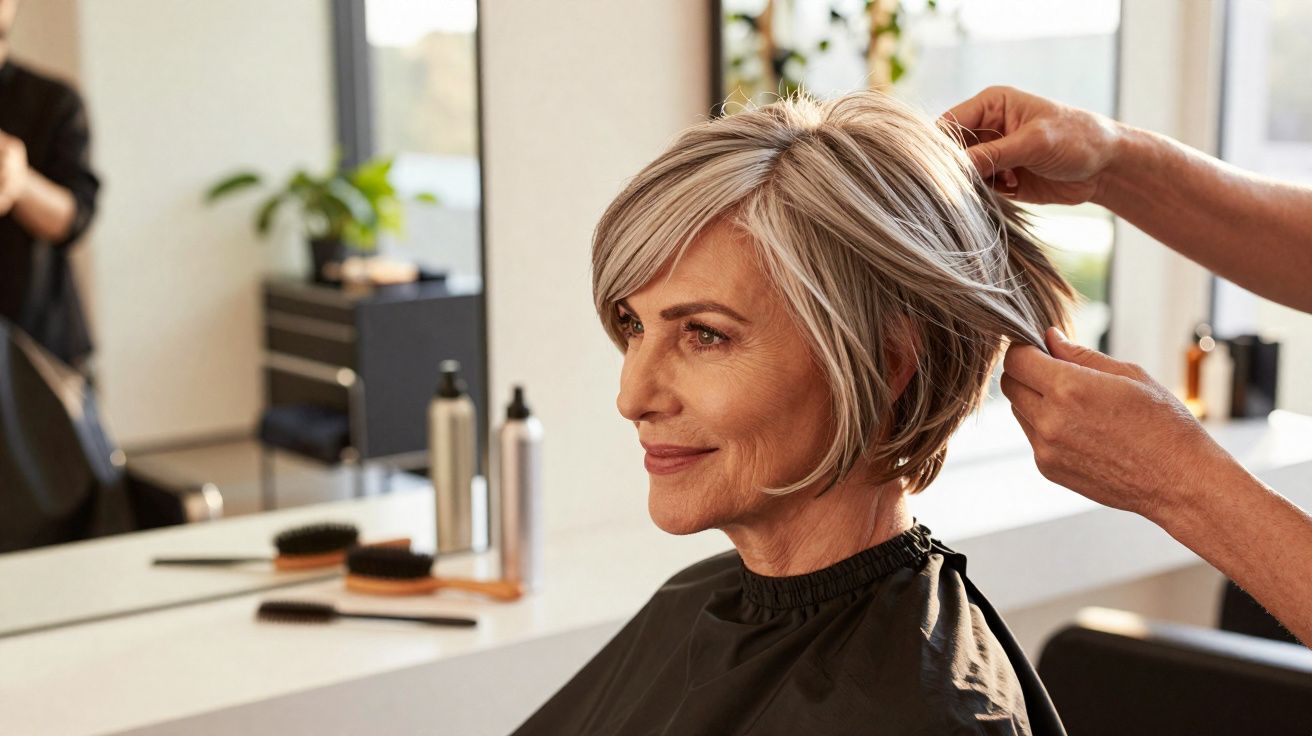
The pixie cut has become a favourite short cut for women over 50 who want their hair to feel lighter and their look to feel fresher. When it’s cut thoughtfully, it can brighten the face, visually lift the jawline and make your features seem softer and more rested. When it’s handled poorly, it can sharpen the expression and make you look older. The difference usually comes down to how hair professionals adjust length, texture and the fringe so the pixie behaves like a soft-focus filter rather than a severe uniform.
Why the pixie cut is enjoying a second life after 50
Once considered a bold, almost rebellious statement, the pixie has quietly become one of the most calculated, flattering hairstyles for mature faces.
Short hair puts your face on show, so every detail of the cut is obvious-and it can make you look brighter and younger, or more tired.
Hairdressers say more women in their 50s, 60s and 70s are requesting pixies for three main reasons: convenience, a lighter feel, and style. With less length, there’s less drying and less time spent styling. The neck and jawline are revealed, which can create the illusion of a “lift”. And the silhouette can be adapted in several popular variations:
- Bixie or boxie – a slightly longer, fuller pixie that sits close to a bob.
- Grown‑out pixie – feathered and layered, with softer edges and extra length through the top.
- Tapered pixie – cropped tighter at the back and sides, left longer on top for shape and structure.
What these options tend to share is the same payoff: less weight around the shoulders and more emphasis on the eyes, cheekbones and smile.
Choosing the right pixie for your face and lifestyle
A pixie isn’t one-size-fits-all. A skilled stylist will consider your face shape, hair texture and what you’ll realistically do at home each morning before recommending a version.
- Round face – extra height on top with less width at the sides helps create a longer, more elongated effect.
- Square face – soft, wispy edges and a side‑swept fringe reduce attention on a strong jaw.
- Long face – a bit more fullness at the sides plus a gentle fringe that skims the cheekbones balances facial length.
- Oval face – usually suits most pixie styles, including bolder asymmetry.
Hair texture is just as important. Naturally wavy or curly hair often gives a pixie instant body, whereas very fine, straight hair typically needs more layering and a touch of lightweight mousse at the roots. If you don’t like styling, ask for a shape that settles well when air‑dried with minimal product.
A practical extra to mention in the consultation: if you wear glasses or hearing aids, say so before the first snip. Tiny adjustments-such as slightly more length around the ears or softer tapering at the temples-can prevent the cut from catching, sticking out, or feeling uncomfortable day to day.
Pixie cut: four pro moves that can make it look 10 years younger
1. Create movement around the face
What separates a dated, “mumsy” pixie from a modern one is often movement. Hair plastered flat across the forehead or tight at the temples can draw attention to lines and give the face a stern set.
Longer, airy, textured pieces at the front act like soft curtains-diffusing fine lines and guiding attention towards the eyes.
Many stylists favour a longer, feathered fringe that melts into the sides rather than a short, blunt, helmet-like fringe. Done well, that front section:
- softens a higher forehead without creating a harsh horizontal line
- frames the upper face so the eyes become the focal point
- can be worn side‑swept, parted, or slightly undone depending on the day
The real trick is subtle internal layering within the fringe. Small, almost invisible layers let the hair shift and flutter when you move, instead of sitting stiffly against the skin.
2. Use generous layering for volume and softness
After 50, hair commonly loses density. A one-length pixie cut like a smooth cap can cling to the scalp, look flat, and age the whole face.
Well-placed layers create lift exactly where it’s most flattering: at the crown, along the parting, and around the cheekbones.
In a more rejuvenating pixie, professionals typically:
- keep the back shorter to expose the neck and lift the overall outline
- leave a touch more length around the ears to soften the side profile
- add shorter layers on top to create height and a lighter, airier feel
This layered build is particularly useful if your hair has thinned or looks uneven in places. Overlapping sections disguise sparse areas and mimic thicker hair-often without needing heavy products.
3. Add subtle asymmetry for a lively, face-hugging shape
Flattering balance doesn’t have to mean perfect symmetry. For many women over 50, a gently uneven pixie is more forgiving than a straight, centred design.
When the front is asymmetrical-slightly heavier on one side-the eye travels diagonally, which can make features seem lifted and more animated.
Stylists commonly create this effect by:
- setting the parting just off-centre where the hair naturally wants to fall
- leaving the fringe longer on one side so it sweeps across the forehead
- trimming the opposite side a little shorter to define the jawline
The goal is deliberate but not dramatic-more “good camera angle” than avant-garde statement. When it follows your natural growth pattern, the cut sits close to the face and can soften the look of heaviness along the jaw.
4. Opt for a feathered fringe that flatters most faces
If there’s one detail many specialists return to, it’s this: a longer, fine, feathered fringe suits an enormous range of face shapes and ages.
This sort of fringe frames the face gently, downplays forehead lines and heavier upper lids, and reads youthful without trying too hard.
For the most seamless result, the fringe can begin higher on the crown and blend into the top layers. Avoid cutting it too thick or too blocky, as that can weigh down the face. Aim for piecey strands you can separate with your fingers-similar to the fringe seen on actresses who move between bobs and pixies.
“Aging” mistakes that can make a pixie feel dated
A cut that’s too short, stiff or uniform
An ultra-short, sharply outlined pixie can look great on very young faces, but after 50 it often exaggerates angles and shadows. Without texture or lift, hollows and lines can appear more pronounced.
The harder the outline, the more every dip and wrinkle shows; softness works like a filter.
Clues your pixie has tipped into harsh territory include:
- little to no movement when you shake your head
- crisp, straight edges around the forehead and ears
- styling that depends on strong gel or lacquer to lock everything in place
A looser, slightly tousled finish-using a light cream or a texturising spray-can instantly make the overall look feel softer and more current.
Flat colour with no dimension
With short hair, cut and colour need to work as a pair. A single, solid shade with no tonal variation can make even a well-shaped pixie appear heavy and dull, especially on grey hair or very dark hair.
Gentle shifts in tone bounce light back onto the face, giving skin more glow and hair more depth.
Short-hair-friendly options include:
- soft balayage to brighten the top and fringe
- fine highlights around the face to lift the complexion
- toning grey hair to a cooler or warmer shade that suits your undertone
Because a pixie reveals roots quickly, regrowth can read messy fast. Keeping up with toner or a root refresh roughly every 4–8 weeks helps the look stay intentional and polished.
Maintenance: the unglamorous secret to a youthful pixie cut
Short cuts usually need more frequent trims than longer styles. A pixie that looked perfectly balanced a month ago can quickly start to feel bulky at the sides, or lose height on top as it grows.
| Aspect | Ideal frequency | Why it matters after 50 |
|---|---|---|
| Shape refresh | Every 4–6 weeks | Stops the cut dropping and drawing attention to areas that may be starting to sag |
| Colour/toner | Every 4–8 weeks | Keeps greys looking deliberate and prevents a dull, flat finish |
| Fringe trim | Every 3–4 weeks | Preserves the eye-opening effect without letting hair cover the face |
Texture care matters as well. Mature hair can be drier and more delicate, so strong gels or alcohol-heavy sprays may roughen the cuticle and make the finish look coarse. A lightweight styling cream, a pea-sized amount of wax, or a salt spray used sparingly can define layers without making them rigid. If you use heat tools, a heat protectant is worth adding-short hair is closer to the scalp and can dry out quickly with repeated blow-drying.
Extra tips: simple styling tricks (and the vocabulary you’ll hear)
Two at-home habits can make a pixie look more modern in minutes. First, lift the front sections up and back with a quick blast of the hairdryer before sweeping them to the side-this builds height rather than leaving the fringe flat. Second, warm a tiny amount of product between your fingertips and pinch random ends to break up any overly smooth, uniform surface.
In the salon, you may hear terms like tapered and texture. Tapered means the hair gradually becomes shorter towards the neck and sides, keeping the outline neat and elegant. Texture refers to small internal cuts that stop the hair forming a solid block; they let air move through the style, creating that softer, slightly tousled, youthful effect.
If you’re hesitant about going very short, a bixie-halfway between a bob and a pixie-can be a lower-risk trial run. If you love the lift and ease, you can go shorter at your next appointment; if you don’t, you’ll still have enough length to grow it into a classic bob without too much awkwardness.



Comments
No comments yet. Be the first to comment!
Leave a Comment