
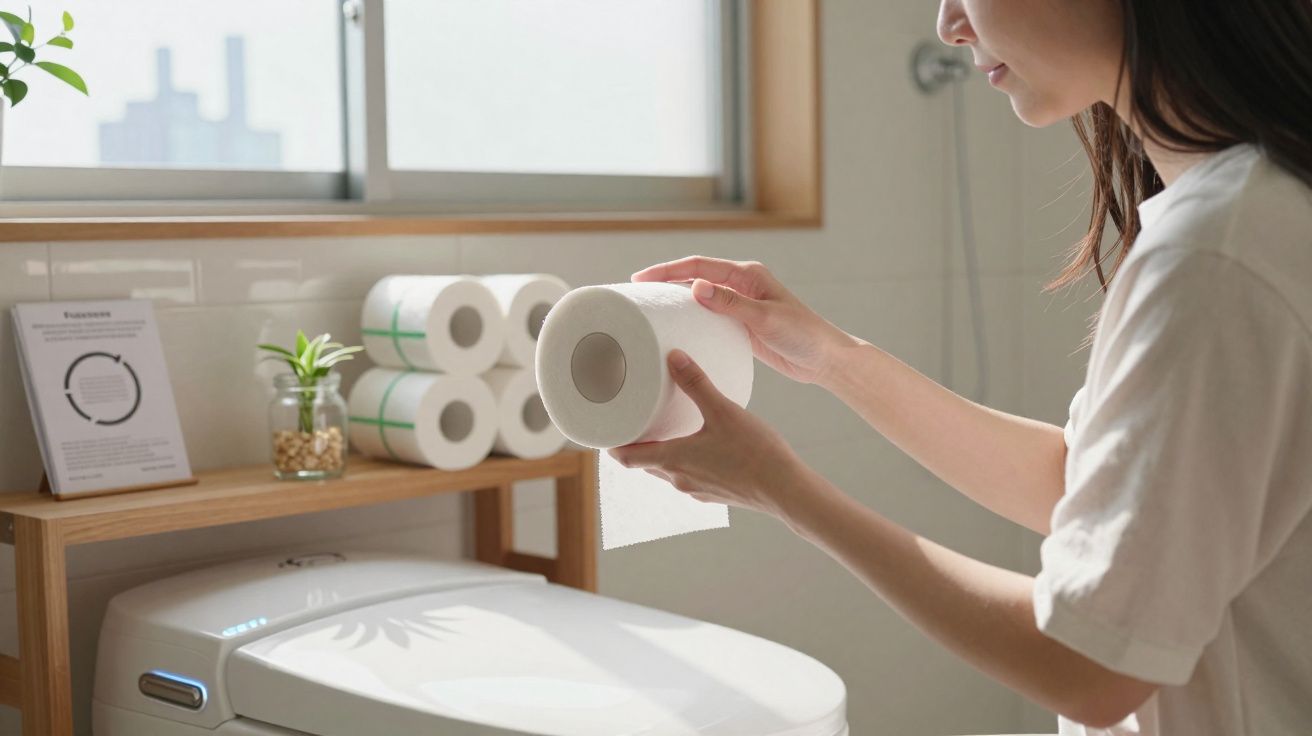
In one small Japanese city, a low-key trial is turning a disposable habit into something cleaner, more unusual and unexpectedly optimistic.
Toilet paper seldom makes the news. Yet a new project in Japan is changing how this everyday staple is produced-without asking anyone to alter what they do in the bathroom.
Why Japan is rethinking toilet paper
Toilet paper seems innocent: soft, single-use and always within reach. But the reassurance comes with a weighty industrial footprint that consumes wood pulp, water and energy.
Most conventional rolls still depend heavily on virgin fibres cut from trees. Those fibres pass through mills, bleaching plants and long supply chains before reaching a bathroom. After flushing, used sheets can contribute to blockages in local systems; even when everything functions properly, they add to the load at wastewater treatment works.
This Japanese project keeps the familiar roll, but rewrites the story of what goes into each sheet.
Japan is already famous for bathroom innovation. High-tech bidet toilets-often with warmed seats and automatic sprays-are standard in many homes. They can reduce paper use and offer a different approach to hygiene.
Even so, bidet-style toilets have not replaced toilet paper everywhere. Many Japanese households still use rolls as their main option. Outside Japan, cultural routines, tenancy restrictions and a reluctance to install new hardware often slow adoption. That tension creates an opening: if people hold on to toilet paper, perhaps the toilet paper can change instead.
Keeping the gesture, changing the material
A team of engineers and local officials chose to work with existing habits rather than fight them. Instead of trying to introduce new bathroom rituals, they focused on the material behind the roll.
The aim is disarmingly straightforward: manufacture a normal-looking toilet paper roll that feels familiar in the hand, yet is sourced from a completely different stream of resources. No gadgets. No apps. Just a radically altered supply chain.
Shibushi’s toilet paper recycling project: a quiet test bed for circular hygiene
The initiative took shape in Shibushi, a modest city in Kagoshima Prefecture. Locally, it has become known for ambitious recycling policies that treat waste as an asset rather than an inconvenience.
Working with Poppy Paper Company, Shibushi targeted one of the most difficult waste streams to handle: used diapers and other absorbent products. In ageing societies these items accumulate quickly, are unpleasant to store and transport, and do not lend themselves to simple recycling. In most places they are sent to incineration or landfill.
Rather than burning them, Shibushi began collecting and processing them. About 98 tonnes of used absorbent products have already passed through the new system, feeding a production line that turns old nappies, tissue and cotton into fresh toilet paper.
A waste stream that once caused municipalities embarrassment is now supplying the raw fibre for a basic household product.
From used diapers to clean rolls: how it works
The obvious question is also the most sensitive: how can used diapers become paper that people are willing to use?
The answer is a tightly controlled, multi-step industrial process. Collected materials pass through several stages:
- Sorting: separating diapers, tissues and cotton from other household waste
- Disinfection: using heat and chemicals to remove pathogens
- Bleaching: whitening fibres to achieve a neutral appearance and reduce odours
- Shredding: breaking treated material down into small fibre fragments
- Blending: mixing the recovered fibres with conventional recycled paper pulp
- Forming and drying: pressing pulp into thin sheets and rolling it into finished products
By the blending stage, the fibres no longer resemble diapers in any recognisable way; they behave like raw pulp. Mixing with recycled paper helps stabilise texture and strength, producing a result close to standard toilet paper in thickness and softness.
Engineers also designed the line to cut emissions compared with incinerating or landfilling the original absorbent products. At the same time, they needed to meet strict hygiene expectations-because any uncertainty about cleanliness would end the idea immediately for consumers.
| Stage | Main goal |
|---|---|
| Collection | Secure a steady flow of absorbent waste from homes and care facilities |
| Treatment | Neutralise pathogens and odours, standardise fibre quality |
| Pulping | Create a usable mix with recycled paper for consistent strength |
| Conversion | Produce rolls that match everyday expectations in feel and performance |
The rolls must also behave properly in existing plumbing. That is not a minor detail: paper that breaks down too slowly can block pipes and quickly alienate users. Testing therefore covers hygiene as well as disintegration rates, flushability and softness.
One further practical complication sits in the background: disposable diapers contain plastic-based components as well as fibres. Any system that uses used diapers as a feedstock has to manage those non-fibre materials carefully so the final paper performs like toilet paper should, while keeping processing safe and consistent.
Price matters: a green idea that had to stay cheap
Environmentally branded products often come with a higher price tag, which shuts out many households. Shibushi’s team understood that if the rolls looked like a niche eco luxury, the pilot would struggle to scale.
So they aimed for a low-end price point: roughly €2 for a pack of 12 rolls (about £1.70, depending on exchange rates). In UK terms, that places the product closer to entry-level supermarket options than premium “quilted” lines.
By matching budget brands on price, the project treats sustainability as the default rather than a paid upgrade.
Early results show more than 30,000 rolls sold. That is a small fraction of national demand, but meaningful for a pilot scheme. Importantly, people bought them in everyday shops rather than only specialist eco outlets, suggesting interest driven by curiosity and convenience, not just signalling.
User feedback will influence what comes next. Minor adjustments-softness, thickness, sheet length-can determine whether buyers return. In a category as habitual as toilet paper, the tactile experience often decides whether a product earns a permanent spot on the shelf.
Sharing space with Japan’s high-tech toilets
Japan’s bidet toilets already offer a credible alternative to paper-heavy routines. Water jets do the cleaning, while a small amount of paper may be used mainly for drying. For many households, that already feels like the direction of travel.
A recycled roll made from used diapers is not trying to outcompete bidet toilets; it is another route to similar goals.
Renters may be unable to install bidet seats. Some older residents prefer familiar fixtures. Tourists and short-term tenants are not going to replace bathroom hardware. A more responsible toilet paper offers these groups a way to reduce impact without changing equipment.
Seen this way, the Japanese trial points to a spectrum rather than a single winner: high-tech water jets, conventional recycled paper, and now a hybrid made from reclaimed absorbent waste.
What this changes for waste and resources
If scaled, the consequences would extend well beyond toilet paper aisles. Used diapers and comparable absorbent products are notoriously difficult to manage: they are bulky, can smell, and their moisture content makes them heavy and costly to transport.
Diverting them into a controlled recycling pathway could reduce volumes sent to incinerators, lower haulage costs, and cut emissions associated with burning plastic-based components found in diapers.
The same fibre that once filled bins and landfill becomes a second-life resource inside a regulated, traceable loop.
The potential benefits arrive on several fronts:
- Reduced demand for virgin wood pulp, easing pressure on forests
- Lower volumes of difficult sanitary waste
- New local jobs and industry around collection and processing
- A visible demonstration that circular systems can include intimate, everyday products
For paper manufacturers, this feedstock could enable a different business model. Instead of depending solely on imported pulp, firms could draw from local waste streams with steady volumes-especially in ageing areas where adult incontinence products are increasingly common.
Questions and hurdles that could slow the revolution
The project remains in its early stages, and several constraints will shape whether it stays a local curiosity or becomes a model others adopt.
Logistics is the first challenge. Collecting used diapers requires sealed containers, frequent collections and strict guidance-particularly from care homes and nurseries. If these materials are mixed into general rubbish, the process breaks down.
Public perception is the next barrier. Many people recoil at the idea of “diapers” and “toilet paper” appearing together. Clear explanations of disinfection, testing protocols, and certification will be as critical as pricing or softness.
Operational consistency is another test. Waste streams fluctuate, and fibre quality can vary between brands of diaper or tissue. To produce reliable toilet paper from inconsistent inputs, operators need robust monitoring and quality control.
Competitiveness sits behind all of this. If energy costs rise or collection becomes more expensive, the recycled route could lose its price edge over conventional rolls or over fully water-based hygiene solutions. Policy tools-such as reduced waste fees for recycling-could influence which option remains economically viable.
A further consideration for countries such as the UK is standards and procurement. If public bodies (for example, councils, schools or care facilities) specify clear quality and hygiene requirements for toilet paper made from recovered absorbent waste, they could help stabilise demand-making it easier for a local circular system to operate at dependable volumes.
Why this matters beyond Japan’s bathrooms
For policymakers in the UK, the US and across Europe, Shibushi offers a practical case study. Rather than waiting for households to install new equipment, authorities could rethink sanitary waste and paper demand together.
A council facing high diaper disposal costs could estimate how much volume might be diverted into fibre recovery, then compare scenarios: incineration versus a small paper facility supplying public buildings, schools or care homes.
Household behaviour would barely change, yet the material loop would tighten. The same principle might extend to other hard-to-recycle items too, including certain medical textiles or blended paper products that currently have no second life.
For consumers, the idea also reframes what “green” means for everyday goods. Instead of focusing mainly on packaging or slogans, the key question becomes simpler-and more revealing: where did the fibres come from, and what were they used for before they became toilet paper?
If projects like Shibushi’s spread, shoppers might eventually choose between rolls made from fresh trees, office paper offcuts, or carefully cleaned sanitary waste. The action in the bathroom would stay identical, but the story behind each sheet would be fundamentally different.


Comments
No comments yet. Be the first to comment!
Leave a Comment