
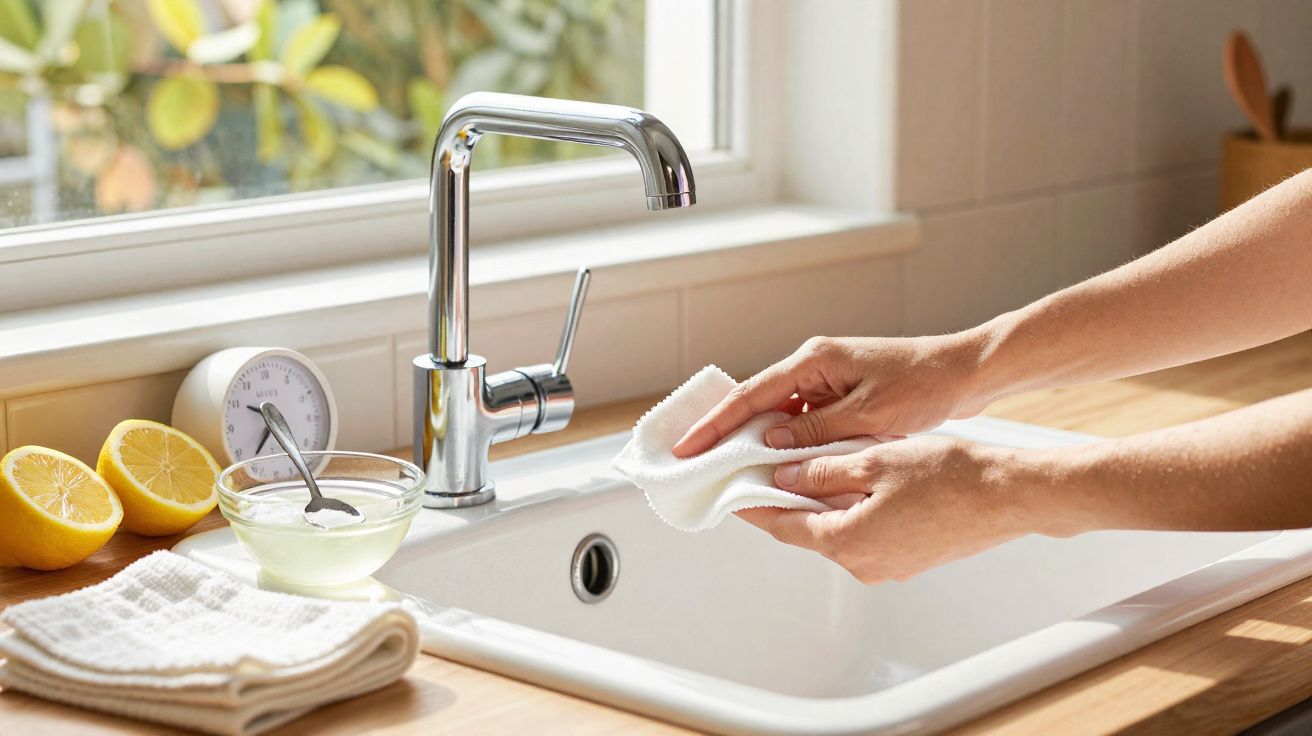
The issue is rarely simple dirt. More often, it’s the mix of hard water, basic chemistry and not having the time for fussy cleaning.
In hard-water areas, minerals dry onto metalwork, leaving a hazy film that dulls chrome and blocks aerators. Harsh bathroom sprays may look like the quickest option, but they also bring extra fumes and expense. A calmer, cheaper solution is usually already in the kitchen cupboard.
Why limescale builds up on household taps
Across many parts of Britain, mains water is drawn from chalk and limestone aquifers. That geology loads the water with calcium and magnesium ions - what we refer to as hardness.
When hard water is heated or simply evaporates on a tap, those minerals convert into calcium carbonate. The result is a pale, powdery deposit that gradually compacts into a stubborn crust. Warmth, splashing and the tiny passages inside aerators speed the build-up. Once the surface is roughened, it catches soap residue and everyday grime, so the dull finish gets worse over time.
The chemistry of removal is straightforward. Mild acids - such as acetic acid in white vinegar or citric acid dissolved in water - react with calcium carbonate. You’ll often see bubbles of carbon dioxide as the deposit loosens, softens and releases.
Hard water + heat forms calcium carbonate. A weak acid + contact time breaks it down. Waiting works better than scrubbing.
The health and energy angle
Limescale looks untidy, but the bigger cost is performance. Scale makes seals less reliable, wears mixer cartridges, and turns smooth flow into spluttering. Your aerators clog, and appliances end up working harder.
Even a very thin coating on a heating element behaves like insulation. Heat transfer drops, so systems run hotter and for longer. Showers can spray off-line, and people tend to leave taps running to compensate - which nudges bills upwards.
Yes, strong descalers can shift scale quickly, but many contain aggressive acids plus fragrances and solvents. In a bathroom, vapours hang around on surfaces and in the air. Wastewater treatment removes a great deal, but not everything. It’s no surprise more households are choosing simpler products with fewer residues.
A practical extra benefit: keeping tap outlets clear can improve perceived pressure and reduce unnecessary over-opening of taps, which helps water efficiency as well as comfort.
The gentle method for descaling household taps (white vinegar or citric acid)
1) Make a simple weak-acid mix
Pick one option and stick with it:
- White vinegar (8–10% acetic acid), used neat
- Citric acid mixed to about 10% in warm water
Vinegar is effective but has a noticeable smell; citric acid is much lower odour. Both are inexpensive and biodegradable. You only need one.
2) Apply it and give it time
Soak a microfibre cloth or kitchen paper in your chosen solution. Press it onto the affected areas to create a small “compress” around the spout, then secure it with an elastic band.
- Leave for 15–30 minutes for typical build-up
- Allow up to 45 minutes for heavier scale around the base of a mixer
Keep the compress damp - the reaction relies on moisture and time.
3) Remove and soak the aerator
Carefully unscrew the aerator. Take out the rubber washer, then place the metal insert in the solution for 30 minutes. Gently clean the mesh using a soft toothbrush, rinse thoroughly, refit the washer, and screw the aerator back on using finger pressure (avoid pliers).
4) Rinse, then dry to keep the shine
Rinse the tap with clean water and buff it with a dry microfibre cloth. Drying matters: if droplets are left to evaporate, they can form new rings and “halos”. Ten seconds of drying makes a visible difference.
5) Take care with special finishes
Chrome and stainless steel usually tolerate brief contact with weak acids. However, black matte, raw brass, PVD and lacquered finishes can be more sensitive. Always test under the spout first, reduce contact time, and avoid abrasives. Keep acids away from marble and other calcareous stone surfaces.
Never combine acids with bleach - it can release chlorine gas. Also skip the “vinegar plus bicarbonate” approach for descaling: the fizz looks impressive, but it neutralises the acid and slows the actual job.
Keep it straightforward: one weak acid, enough contact time, a gentle wipe, and a proper rinse. No bleach, no abrasives, no gimmick mixes.
A simple maintenance cadence:
- Weekly: wipe down and spot-descale any visible crust
- Monthly: remove and soak the aerator
- After each use: quick dry around the base and spout
What the experts actually recommend for household taps
Manufacturers of taps routinely caution against aggressive products. Decorative coatings are designed for everyday wear, not repeated acid attacks. Their guidance tends to focus on neutral to mildly acidic cleaners, soft cloths, and letting the product sit on the surface rather than forcing the issue with scrubbing.
Chemists broadly agree. Hydrochloric acid acts fast, but it can pit metals and produces corrosive fumes. Sulfamic acid is powerful and effective, yet it’s better suited to controlled use with proper precautions. For routine domestic work, weak acids are typically the best compromise - provided you allow enough time and rinse well afterwards.
| Agent | Strength | Pros | Risks | Best for |
|---|---|---|---|---|
| White vinegar | Weak acid | Inexpensive, easy to find, effective on taps | Strong odour; keep off stone | Regular descaling, aerators |
| Citric acid (10%) | Weak acid | Low odour, biodegradable, accurate dosing | Can dull delicate finishes if overused | Ongoing maintenance, kettles, shower heads |
| Sulfamic acid | Medium | Quick on heavy scale | Requires PPE and careful handling | Severe deposits, professional jobs |
| Hydrochloric acid | Strong | Very rapid reaction | Damages metal, strong fumes, higher safety risk | Not recommended for domestic taps |
If you do use any descaler, open a window or run the extractor fan, and consider gloves - not because weak acids are “dangerous” in normal use, but because repeated exposure can irritate skin and sensitive finishes alike.
Prevention beats scrubbing
The easiest limescale to remove is the limescale that never gets a chance to harden. After showers, wipe around the base of the mixer. Give the shower hose a shake to clear trapped water. Dropping the hot-water setpoint by a few degrees can also help - less heat means less precipitation.
Water treatment can be worth considering, but only when your situation truly warrants it:
- Ion-exchange softeners reduce hardness effectively, but require salt, maintenance and correct adjustment.
- CO₂ dosing can alter the carbonate balance without salt.
- Cartridge filters can catch sediment, but they do not reduce hardness.
- Magnetic devices make bold claims; independent testing shows mixed, often limited, benefits for taps.
A sensible approach is to start with the low-effort routine (cloth + weak acid + time) and add hardware only if scale build-up consistently outpaces your cleaning.
What this means for a busy home
When you keep deposits thin, taps stay smoother to operate, seals tend to last longer, and aerators produce an even stream - so you’re less likely to over-open the tap. Surfaces also stay cleaner between proper cleans, which means fewer bottles under the sink and less perfume-like residue in the air.
The energy side is worth attention too. A 1 mm limescale layer on a heating element can push energy use up by roughly 7–10%. If a gas cylinder supplies 3,000 kWh a year for hot water, that’s around 210–300 kWh extra. At 7p per kWh, that’s roughly £15–£21 annually. With an electric immersion heater, the same loss at 28p per kWh comes to about £59–£84. That’s far more than the cost of a small amount of descaler.
Extra context for British homes: spotting and measuring hard water
Hardness varies significantly around the UK. Parts of the South East often sit in the very hard range, while large areas of Scotland and the North West are soft to moderately hard. Your home usually gives quick clues: a chalky kettle, shower glass that clouds easily, and spluttering aerators all point towards hard water.
If you’re unsure, measure it. Hardness test strips are inexpensive, and a plumber can confirm the reading while checking the condition of your fittings. Choose solutions based on the numbers rather than marketing claims - begin with cloth, weak acid and contact time, then only escalate if needed.
A routine you can actually keep
Set aside ten minutes on a Sunday: wrap the spout, soak the aerator, wipe the base, then rinse and dry. Add a monthly reminder for areas that scale heavily, such as shower heads. Keeping a small jar of ready-made citric solution under the sink makes the whole process easier to repeat.
Two practical finishing touches help prevent mistakes: rotate two microfibre cloths so one stays dry for buffing, and clearly label any acid spray bottle while storing it well away from bleach. That small bit of organisation protects finishes and avoids accidents.
Shine comes back when you let chemistry do the work: short sessions, simple tools, lower exposure - and often lower bills.
If you like tracking improvements, try a quick before-and-after: time how long the shower takes to reach temperature, note how steady the flow is after aerator care, and check the kettle for new scale monthly. Small wins build momentum, which is what keeps the routine going.
Interested in finishes? PVD and matte coatings look modern, but they can scratch or etch more readily than chrome. Keep acid contact brief, use only soft brushes, and test an inconspicuous area first - then wait a day to confirm the finish hasn’t dulled. Patience still beats force.




Comments
No comments yet. Be the first to comment!
Leave a Comment