
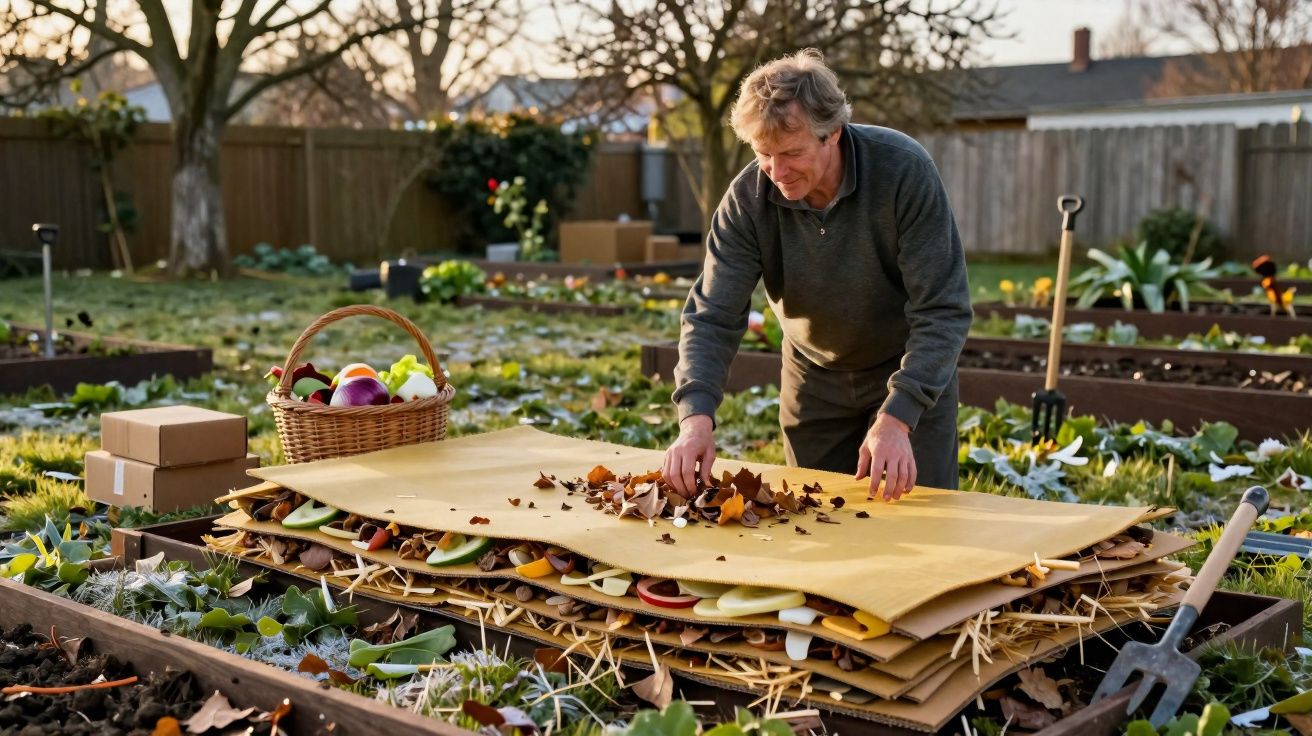
Instead of chiselling at frozen soil or battling with a rotavator, more and more gardeners are spending the tail end of winter quietly piling kitchen peelings and cardboard into oddly satisfying raised beds. The practice goes by a name that sounds like a punchline - lasagna gardening - but it is steadily changing how people get their plots ready for spring.
From aching backs to upright gardeners
That familiar image of someone hunched over in February drizzle, heaving a spade through heavy ground, is beginning to feel out of date. Plenty of amateurs and professionals have decided that strenuous digging takes more than it gives back - to their bodies and to the soil itself.
Lasagna gardening replaces deep cultivation with calm layering: you stop battling the soil and start building above it.
With lasagna gardening, you leave the soil the right way up. Materials are laid in layers that gradually lift the surface level, which can be noticeably kinder on knees, hips, shoulders and spine. Gardeners who had quietly stopped growing veg because it hurt are finding a way back in.
Soil biologists highlight another advantage that is easy to miss. Turning the ground disrupts a complex underground community: surface-dwelling creatures get buried, deeper-living organisms are hauled into light and dry air, fungal threads are ripped, worm tunnels are crushed. By keeping disturbance to a minimum, lasagna beds allow this hidden workforce to remain intact and effective.
Why late winter is the sweet spot for lasagna gardening
Many people only start thinking about new vegetable beds once mild days arrive. Lasagna gardeners plan further ahead, treating January and February as ideal construction months.
The cold season offers the moisture and the waiting time layered beds rely on, so they are ready right as spring planting begins.
Winter rain and snowmelt seep through the cardboard and the dry layers, softening them and helping fungi and bacteria get going without constant watering. Low temperatures slow decomposition, but they do not halt it. By April or May, the stack has usually slumped into a denser, darker and more even layer.
Starting earlier also spreads the workload. Rather than trying to prepare ground and raise seedlings at the same time in March, gardeners can concentrate on sowing while their beds quietly finish maturing.
The principle: “cooking” a bed in layers
Despite the playful label, the method rests on a simple concept: surface composting. Instead of carrying garden and kitchen waste to a compost bin and later carting finished compost back again, you let the transformation happen in the bed itself.
The basic pattern is to alternate carbon-rich layers with nitrogen-rich layers. Cardboard, straw and dry leaves provide the “dry”, structural components. Grass clippings, kitchen peelings and coffee grounds bring moisture and nitrogen.
The bed acts like a slow, cool compost heap: a thick organic “sandwich” that converts itself into dark, crumbly soil by spring.
A simple layer-by-layer method (lasagna beds)
- Place flattened brown cardboard directly onto grass or bare soil, overlapping the edges.
- Add a damp, nitrogen-rich layer such as peelings, fresh manure or green clippings.
- Cover it with a dry carbon layer: straw, shredded paper or dry leaves.
- Continue alternating green/brown layers until the pile is about 20–40 cm high.
- Finish with a light dusting of completed compost or garden soil to make planting easier later on.
Over the following weeks, the pile settles. Fungi, bacteria and worms work through the layers from the bottom upwards. The end result is a loose, fertile growing zone - often rich enough in year one for hungry crops such as tomatoes or courgettes without additional fertiliser.
Turning everyday rubbish into soil wealth
Late winter often comes with a glut of bin-bagged cardboard and heaps of fallen leaves. Lasagna gardeners tend to see that clutter as useful raw material rather than an inconvenience.
Cardboard boxes, leaf piles and kitchen scraps stop being “waste” and become the ingredients of a self-feeding vegetable bed.
Plain brown cardboard without glossy inks is especially valuable as the first layer, because it blocks light and suppresses grass and weeds underneath. Above it, a wide range of clean organic matter can help: apple cores, tea bags, spent cut flowers - and even vacuum cleaner dust, provided it is mainly pet hair and fluff.
For anyone trying to reduce car journeys and trips to the tip, building lasagna beds in late winter can change the routine completely. Instead of queuing at the local recycling centre with sacks of prunings, you can carry them a few metres into the garden. Fuel use drops, wheelie bins are less full, and the plot becomes a small recycling station in its own right.
What you can and can’t use
| Suitable materials | Best avoided |
|---|---|
| Plain cardboard, paper, straw, hay | Glossy printed cardboard, heavy tape |
| Vegetable peelings, coffee grounds, tea leaves | Cooked food, meat, fish, large amounts of fat |
| Grass clippings, green prunings | Weeds with ripe seeds or invasive roots (e.g. bindweed) |
| Autumn leaves, shredded hedge trimmings | Pet faeces, vacuum bags from smokers’ homes |
Added practical note: it is also worth removing plastic labels, staples and tape from cardboard before layering, and avoiding anything that may be contaminated (for example, prunings from plants recently treated with persistent weedkillers). Clean inputs help the bed break down reliably and keep the finished soil safe for food crops.
Letting the underground workforce take over
Once the layers are stacked, most of the human effort is done. The rest is handled by organisms that rarely get much appreciation: earthworms, beetles, springtails and a vast range of microbes.
Attracted by the fresh organic matter, worms travel up from the soil below and begin tunnelling. As they eat and redistribute material, they form vertical channels that improve drainage and help roots explore deeper.
Every worm tunnel is free aeration - a shaft that carries air, water and nutrients down through the bed without a single spadeful of digging.
As the layers decompose, the material behaves like a sponge: it holds far more water than compacted mineral soil while still draining effectively. With hotter, drier summers becoming more common in both the UK and parts of the US, this built-in water storage can help plants cope with short dry spells and reduce the need for constant hose use.
Added related aspect: gardeners sometimes edge these beds with boards, logs or bricks, not because it is essential, but because it keeps the pile tidy, reduces drying at the sides in windy weather, and makes it easier to spot (and remove) any deep-rooted perennial weeds that try to creep in around the margins.
Fewer weeds and a head start in spring
Weed suppression is often where late-winter lasagna gardening convinces the doubters. The initial cardboard layer blocks light well enough to weaken many lawn grasses and common annual weeds.
With photosynthesis cut off, most of what is underneath gradually dies back and decomposes - feeding the bed rather than competing with it. A few deep-rooted perennial weeds can still reappear, particularly at the edges, but they tend to be far less numerous.
By the first warm days, gardeners frequently find a dark, crumbly surface instead of a snarl of regrowth. After settling, the raised structure is commonly 15–20 cm higher than the original ground level, and it tends to warm faster than flat soil. That can mean earlier planting, especially if you add a cloche or a simple layer of horticultural fleece.
Planting into a lasagna bed
Planting is usually uncomplicated. For transplants, many gardeners simply pull back the top layer by hand, set the root ball in place, then tuck the material back around it. For sowing seed, a narrow line of compost or fine soil spread over the surface can create a neat, even drill.
Heavy feeders - including squash, pumpkins and tomatoes - often thrive in year one because the bed is so rich. Lighter feeders and root crops commonly do better in the second season, once coarser ingredients have broken down further.
A quieter, lazier philosophy of gardening
The popularity of this approach has a context. Increasingly, home growers want productive plots without rigid, militarised schedules or gym-level exertion. Lasagna gardening suits that mindset, trusting decomposition, gravity and soil life to do much of the work - as long as they are given the right ingredients.
The method trades control for cooperation, asking what changes when a garden is treated less like a building site and more like a forest floor.
For many people, that change removes a psychological barrier. A soggy, neglected patch of lawn in February stops looking like a list of failures and starts looking like a blank canvas. A couple of afternoons collecting cardboard and layering organic matter can lay the groundwork for an entire season of harvests.
Taking it further: small risks, smart tweaks
Before converting every spare corner into layered beds, a few checks are sensible. In places where rats or foxes are a problem, large quantities of cooked leftovers can invite unwelcome visitors, so most gardeners stick to raw plant waste and coffee grounds. In very wet climates, loosely covering a newly built bed with fleece or offcuts of cardboard for a week can help reduce nutrient wash-through.
Gardeners who enjoy mixing techniques are experimenting as well. Some spread a thin lasagna layer over compacted paths in autumn, then sow wildflowers into the softened strip the following year. Others use a lighter, container-friendly version, layering kitchen scraps and shredded paper beneath a final topping of potting compost.
For anyone just getting to grips with soil care, lasagna gardening is also a practical introduction to ideas such as humus, soil structure and carbon balance. Seeing a rough stack of cartons and peelings become rich, plant-ready earth within a single season makes those concepts feel real rather than theoretical.
As more gardeners look out over quiet late-winter plots, the question is increasingly not whether to dig, but what to layer next - another armful of leaves, a pile of cereal boxes, or the peelings from tonight’s supper.






Comments
No comments yet. Be the first to comment!
Leave a Comment