
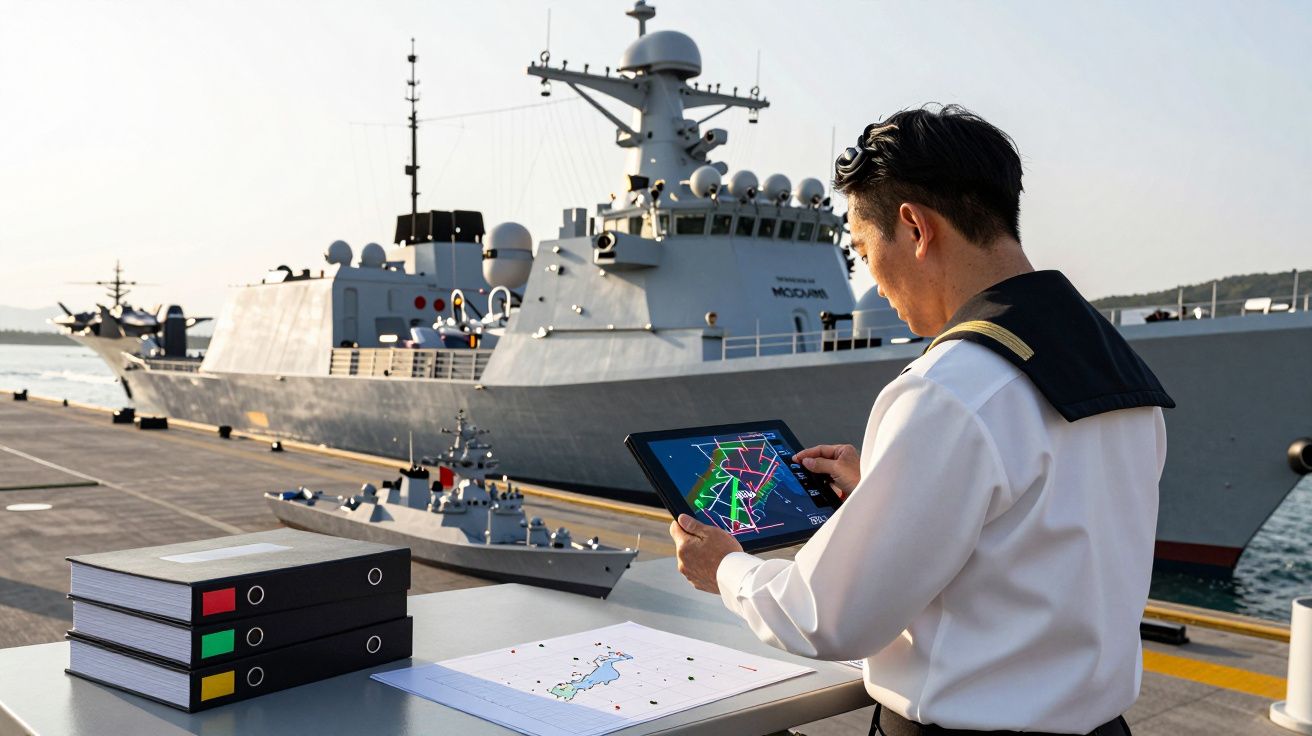
Japan is pressing ahead with a once-unthinkable military expansion, and the pace of that change may soon edge France out of the world’s top 10 defence spenders. Beneath the headline politics are the figures: bigger budgets, new hulls, dense drone networks and a blunt signal to Beijing, Pyongyang and Moscow that Japan’s post-war restraint is ebbing quickly.
Japan’s record defence budget puts France under pressure
Tokyo has lodged a request for a 2025 defence budget of about $60.2 billion (roughly €55.3 billion). For a state that for years informally held spending to around 1% of GDP while leaning on a constitution framed in pacifist terms, this is a striking shift.
France, by contrast, is estimated to spend around €56.6 billion on its armed forces in 2024. That leaves only a narrow margin between Paris and Tokyo; if Japan continues to accelerate while France increases more cautiously, the order will reverse.
Japan now sits directly behind France in the global defence spending tables - and the direction of travel currently favours Tokyo.
According to data from the Stockholm International Peace Research Institute (SIPRI), Japan ranks tenth worldwide in 2024, with France in ninth. If Japan’s 2025 request is fully approved and then sustained, the global top 10 could look noticeably different by the end of the decade.
Why Japan is rearming: three neighbours, one anxiety
Japan’s rearmament is driven by geography as much as politics. It sits in an unforgiving strategic environment alongside three nuclear-armed powers: China, North Korea and Russia.
- China is expanding its navy rapidly and has stepped up pressure around Taiwan and the East China Sea.
- North Korea continues ballistic missile testing, including launches that fly over or threaten Japanese territory.
- Russia has increased its Pacific military activity, including submarine operations near critical sea lanes.
Japanese decision-makers frame today’s spending as an effort to build a modern force that can protect long coastlines, far-flung islands and vital shipping routes - without depending exclusively on United States protection.
Japan defence budget and SHIELD: a digital wall along nearly 30,000 kilometres of coastline
A headline capability inside the spending plan is a coastal defence architecture called SHIELD (“Synchronized, Hybrid, Integrated and Enhanced Littoral Defense”). The concept is to blanket Japan’s 29,751 kilometres of coastline with layered sensors, unmanned platforms and fast-reaction weapons.
The SHIELD programme on its own is set to receive more than €800 million in 2026. It is structured around multiple tiers of drones and remotely operated systems, including:
- Strike-capable aerial drones launched from frigates
- Surveillance drones operating from ships and shore bases
- Uncrewed surface vessels (USVs) patrolling coastal waters
- A remote-controlled fleet integrated with new-generation frigates
Japan’s navy has already proven integration of the US-made V-BAT drone, manufactured by Shield AI, for future 1,900-tonne patrol ships. Tokyo intends to purchase six V-BAT systems from 2025, alongside Turkish Bayraktar TB2 drones and larger MQ-9B SeaGuardian platforms for long-range maritime surveillance.
Japan is shifting from a conventional fleet to a connected “system of systems” built around drones, sensors and data links.
Tokyo has also earmarked €15 million specifically to trial the simultaneous co-ordination of multiple drone types - a strong indicator that swarming tactics and dispersed operations are central to its future approach.
Related headlines circulating alongside the SHIELD coverage
A series of other stories has been published alongside reporting on SHIELD, including:
- Meteorologists say the jet stream will realign unusually early this February
- Inheritance: a new law arriving in February changes the rules for heirs
- One of the world’s most dependable brands has conceded that electric cars are not its ultimate long-term objective
- Specialists argue a subtle phone habit may be eroding attention without people realising
- How expectations quietly influence how tired you feel
- France rejects the US option and invests €1.1 billion in a European detection “monster” with 550-kilometre reach
- Farewell to classic high kitchen cabinets as more homes adopt a space-saving, more comfortable alternative
- Farewell to traditional hair dyes: an emerging trend claims to cover grey hair naturally while helping people look younger
New frigates, bigger missiles and Australian interest
A more heavily armed New FFM based on the Mogami class
Japan is not only buying drones; it is putting money into steel. A new multi-role frigate design known as the “New FFM”, derived from the Mogami class, will receive €713.9 million for a single ship ordered this year.
The vessel is planned with a longer hull, a larger weapons load and improved anti-submarine performance. It is expected to carry more missiles, including upgraded Type 12 land-attack and anti-ship missiles, the Type 17 anti-ship missile, and two new surface-to-air systems referred to as “NSAM” and “A-SAM”.
A pivotal change is the expansion of vertical launch system (VLS) capacity: cells are due to rise from 16 to 32. That gives each frigate far more flexibility, with additional space for air-defence, anti-ship or land-attack rounds - increasing lethality and adaptability.
This is also about influence beyond Japan’s immediate self-defence needs. Canberra has chosen this Japanese design for the Royal Australian Navy, laying foundations for deeper Tokyo–Canberra collaboration on shipbuilding and shared sustainment.
Aegis destroyers to replace the abandoned Aegis Ashore plan
Japan once intended to deploy Aegis Ashore, a land-based missile defence system, but cancelled the plan in 2020 due to safety issues and political objections. In its place, Tokyo is financing two next-generation Aegis-equipped destroyers known as ASEV, backed by a budget of around €545.5 million.
By regional standards these ships will be enormous: roughly 190 metres long, 25 metres wide and displacing more than 16,000 tonnes, making them larger than some US and Chinese surface combatants. Sea trials are anticipated from 2026, with deliveries planned for 2027 and 2028.
The destroyers will carry the AN/SPY-7(V)1 radar from Lockheed Martin, built under licence in Japan with Fujitsu. The sensor is designed to detect and track ballistic missiles and potentially hypersonic weapons, positioning Japan as a key node in any regional missile-defence architecture.
From helicopter carriers to F-35B launch pads
Japan’s two Izumo-class helicopter carriers - JS Izumo and JS Kaga - are being extensively modified to operate F-35B stealth fighters capable of short take-off and vertical landing. For 2026, the refit is costed at €195 million.
On JS Izumo, the work includes new deck lighting intended to synchronise flight-deck movements with F-35B onboard systems. JS Kaga will receive structural reinforcement within the hangar to support jets and associated support equipment.
A further €650,000 is allocated for detailed analysis of initial operations. The findings could inform debate about a future, purpose-built Japanese aircraft carrier - a move that would have been politically unimaginable a generation ago.
Submarine deterrence and long-range strike
Taigei-class submarines and hidden missiles
Submarines remain one of the least visible but most important pillars of Japan’s defence posture. In 2026, Tokyo plans to:
- Construct the 10th Taigei-class diesel-electric submarine (3,000 tonnes) for about €816 million
- Purchase long-range, submarine-launched missiles valued at €110.2 million
- Procure an enhanced version of the Type 12 surface-to-ship missile for €246.4 million
The new submarine-launched missile is designed to hit both ships and land targets from stand-off range, launched via standard torpedo tubes. Fielded on the Taigei class (with delivery due by 2027), it would give Japan a discreet deep-strike capability across the region.
Quiet additions: patrol ships, Tomahawks and hypersonic defence
Several smaller budget lines outline Japan’s longer-term trajectory. A 2026 snapshot includes:
| Project | Planned 2026 spend | Purpose |
|---|---|---|
| Two patrol ships | €195 million | 1,900-tonne vessels for maritime surveillance |
| Tomahawk integration | €11.6 million | Fitting US-made Tomahawk cruise missiles to destroyers JS Myoko and JS Atago |
| Awaji-class minesweeper | €232.8 million | Seventh ship in the class, 690 tonnes, mine countermeasures |
| GPI hypersonic interceptor | €378.6 million | Joint US–Japan programme to shoot down hypersonic missiles |
The GPI (Glide Phase Interceptor) is intended to defeat hypersonic weapons during the “glide” phase, when they move at extreme speed inside the atmosphere and can manoeuvre unpredictably. Mitsubishi Heavy Industries will contribute the second-stage motor and guidance systems, while the United States leads overall design and integration. Operational deployment is envisaged at some point in the 2030s.
Two additional pressures behind the numbers: industry and people
Beyond platforms and missiles, Japan’s build-up depends on whether it can expand the industrial base required to produce, maintain and upgrade these systems at tempo. Shipyards, electronics suppliers and munitions lines will need sustained investment, resilient supply chains and a steady flow of skilled engineers - especially if Japan aims to move from importing complex systems to co-developing them at scale.
Manpower is another constraint that budget lines do not automatically solve. More ships, drones and missile units require trained crews, maintainers and cyber specialists, and Japan must compete with an ageing population and a tight labour market. How Tokyo addresses recruitment, retention and the use of automation will shape how much of the planned capability becomes real operational power.
What this means for France and the global top 10
For years, France has remained comfortably among the world’s biggest defence spenders, underpinned by a nuclear deterrent, a blue-water navy and a strong arms-export sector. Japan, limited by constitutional interpretation and political caution, stayed a step behind.
That distance has now almost vanished, raising genuine questions about where France will sit in global rankings by the mid-2030s.
If Japan continues to increase spending and evolves from buying high-end imports to co-developing and exporting sophisticated equipment, it could put added competitive pressure on European defence industries. Japanese ship designs are already drawing overseas interest, and Japan’s strength in advanced electronics positions it as a credible contender in future missile-defence and naval programmes.
France still retains major advantages - nuclear submarines, an independent deterrent, a battle-tested carrier group and established export markets stretching from the Middle East to India. However, defence budgets in Asia are growing faster than in much of Europe, and league tables based purely on spending are likely to tilt eastwards.
Key terms and what they mean for non-specialists
What is an Aegis destroyer?
An Aegis destroyer is a warship fitted with the Aegis combat system, originally developed in the United States. It links powerful radars, missiles and computing to detect, track and intercept hostile aircraft and missiles.
Japan’s future ASEV ships are intended to function as mobile missile-defence hubs, capable of integrating with US and allied networks across the Pacific.
Why hypersonic missiles matter
Hypersonic missiles travel at least five times the speed of sound and often operate at lower altitudes than traditional ballistic missiles. They may also manoeuvre during flight, which makes detection and interception more difficult.
The GPI effort illustrates how seriously Tokyo and Washington view the threat. If a dependable interceptor is fielded, it could alter strategic calculations during any crisis involving China or North Korea.
Possible scenarios for the 2030s
If present trends persist, the early 2030s could see Japan ranking above France in global defence spending, backed by a larger force of advanced submarines, Aegis destroyers and F-35B-capable carriers. Japan would still present itself as defensive in intent, but with a much stronger capacity to respond at long range.
For Europe - and France in particular - this raises practical choices: whether to emphasise co-operation or rivalry in arms exports, how much attention to devote to the Indo-Pacific versus Europe’s own neighbourhood, and how to keep high-technology defence industries funded as domestic fiscal pressures grow.
A plausible end state is a more crowded top tier of military powers, in which mid-sized states such as France and Japan shoulder greater regional responsibilities alongside the United States and China. In that environment, a single percentage point of GDP - spent or not spent - could determine who remains in the global top 10 and who falls out.






Comments
No comments yet. Be the first to comment!
Leave a Comment