
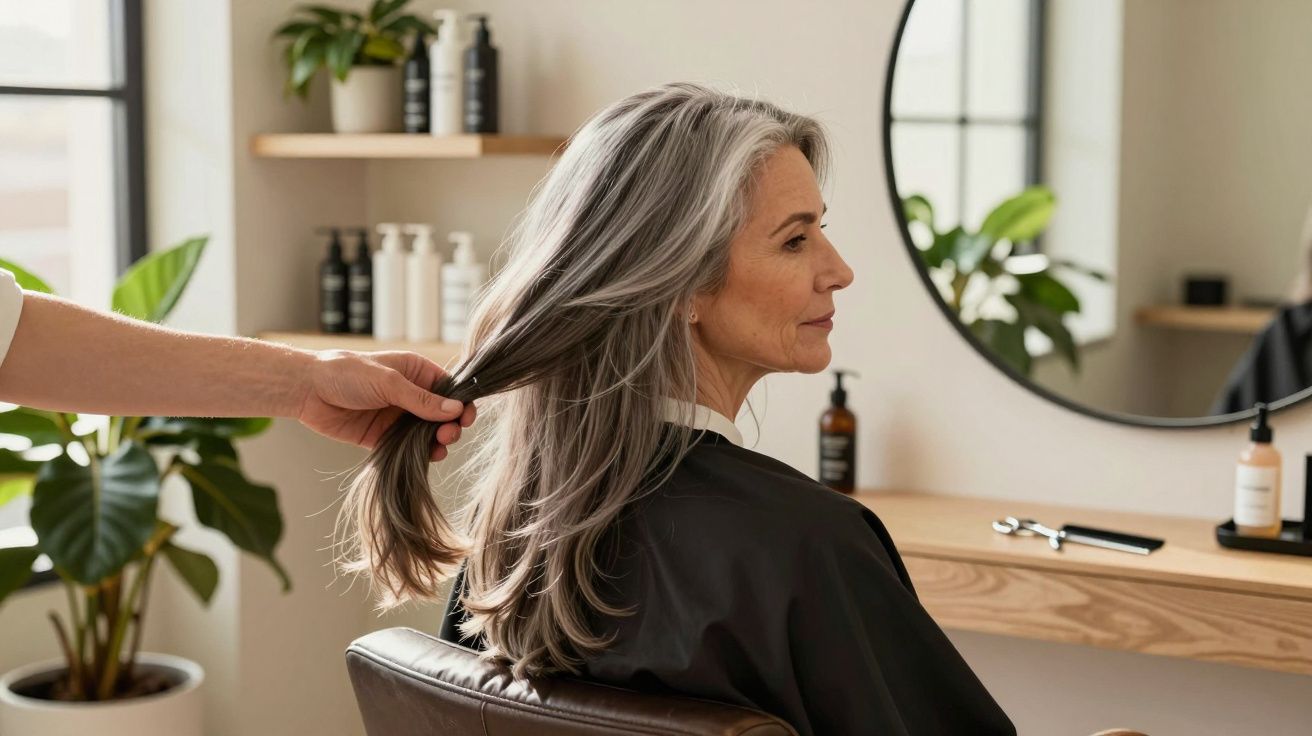
Growing out grey can feel wonderfully freeing - but there’s one particular hair length that can quietly add a decade to your look before you realise it.
As more women choose to wear their natural salt-and-pepper hair, hairdressers are flagging a surprisingly common misstep: once the grey takes over, keeping the same length and shape can work against you.
The turning point: when grey changes your whole haircut strategy
A handful of white hairs rarely demands a new haircut. You can gloss, add a few highlights and carry on as normal. The real shift tends to happen when grey becomes the dominant colour and your hair genuinely reads as salt-and-pepper.
At that point, the hair fibre often behaves differently. For some people it turns coarser and more wiry; for others it becomes softer, finer and noticeably flatter through the lengths. Frizz can creep in, shine often drops, and the contrast between roots and ends can look more pronounced than it used to.
Once hair is clearly salt-and-pepper, the wrong length doesn’t just feel dated - it can pull your whole face down.
That’s why adding more colour isn’t always the fix. How your hair is cut - and exactly where it lands on your shoulders - becomes just as tactical as the shade itself.
Salt-and-pepper hair and the “granny length” that ages you most
Hair professionals who work with grey and white hair every day repeatedly point to one choice that hardens the face: very long hair with no layers at all.
This is not about banning long hair after 50, nor is it about ageism. It’s the trio of length, weight and zero structure that causes the issue.
Why ultra-long, one-length grey hair is so unforgiving
When salt-and-pepper hair is worn very long and cut bluntly, several visual effects tend to show up:
- The overall weight drags downward, drawing attention to jowls and softer, less firm skin.
- A single heavy line across the chest or back creates a strong horizontal block that can make the neck and shoulders appear broader and heavier.
- Thinner ends stand out more, because grey hair often loses density over time.
- With no movement, the hair can hang like a “curtain”, swallowing your features rather than framing them.
Hairdressers often say the end result reads as “tired” instead of romantic or bohemian. Rather than enhancing your face, the hair dominates it.
Very long, non-layered grey hair can flatten your expression, soften your jawline and broadcast fatigue you may not even feel.
On darker hair with plenty of pigment, the same one-length cut can look sleek and pared-back. On salt-and-pepper hair, that shape tends to come across as harsher, less forgiving and noticeably old-fashioned.
Keeping your length without looking like a nan
If you want to stay long while you go grey, you don’t have to give up your length - but you do need to rethink the design.
The long cut that works with grey, not against it
Hairdressers who specialise in mature and grey hair often recommend one straightforward adjustment: soft, light layering rather than a single heavy block.
Light layers can do several jobs at once:
- Add movement to stiff, wiry or frizz-prone grey strands.
- Reduce heaviness at the ends without making them look thin.
- Be placed to draw attention to cheekbones and the jawline.
- Create the illusion of volume if your hair has become fine or flat.
Think of layers as scaffolding: they give your salt-and-pepper hair structure, lift and a fresher, more modern attitude.
Instead of ending in one blunt line, the hair falls in gentle levels - looking deliberate and current rather than “I haven’t had it cut in years”.
Why soft waves are your best ally
Texture matters just as much as length. On long salt-and-pepper hair, loose waves tend to be far more flattering than poker-straight lengths.
Soft curls or waves:
- Break up solid blocks of grey and white so the colour looks multi-dimensional, not flat.
- Create a visual lift, particularly when the wave starts around cheek level.
- Put “air” between the strands, avoiding that heavy, sheet-like effect.
- Make the overall silhouette feel lighter and more energetic.
This doesn’t mean a full blow-dry every morning. A large-barrel curling wand on a few face-framing sections, or braiding slightly damp hair overnight, is often enough to soften the shape.
Length guidelines for salt-and-pepper hair
There’s no one-size-fits-all rule, but certain length zones tend to suit salt-and-pepper hair more reliably. Use these as discussion points to take to your stylist.
| Length zone | Effect on salt-and-pepper hair |
|---|---|
| Chin-length bob | Lifts and brightens the face, sharpens the jaw; works for thick or fine hair when paired with light layers. |
| Between chin and collarbone | Often the sweet spot: long enough to feel feminine, short enough to avoid the “curtain” effect. |
| Just past the shoulders | Still very wearable if you add layers and movement, especially around the face. |
| Mid-back and longer | Higher risk of an ageing effect if worn blunt and straight; needs shaping, texture and regular trims. |
How ageing changes hair - and why your old cut stops working
One reason going grey can feel frustrating is simple: the cut that flattered you as a brunette or blonde at 30 may not translate to your salt-and-pepper texture at 55 or 60.
Several shifts tend to happen at once:
- Texture shift: Grey fibres often feel different - sometimes more wiry, sometimes softer and more fragile.
- Density loss: Many people gradually lose volume, particularly at the crown and through the temples.
- Scalp visibility: Lighter roots around the parting can make flat hair look more see-through.
- Face shape evolution: As skin loses firmness, the haircut often needs to create lift and framing more deliberately than before.
When your hair and face change, the purpose of your cut changes too - from a pure style statement to quiet architecture around your features.
A long, heavy curtain ignores these new needs. A shaped, layered cut works with them.
Practical scenarios: what to ask your hairdresser
Picture this: you’ve got long, blunt salt-and-pepper hair reaching mid-back. You feel it’s ageing you, but you’re not ready for a dramatic bob. A useful, realistic conversation with your hairdresser might include:
- Taking the length up to just past the shoulders as a first step.
- Adding soft, long layers that begin around the cheekbones.
- Keeping the front slightly shorter than the back to create lift.
- Trying a loose curtain fringe to break up the forehead, if it suits your features.
For someone with fine, flat salt-and-pepper hair, the brief may be different:
- Choosing a collarbone-length (or slightly shorter) cut to avoid stringy ends.
- Asking for minimal, carefully placed layers so you don’t lose too much density.
- Requesting styling guidance for gentle root lift without aggressive backcombing.
Key terms and what they really mean at the salon
Salon wording can be baffling - especially when you start talking about layers. Here’s what hairdressers usually mean:
- “Long layers”: Layers that begin lower down (often below the cheekbones), keeping the top fuller while the bottom gains movement.
- “Soft graduation”: A subtle progression in length that shapes the neck and jaw without obvious “steps”.
- “Texturising”: Methods such as point cutting or slide cutting to remove bulk and reduce frizz; on delicate grey hair, this needs a light touch to prevent fuzziness.
When you’re in the chair, photos of women with salt-and-pepper hair that’s similar to your own in length and thickness are usually more helpful than describing a vague end result.
Two extra details that make long grey hair look intentional
Regular maintenance matters more with salt-and-pepper hair than many people expect. If you’re keeping it long, aim for trims often enough to stop ends looking wispy and uneven - otherwise the length can quickly drift back into that “uncut” look, even if the colour is beautiful.
It can also help to plan your parting and face-framing with purpose. A slightly off-centre parting, a touch of lift at the crown, or a subtle face-frame can stop grey hair from sitting too flat against the scalp - which is especially useful when lighter roots make sparse areas more noticeable.
Beyond the cut: small habits that change the result
Even the best length can fall flat if the hair looks dull or uncared-for. Grey and white strands often need more hydration and more shine support than pigmented hair.
A gentle routine using nourishing masks, heat protection and occasional glossing treatments helps the hair reflect light. On a layered cut, that shine highlights movement and makes the salt-and-pepper blend look chic and intentional rather than faded.
The right length, plus structure, plus care: that trio keeps salt-and-pepper hair looking like a choice - not an afterthought.





Comments
No comments yet. Be the first to comment!
Leave a Comment