
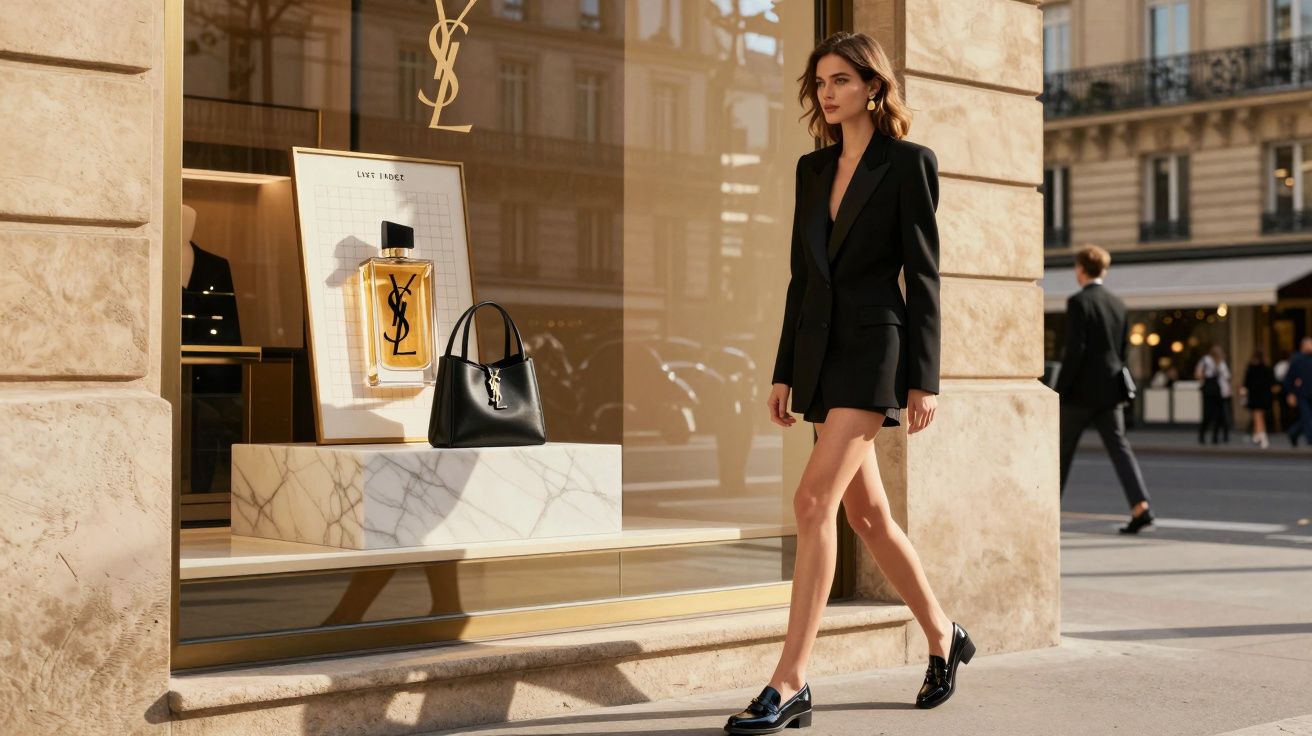
The French fashion house proves, with real finesse, that a clear, consistent artistic direction can outdo any marketing campaign.
The post-COVID luxury boom is cooling: growth is slowing and demand is easing, exposing fatigue in parts of the sector (LVMH, for instance). In a slightly turbulent economic climate, a handful of maisons are still managing to stand out-and Yves Saint Laurent is one of them. The latest Lyst Index ranks Yves Saint Laurent as the most searched-for brand, elevating the French house to the top of the global luxury hierarchy for the first time. Built on the purchasing and search behaviour of 160 million users, the report acts as a reliable barometer of what shoppers are actively seeking.
Yves Saint Laurent (YSL): Quiet confidence
Founded in 1961, YSL built its reputation on a distinctive tension between transgression and classicism-a duality that remains uniquely its own and continues to appeal, now functioning as a powerful point of differentiation. If you had to compare the house to a tech company, it would be Apple: a brand known for setting its own standards and aesthetic codes rather than following the crowd.
Anthony Vaccarello’s Yves Saint Laurent (YSL) codes, recognised by the Lyst Index
Since taking the helm in 2016, Anthony Vaccarello has translated Yves’s legacy into an unmistakably codified visual language that runs through almost everything the house produces: razor-sharp silhouettes, black tailoring, rigid leathers, and sunglasses defined by a singular geometry. It is a look that is instantly recognisable, and the Lyst Index explicitly praised that kind of discipline this year, noting that the maisons pulling ahead are those with “a clear creative direction and consistent execution”.
Le Loafer and intentional shopping: why YSL is winning now
Among the hero pieces that embody this aesthetic, Le Loafer-a signature autumnal style-has climbed into the list of the most searched luxury items worldwide. Emma McFerran, Chief Executive Officer of Lyst, explains that “customers now shop with intention, prioritise versatile pieces that carry across seasons, and gravitate towards brands with strong identities.” That description aligns precisely with Yves Saint Laurent’s marketing strategy: assert a strong identity without trying to reinvent it every year.
A heritage-like pace in a saturated market
Today’s market is crowded with fleeting collections and fast fashion, and YSL refuses to play by those frantic cycles, positioning itself as an almost heritage-like brand that never rushes. Without resorting to escalation or a “more and more” mentality, the Parisian house is managing to maintain its authority. “Fashion fans value a clear, consistent vision, expressed through a strong, recognisable product,” summarises Katy Lubin, Vice President of Communications at Lyst.
By choosing not to scatter its identity the way others often do-Balenciaga, Versace, Gucci, Prada, and others-Yves Saint Laurent appears to have found the right formula: fewer swings, more coherence, and a product-led proposition that stays legible from season to season.
One additional factor reinforcing that coherence is how the house turns its visual codes into a full experience: from runway to retail to digital. When the silhouettes, materials, and accessories speak the same design language, shoppers encounter fewer mixed signals-and the brand becomes easier to recognise, remember, and search for.
That clarity also suits a UK audience increasingly focused on cost-per-wear and long-term use. In a period where discretionary spending is scrutinised more closely, pieces that feel enduring-rather than tied to a short-lived micro-trend-fit the demand for practicality without sacrificing the edge and glamour that define Yves Saint Laurent.






Comments
No comments yet. Be the first to comment!
Leave a Comment