
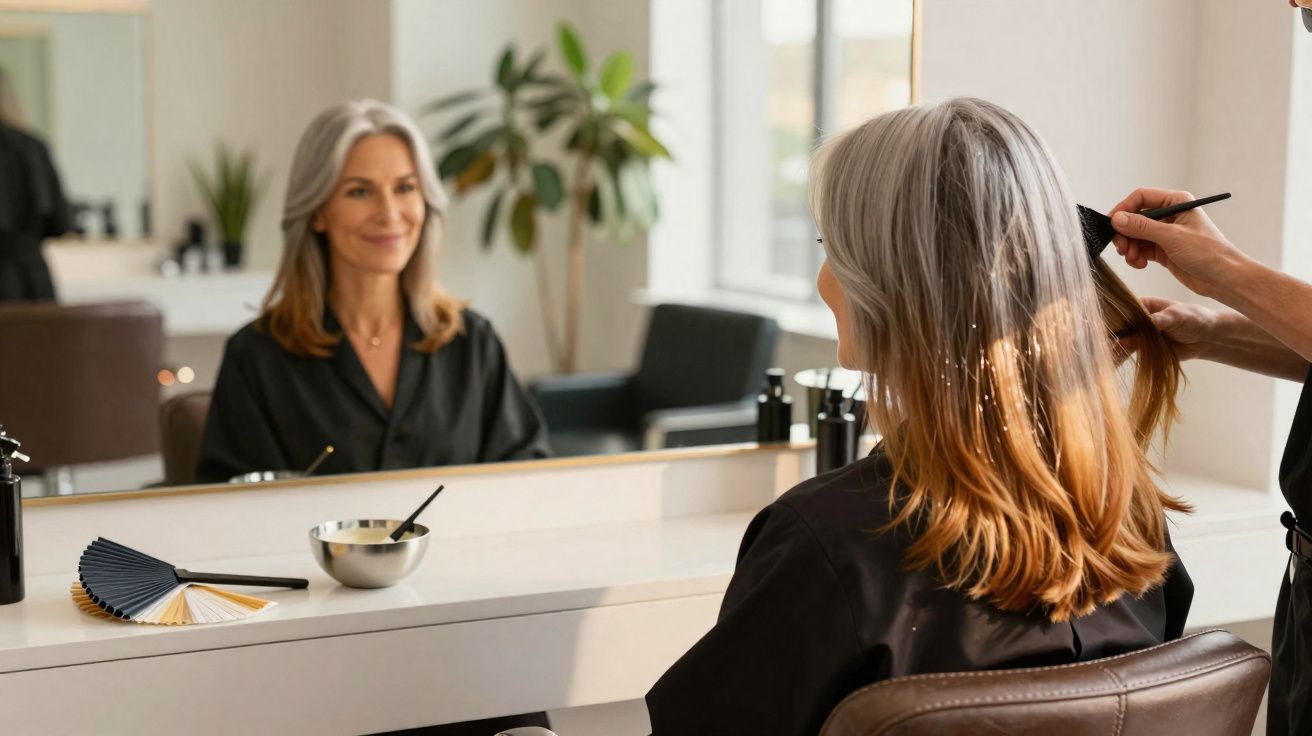
Grey hair no longer has to mean an endless cycle of root touch-ups.
A low-key colouring technique is changing the way stylists approach ageing hair.
For years, managing grey strands meant strong dyes, obvious colour bands and relentless salon appointments. Increasingly, colourists are choosing gentler, more considered methods that blend with greys rather than trying to obliterate them.
The quiet revolution against visible grey hair
Across much of the Western world, spotting the first silver strand can feel less like a sign of experience and more like a challenge to youth. That pressure nudges people in their 30s, 40s and 50s towards quick fixes-often repeating intense colouring routines that can weaken hair and drain budgets.
Classic full-head colour delivers an even, single shade, but it comes with a predictable drawback. As hair grows, the difference between dyed lengths and naturally greying roots becomes stark. That hard “line of demarcation” pushes many people back into the salon every 4–6 weeks.
Highlights and balayage were meant to soften that contrast. By weaving lighter pieces through the hair, stylists could disguise greys within a more dimensional finish. But even balayage-once treated like the universal solution-can struggle when white hairs become more widespread rather than staying around the temples.
Relying only on traditional highlights or balayage often falls short once grey spreads throughout the head, not just at the sides.
As hair matures, its feel and behaviour change as well. It can become drier, more porous and less predictable when colouring. Stronger colour may lift and cover, but it can also leave hair feeling rough and fragile. Many clients now want a way to downplay grey that doesn’t punish the hair fibre or create that unmistakable “freshly dyed helmet” look.
Colour melting for grey hair: what “melting” really means (and why stylists love it)
A newer salon approach-known as melting or colour melt-is increasingly viewed as the next step beyond balayage. It isn’t selling the fantasy of turning back time. Instead, it focuses on subtlety: soft tones, blurred boundaries and regrowth that’s far less noticeable.
From harsh contrasts to seamless transitions
With colour melting, the colourist uses multiple closely related shades rather than relying on one flat tone. These colours are placed so the eye can’t easily identify where one ends and the next begins. Roots, mid-lengths and ends flow into each other instead of forming distinct stripes.
Colour melting is designed to create such a smooth gradient that the boundary between natural colour and dye is barely detectable to anyone casually looking.
Rather than bold, bright streaks, a stylist typically selects two to four shades near your natural level: one slightly deeper, one that matches closely, and one or two slightly lighter. Applied in ultra-fine sections and softened through the hair, the result resembles a natural sun fade-not an obvious salon colour.
How colour melting differs from balayage
| Technique | Visual effect | Regrowth management | Best for |
|---|---|---|---|
| Balayage | Noticeable lighter panels and streaks | Contrast can become obvious as roots grey | Adding dimension by lightening mid-lengths and ends |
| Colour melting | A soft gradient with minimal visible lines | Grey regrowth disperses into the blend | Blending grey hair while maintaining a natural-looking base |
Balayage still works brilliantly for higher-contrast lightening and that beachy, brighter finish. However, if grey is now showing through the crown and hairline, colour melting can soften the “line of demarcation” and often extends the time between appointments by several weeks.
How melting blends grey without masking who you are
Melting isn’t simply about covering grey hair. It’s about changing how it reads. Your natural base remains present, while the eye is drawn to a veil of closely matched, harmonious tones.
What typically happens in the salon
Every colourist has their own method, but the appointment often follows a familiar structure:
- Consultation: your colourist checks how much grey you have, where it’s concentrated, and what your natural undertones are.
- Tone mapping: they choose a small “family” of shades near your base-some warmer, some cooler, some slightly lighter.
- Application: colour is placed in extremely fine sections (often on a diagonal) to prevent strong lines as the hair moves.
- Blending: the joins between shades are softened using a brush, comb, and sometimes fingertips, so the colours merge gently.
- Gloss: a semi-permanent glaze is applied to boost shine and adjust tone (reducing excessive warmth or dull ashiness).
The biggest change is the goal. Instead of chasing one “perfect” all-over shade, the stylist builds movement and depth. Grey strands become part of that gradient, reading as light-catching highlights rather than unwanted interruptions.
Why upkeep is usually simpler
Because colour melting works with your natural root rather than against it, regrowth looks far less abrupt. As new silver hairs appear, they blend into an already varied mix of tones. For many people, this means returning every 8–12 weeks rather than every month.
For many clients, melting changes the emotional rhythm of ageing hair: fewer mirror panics, and fewer “emergency” appointments.
This approach also fits well with softer colour choices. Many colourists opt for demi-permanent formulas that fade gradually instead of leaving a sharp edge. For hair that’s already more delicate due to age, hormones or frequent heat styling, that gentler chemistry can make a noticeable difference.
Who benefits most from colour melting?
Colour melting can work across a wide range of natural shades, from deep brunette through to pale blonde. The main common factor isn’t the starting colour-it’s the preference: looking well-groomed and elevated, not completely “changed”.
People who often get the best results
This technique is frequently a strong match for:
- Those with roughly 20–70% grey who still want to keep their natural base colour.
- Anyone worn down by block colour and sharp root contrast.
- Professionals who need a polished appearance but can’t commit to monthly touch-ups.
- People with curly or textured hair, where chunky highlights may appear uneven.
- Clients growing out years of heavy balayage who now want something subtler and more refined.
Shade choices vary by hair colour. On very dark hair, a colourist might melt between deep chocolate, softer mocha and understated caramel. For blondes, the blend might shift from a deeper beige at the root to a creamy finish on the ends. Redheads can benefit as well, using copper, strawberry and golden tones to draw attention away from white regrowth.
Limits, risks and what to ask your stylist about colour melting
Colour melting isn’t a miracle that removes grey hair overnight. It still involves colour, time and technical skill. Done poorly, it can look dull, overly brown (“muddy”), or leave patchy bands. The final result depends heavily on the colourist’s precision and confidence with micro-blending.
Before you book in, it helps to ask direct questions:
- Which products are you using-permanent, demi-permanent, or a combination?
- How many shades will you use in the melt, and how close will they be to my natural base?
- How often should I realistically return for maintenance?
- What home routine will keep the blend glossy and the tone balanced?
This trend is all about subtlety, so the real decision isn’t “colour or not”, but “how many tones-and how softly do they meet?”
Cost is another practical factor. The first appointment can take longer than a straightforward root refresh, so it may be more expensive upfront. However, because the regrowth is softer, the longer gap between visits can balance out spend across the following months.
Between appointments: aftercare that helps grey hair behave better
Colour technique is only part of the picture. How grey hair looks and feels is also influenced by lifestyle and routine. UV exposure can speed up yellowing and dryness in grey strands. Hot tools can snap and roughen hair that’s already more fragile. Stress levels and certain medications may also play a role in how quickly pigment changes.
Many people who choose melting also adjust their haircare: richer hydration masks, UV-protectant sprays, gentler shampoos and less daily heat. Those habits help the blend look more expensive and keep the natural grey that peeks through looking softer and more reflective.
The “natural, but better” approach keeps winning
The popularity of colour melting reflects a broader shift in beauty standards. Some people feel happiest going fully grey. Others find an abrupt return to natural feels too stark. Colour melting sits in the middle, offering a practical compromise.
Rather than pretending age doesn’t exist, it works with it-softening, blending and reframing grey hair instead of denying it. For a growing number of clients, that balance of authenticity and enhancement feels far more liveable than the old pursuit of one solid, unchanging shade.





Comments
No comments yet. Be the first to comment!
Leave a Comment