
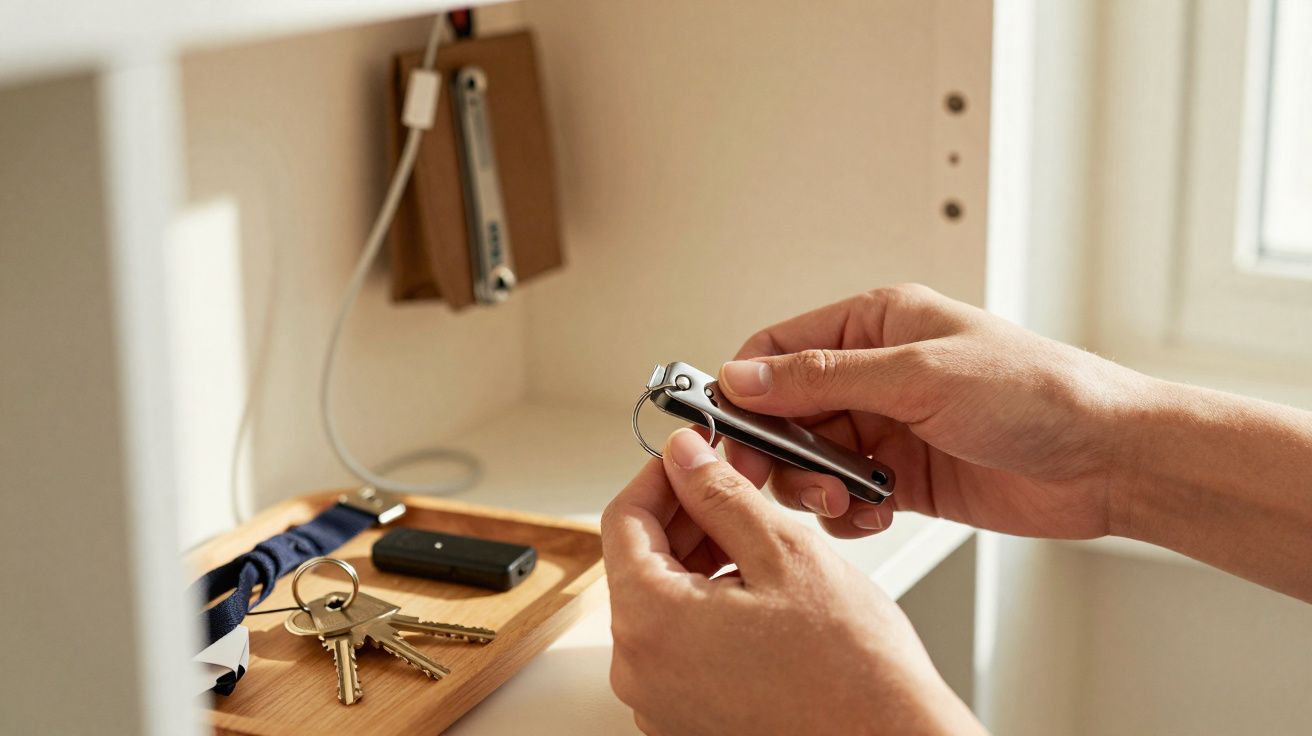
Look a little more carefully at a standard nail clipper and you’ll notice a tiny feature that’s usually ignored: a small round hole at one end of the tool. It can seem purely decorative-almost like a manufacturing oddity. In reality, that opening is genuinely useful, helping to make the clipper safer to keep, easier to carry and much harder to misplace.
The tiny hole most people never question
If you pick up the nail clipper from your bathroom shelf, bedside drawer or key tray, chances are you’ll find the same detail: a neat perforation in the lever arm or one of the jaws. Plenty of people assume it’s just there for appearance, or perhaps to shave off a sliver of metal.
That small hole is primarily a mounting point, turning a humble nail clipper into a portable, hangable, multi‑purpose tool.
Manufacturers include the hole so the clipper can be attached to a keyring, lanyard, chain or simple metal loop. Once it’s fixed in place, it stops clattering loose inside handbags, backpacks or wash bags. For frequent travellers, parents, or anyone who’s tired of digging through clutter, this tiny design choice can completely change how (and where) the clipper gets used.
Keeping nail clippers where you can actually find them
Nail clippers are compact, weighty and strangely talented at disappearing into the depths of a home. The built‑in hole gives you several straightforward ways to prevent that.
Smart ways to use the hole for storage
Rather than letting your clipper drift from room to room, you can give it a dedicated “parking spot”. With the hole, it’s simple to:
- clip it to your main keyring, so it’s always with you
- hang it on a hook in the bathroom or inside a medicine cabinet
- attach it to the zip pull of a toiletry bag for travel
- keep it on a small carabiner with other grooming tools
Kept on a visible hook or keyring, a nail clipper turns from a “where did I leave it?” object into a reliable, always‑ready tool.
This approach is particularly effective in shared flats or busy family homes, where clippers tend to “wander” between bathrooms and bedrooms-or disappear into a teenager’s room. A fixed hanging point makes it obvious where the tool belongs when you’ve finished with it.
On‑the‑go grooming without rummaging
Clipping a nail clipper to keys or a travel pouch isn’t only about tidiness. It can also improve hygiene and day‑to‑day convenience. A clipper that rolls around at the bottom of a handbag can collect dust, crumbs and cosmetic residue. When it’s secured to a ring or strap, it stays more exposed to air and is quicker to wipe clean.
For people who travel often or work long shifts, being able to deal with a snagged nail in seconds-without emptying a whole bag-can stop a minor catch turning into a painful tear or even an infection.
An extra practical benefit: easier handling
Another advantage of using the hole is grip and accessibility. If you attach the nail clipper to a short lanyard or loop, it becomes easier to hold and retrieve-particularly for anyone with reduced dexterity, arthritis, or limited hand strength. The tool is less likely to slip from your fingers, and far easier to locate quickly.
The “hidden” hardware trick: bending cables and wires
There’s a second, less obvious job for that hole that has nothing to do with nail care. Because it’s a small, round opening set in strong metal, it can act as a basic bending guide for thin wires and cables.
If you feed a fine electrical wire, jewellery wire or similar material through the hole and gently rotate the body of the clipper, you can form a smoother, more controlled curve rather than a sharp kink. The metal edge supports the bend and helps distribute force more evenly.
Used gently, a nail clipper can produce smoother bends in thin wire than fingers alone, especially when you lack professional tools.
This can come in handy for occasional household tasks: reshaping a wire hook, guiding a thin cable during a DIY fix, or adjusting a small metal tag. It’s not a substitute for proper pliers, and it must never be used on thick or live electrical cables-but for light jobs it can be surprisingly useful.
Where that trick has limits
The steel in a nail clipper is made to cut keratin cleanly, not to tolerate heavy loads from metalwork. Forcing thick or hard wire through the hole can damage the clipper, dull the cutting edges or even bend the arm out of alignment.
A simple rule of thumb:
| Material | Use with clipper hole? |
|---|---|
| Thin jewellery wire | Generally fine, with gentle pressure |
| Soft electronics leads (non‑live) | Possible, but avoid crushing insulation |
| Thick steel wire or coat hangers | Best avoided - use proper pliers |
| Live electrical cables | Never - serious safety risk |
More built‑in functions than you’d expect in a nail clipper
Once you start examining nail clippers closely, you’ll often notice features beyond the hole. The most familiar extra is a folding nail file, usually fitted along the side of the lever. It’s useful for smoothing sharp edges after clipping, or for dealing with a small snag when you’re away from home.
Some designs also include a small metal pick or a spatula‑like tip. That single piece of metal is commonly used to:
- clean dirt from under fingernails
- gently push back soft cuticle tissue
- open envelopes or stubborn plastic seals
- turn or tighten tiny screws on glasses or small gadgets
In a pinch, people may also use that tip for light cable stripping or cracking soft nutshells, although doing so increases the chance of bending or blunting the tool. Overall, what looks like a simple nail cutter often functions as a compact multi‑tool.
Why proper use of a nail clipper matters for health
The nail clipper in something close to today’s form dates back to the late 19th century. It was created to trim nails more accurately than knives or scissors, which frequently left uneven edges and rough, jagged shapes.
Correct clipping technique lowers the chance of ingrown nails, painful tears and long‑term deformation of fingers and toes.
Specialists typically advise shaping fingernails with a rounded or gently curved cut that follows the natural line of the nail. For toenails, many podiatrists recommend a straighter cut, with the corners softened slightly, to reduce the risk of the nail growing into the surrounding skin.
What research says about decorated and stressed nails
Recent scientific research has explored how nails respond to decorative treatments and chemical exposure. A study published in Physical Biology examined how coatings, extensions and aggressive shaping influence the forces inside the nail plate.
The researchers cautioned that harsh chemicals and extreme shapes can weaken nail structure and, over time, affect the health of hands and feet. They advised avoiding very sharp or exaggerated edges, suggesting straight or parabolic (gently curved) cuts instead.
The study also noted that when the balance between growth forces and how the nail adheres to the nail bed is disrupted, residual stresses can accumulate. These stresses may change over time and contribute to splitting, deformation or painful problems such as ingrown nails.
Using a clipper or nipper that allows clean, controlled shaping helps minimise these hidden stresses compared with tearing or biting nails, or using dull blades that crush rather than slice.
Practical scenarios: using the nail clipper hole to build better habits
Thinking of the small hole as an intentional design feature-rather than a quirk-can encourage more consistent nail‑care routines.
One straightforward example: a family fits a small hook inside the bathroom cabinet specifically for the nail clipper, which is attached via its hole to a ring. Weekly nail checks become part of a Sunday evening habit. Because the clipper is always visible and always in the same place, nobody has to ask where it’s gone, and nails are trimmed before they split or catch.
Another scenario: a frequent business traveller clips a lightweight nail clipper onto a toiletry bag zip. The same tool moves from hotel to hotel, reducing the temptation to bite off a broken nail when it happens during a meeting or mid‑flight.
Risks, hygiene and small details that matter
Using the hole to keep the clipper somewhere visible can make cleaning more likely. A tool forgotten at the bottom of a drawer rarely gets wiped; one hanging at eye level is easier to check for rust, grime or nail dust.
Routine disinfection with a little alcohol or hot soapy water-followed by thorough drying-helps limit the spread of fungi and bacteria, especially if several people share the same clipper. Another commonly missed step is sharpening or replacing a worn clipper: a blunt edge crushes the nail, leaving rough surfaces where microbes can cling and where stresses concentrate.
Seen in that light, the tiny hole is more than a convenience. Used properly, it supports better storage, cleaner tools, tidier nails and fewer avoidable problems-proof that a barely noticeable detail can hold together a surprising amount of everyday care.

Comments
No comments yet. Be the first to comment!
Leave a Comment