
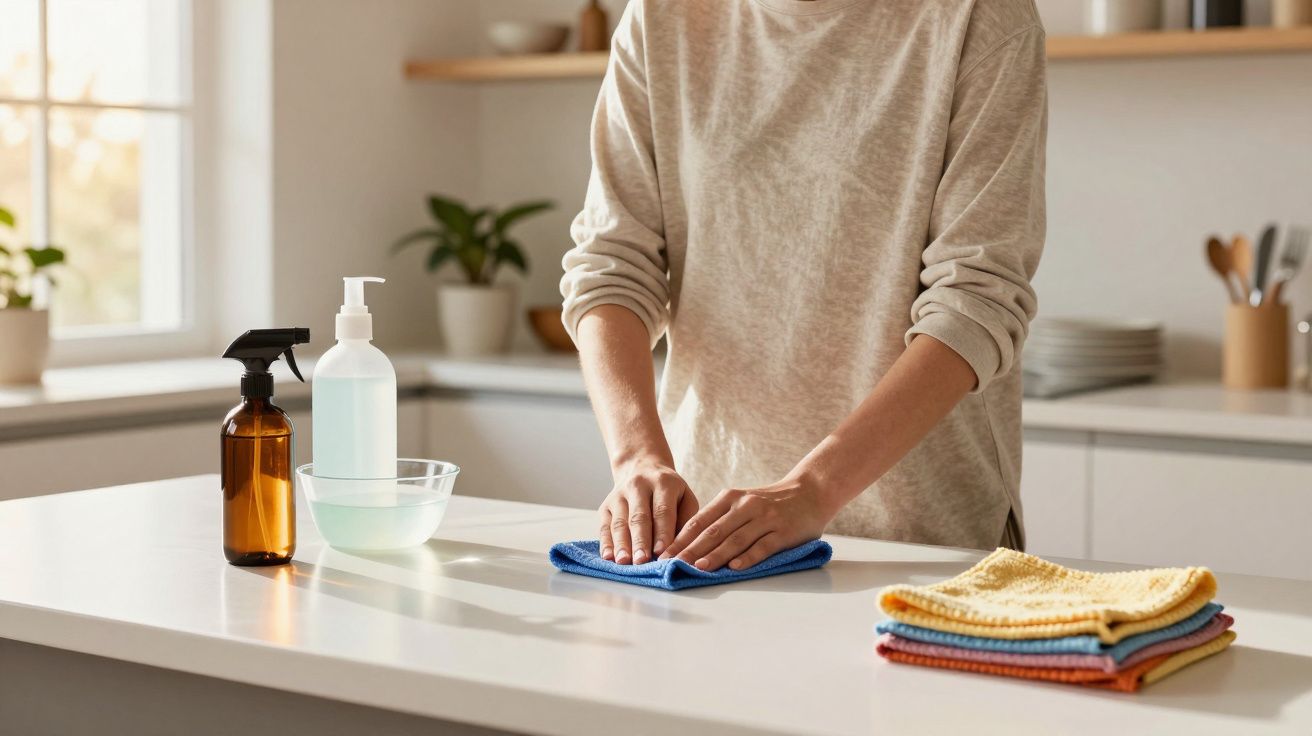
The scent arrives before anything looks different: lemon, pine, artificial orange blossom - a full chorus of “fresh” trying to mask yesterday’s pasta and the dog’s damp pawprints. You pump the trigger again and again; the bottle clacks, and the mist settles not only on the worktop but also on your hands, your sleeves, and even the cat if he’s foolish enough to wander through.
A few minutes on, the surface feels tacky, your throat is a bit tight, and you’re left wondering whether the kitchen is actually cleaner at all - or merely more reflective.
Most of us recognise that moment: standing in our own home and suddenly feeling as though we’re running a miniature chemistry lab.
There is a calmer way to do it. Oddly, it begins by using less.
The over-cleaning trap in household cleaning products most of us fell into
Stroll along a supermarket aisle and the instruction is unmistakable: more foam, more fragrance, more “power”. Extra-strong degreaser. Ultra disinfectant. Triple-action bathroom gel that sounds as though it could lift paint if it fancied. You reach for the largest bottle - the one boasting it will “kill 99.9%” of something you can’t even see.
At home, the thinking continues in the same direction: extra product, extra passes, extra elbow grease. The sink gets hit with three different sprays. The floor gets a capful, then another, “just to be sure”. It feels like the responsible, grown-up thing to do.
Then the headaches and streaks tell you something else is going on.
A cleaning coach once told me about a client who poured half a bottle of floor cleaner into a two-room flat. She was delighted with herself. “It smells like a hotel lobby for days,” she said. The coach glanced at the cloudy tiles and the oily-looking shine and asked, gently, how often she found herself cleaning again.
“Every two days,” the woman confessed. “It never feels properly clean.”
She’s far from the only one. Some European consumer tests have suggested that, on average, people use roughly two to four times the dose recommended on cleaning-product labels. It isn’t usually because they can’t read the instructions - it’s because, somewhere along the line, we started acting as though dirt responds to enthusiasm.
Here is the straightforward reality: dirt doesn’t care how enthusiastic you are. What matters is contact time, the correct dilution, and a little mechanical action. That’s the list - not the volume of blue liquid you tip over it.
When you swamp a surface with product, a few predictable problems follow. The cleaner doesn’t rinse away well, leaving a film that grabs dust and grime more quickly. Indoor air ends up loaded with volatile compounds that can aggravate lungs and skin. And your money disappears at a pace that would impress even your bank manager.
The odd thing is how instinctive the “more = cleaner” belief feels, so we rarely stop to challenge it.
The “less product, more method” way to clean
Here’s the approach professional cleaners rely on without much fuss: dilute properly, apply once, give it time to work, then wipe thoroughly. That’s it.
Start with a bucket of warm water and the exact amount stated on the label. If it says one capful, use one capful - not three “for safety”. With sprays, aim for a light mist so the area is evenly damp rather than dripping. Then step away for a minute or two and let the chemistry do its job.
Return with a clean microfibre cloth folded into quarters. Wipe using overlapping strokes, turning to a fresh section as soon as the cloth starts to pick up grime. Clean side, clean pass. This one habit often improves results far more than doubling or tripling the product.
At first, this “less but correct” approach can feel wrong. You may hover over the sink thinking, “Surely that tiny squirt can’t be enough,” and feel tempted to add more - the way people instinctively keep salting pasta water.
But most modern cleaners are concentrates designed to work at a specific dilution. Push beyond it and you’re not making them stronger; you’re creating a different mixture the manufacturer hasn’t tested. That’s when streaks show up, floors start feeling sticky, and shower tiles can turn dull or cloudy.
If you’ve been overusing products for years, the first few cleans with less can feel like a reset. The glossy coating fades. The fragrance becomes gentler. Your head feels clearer. And cleaning stops resembling a low-level chemical hangover.
“When I halved the amount I used and spent more time rinsing, my bathroom stayed clean for longer,” one reader told me. “Before that, I was scrubbing away soap scum that was basically residue from my own cleaning products.”
Practical examples:
- Kitchen worktops
Use a single light spray per section, spread with a damp cloth, leave for 60 seconds, then buff dry using a clean part of the cloth. - Floors
Measure the dose on the back of the bottle into a full bucket of warm water. Mop with a well-wrung mop, and every few cleans do one pass with plain water. - Bathroom surfaces
Spray, leave for 2–3 minutes, then wipe with a microfibre cloth. For limescale, repeat the same cycle rather than flooding the area with extra product. - Glass and mirrors
A barely damp cloth followed by a dry cloth typically beats using half a bottle of glass cleaner. Two passes, small circular movements. - Laundry
Stick to the lower end of the detergent dosing range unless clothes are genuinely filthy. Modern machines need water and space, not towering suds.
A helpful addition to the routine is ventilation. If you’re spraying anything, crack a window or run the extractor fan for a few minutes; “less product, more method” works best when you also avoid trapping vapours indoors. And if you share your home with children, pets, or anyone with asthma, choosing lower-fragrance options can make the benefits of “using less” even more noticeable.
It’s also worth treating measuring as part of the method, not a nuisance. Keep a small measuring cup or use the product cap consistently, and store concentrates securely. Accurate dosing reduces residue on surfaces and makes it easier to spot what’s actually working - rather than masking problems with more fragrance.
Living lighter with “just enough clean”
Once you switch to this “less, but intentional” style of cleaning, a second change tends to happen in the background. Your home stops smelling like a perfume aisle and starts smelling like… nothing much. Simply air. Cupboards free up where bulky plastic jugs used to sit. Your shopping list shortens.
You may also notice fewer minor irritations: skin that protests less after cleaning the shower, a partner who coughs less when you mop, a dog that stops skidding across a product film on the kitchen tiles. Small details, but together they make a home feel less harsh and more liveable.
This isn’t about becoming the person who decants everything into glass bottles and makes detergent from scratch - realistically, almost nobody does that every single day. It’s about taking one part of your routine and asking a simple question: if I used half as much, could I clean twice as well by changing the method rather than increasing the dose?
Often, the answer is yes. And once you see the difference on worktops and floors, you start noticing the same principle elsewhere too: in how many clothes you keep, how many apps you carry, and how much noise you tolerate in your head at the end of a long day. Less isn’t a fashion - it’s a skill we’ve allowed to go rusty.
| Key point | Detail | Value for the reader |
|---|---|---|
| Use correct dilution | Use the recommended dose on the product rather than adding extra “by eye” | Cleaner surfaces, fewer streaks, and products that last longer |
| Let products sit | Allow sprays 1–3 minutes of contact time before wiping | Less scrubbing effort and better hygiene with less product |
| Rinse and wipe properly | Use clean microfibres, turn to fresh sides, and do occasional plain-water rinses | Removes residue that attracts new dirt and helps improve indoor air |
FAQ
- Question 1 Is it risky for my health if I stop over-disinfecting everything?
- Question 2 How can I tell whether I’m using too much product on my floors?
- Question 3 Can I combine different cleaning products to “increase” their strength?
- Question 4 Is using less product genuinely better for allergies and sensitive skin?
- Question 5 What is one small change I can try this week to test this method?





Comments
No comments yet. Be the first to comment!
Leave a Comment