
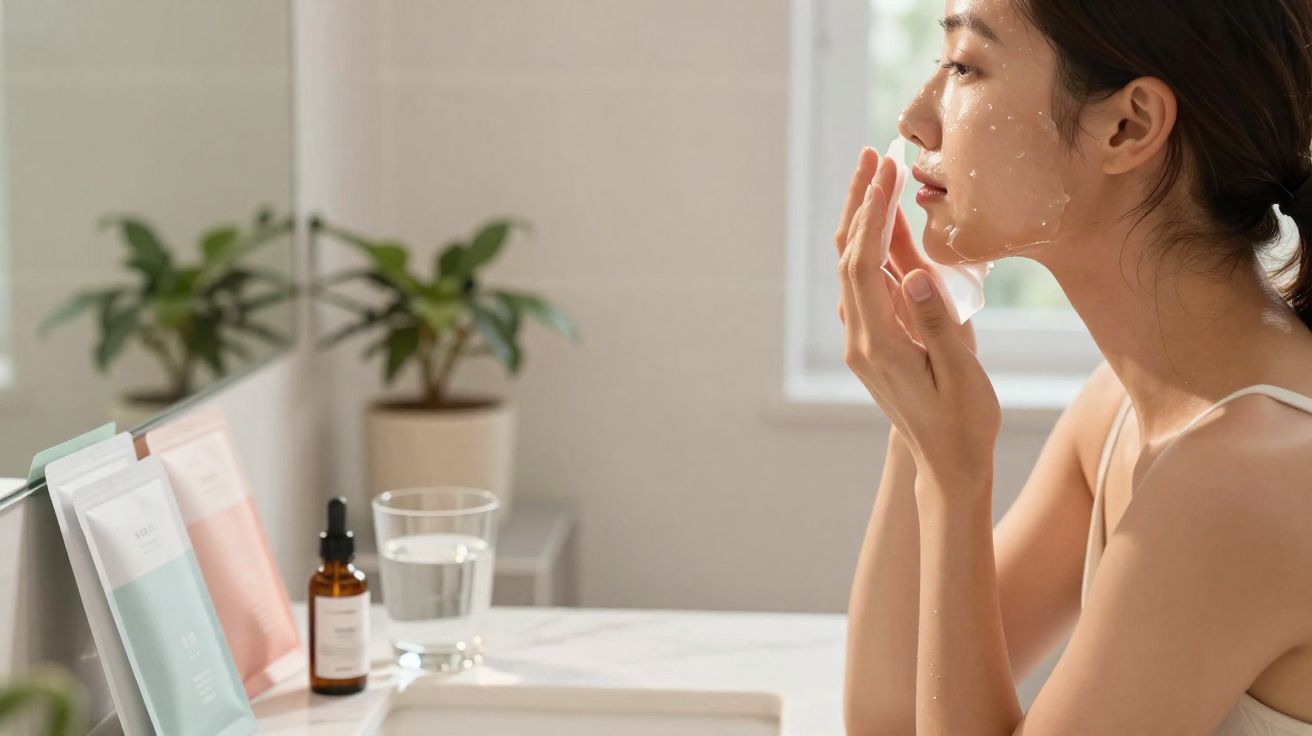
Less dullness in your complexion, a calmer look in the mirror, and skin that feels measurably plumper: that’s the promise.
The craze started in Korea, arrives in surprisingly plain packaging, and costs roughly the same as a coffee with oat milk and a tip. The visible “after” is driven by a potent antioxidant blend plus a smart film technology approach that doesn’t just sit on top of the skin - it helps keep the actives where they’re meant to do their job.
What’s really behind the “£10 (about €11) per use” hype
The product is called the House of B Glutathione Face Film Set. It’s designed as a two-step routine: first a concentrated Synergy Ampoule, then an ultra-thin Face Film that seals everything in. Users often describe near-immediate pay-off - more radiance, pores that look smoother, and redness that appears calmer by the next morning.
Key facts at a glance
- Price per use: about £10 (approx. €11)
- Two steps: Synergy Ampoule + Face Film
- Processing time: 60–180 minutes
- Aim: a more even complexion, glow, and long-lasting hydration
According to the brand, the formula uses 99% high-purity glutathione. In K-beauty circles, this molecule is a go-to for brightening support, shielding against oxidative stress, and helping the skin look more settled overall. The treatment is aimed at anyone chasing the glass skin effect: refined-looking pores, a reflective freshness, and fewer grey, tired shadows.
Glutathione in K-beauty: the quieter star ingredient
Glutathione is an antioxidant produced naturally in the body. Applied topically, it’s commonly used to help neutralise free radicals and to support a more balanced-looking skin tone by influencing how pigmentation presents on the surface. Study results and effective concentrations differ between products, but in everyday use many people report clearer-looking skin after several weeks of consistent application. Paired with hydrating ingredients, it can feel like a double win: protection plus a “cushioned” finish.
| Active ingredient | What it can do for skin | Works well with |
|---|---|---|
| Glutathione | Supports a more even-looking skin tone; antioxidant protection | Niacinamide, vitamin C in moderate strengths |
| Hyaluronic acid | Helps bind moisture; plumps the look of skin | Ceramides, glycerin |
| Vitamin C | Antioxidant support; boosts visible radiance | Ferulic acid, SPF in the morning |
| Bakuchiol | Helps improve texture; gentler anti-ageing support | Squalane, peptides |
How the House of B Glutathione Face Film Set “film technology” works
The whisper-thin film is occlusive, meaning it reduces water loss from the skin’s surface, helps the skin stay hydrated for longer, and can increase the uptake of certain ingredients. The brand states that penetration can rise multiple times compared with more conventional masks. In practice, many people notice results after the first use: more bounce, fewer crêpey areas, and a soft sheen rather than a tired, flat finish.
Important: Occlusion can amplify results - but it can also increase the chance of irritation if you layer strong acids or retinoids underneath.
A practical note that often gets overlooked: occlusive products work best when the application is neat. Applying the film evenly and pressing down edges properly makes a bigger difference than adding extra layers of product.
Application: what to do, when to do it, and how long to leave it on
To get the most out of the set, the order and timing matter. A typical session looks like this:
- Cleanse thoroughly, then use a light toner; avoid acid exfoliants beforehand.
- Apply the ampoule evenly until the skin is coated in a damp layer.
- Place the Face Film over the skin, smooth out creases, and press the edges down firmly.
- Leave on for 60 to 180 minutes and avoid heavy sweating while it’s on.
- Peel off the film, pat in any residue, and finish with a neutral moisturiser.
- Frequency: 1–2 times per week, depending on how your skin responds.
For hygiene (and to reduce the risk of breakouts), it’s worth using clean hands, avoiding re-dipping fingers into the ampoule, and not sharing the set with anyone else - occlusive wear can trap whatever’s on the skin, including bacteria.
Who is it for - and where are the limits?
This treatment tends to suit skin that looks dull or dehydrated, early fine lines, and uneven-looking tone. Oilier areas can benefit too, as the smoothing effect can make pores look more refined.
If your skin is very reactive, you have active acne, or rosacea that’s currently flaring, the occlusion may feel too intense. In those situations, a patch test (inner forearm or behind the ear) before the first full use is the safer route.
If you already use high-strength retinoids, AHA/BHA exfoliants, or very potent vitamin C serums, it’s best not to layer them directly under the film. Occlusion intensifies everything - including ingredients that sting. Most people do better with a minimalist routine on mask days.
Realistic results and a sensible timeline
Hydration and glow often show up right after the first session. Redness can look more balanced after one night. For pigmentation marks and a truly even-looking complexion, you’ll need more time: common experience points to 4–8 weeks with one to two uses per week.
Daily SPF remains non-negotiable. Without UV protection, any progress towards a brighter, more even look can quickly swing back the other way.
Mini routine for maximum glow
- Morning: gentle cleanse, toner, light vitamin C, moisturiser, high SPF.
- Evening (mask days): cleanse, toner, Synergy Ampoule + Face Film, neutral moisturiser.
- Evening (no mask): cleanse, niacinamide or peptides, ceramide cream.
If you’re trying to tackle visible pores, a lacklustre complexion, and fine dehydration lines, this film treatment can be a fast lever - at a price point that’s genuinely manageable day to day.
Quick definitions
Glass skin: a smooth, even, almost reflective skin finish with refined-looking pores, without appearing greasy. It’s typically built through consistent hydration, gentle exfoliation, and UV protection.
Occlusion: a physical layer that reduces transepidermal water loss and can increase the absorption of certain actives. It’s especially useful for hydrating and antioxidant-focused formulas.
Practical tips to squeeze the most out of the results
- Skip strong exfoliation for 48 hours before the treatment to reduce the chance of irritation.
- If you have combination skin, take extra care pressing the film into the T-zone so it sits flush.
- Between sessions, focus on barrier-supporting care, especially ceramides.
- When travelling, the mask can work like a jet-lag reset: apply in the evening, then start the morning with SPF.
If you’re unsure how your skin will handle glutathione, start with the shorter wear time (60 minutes) and increase gradually. That’s often the easiest way to find your personal sweet spot without pushing your skin too far - and it’s exactly what makes this roughly £10 (about €11) routine feel so doable, and so widely talked about right now.


Comments
No comments yet. Be the first to comment!
Leave a Comment