
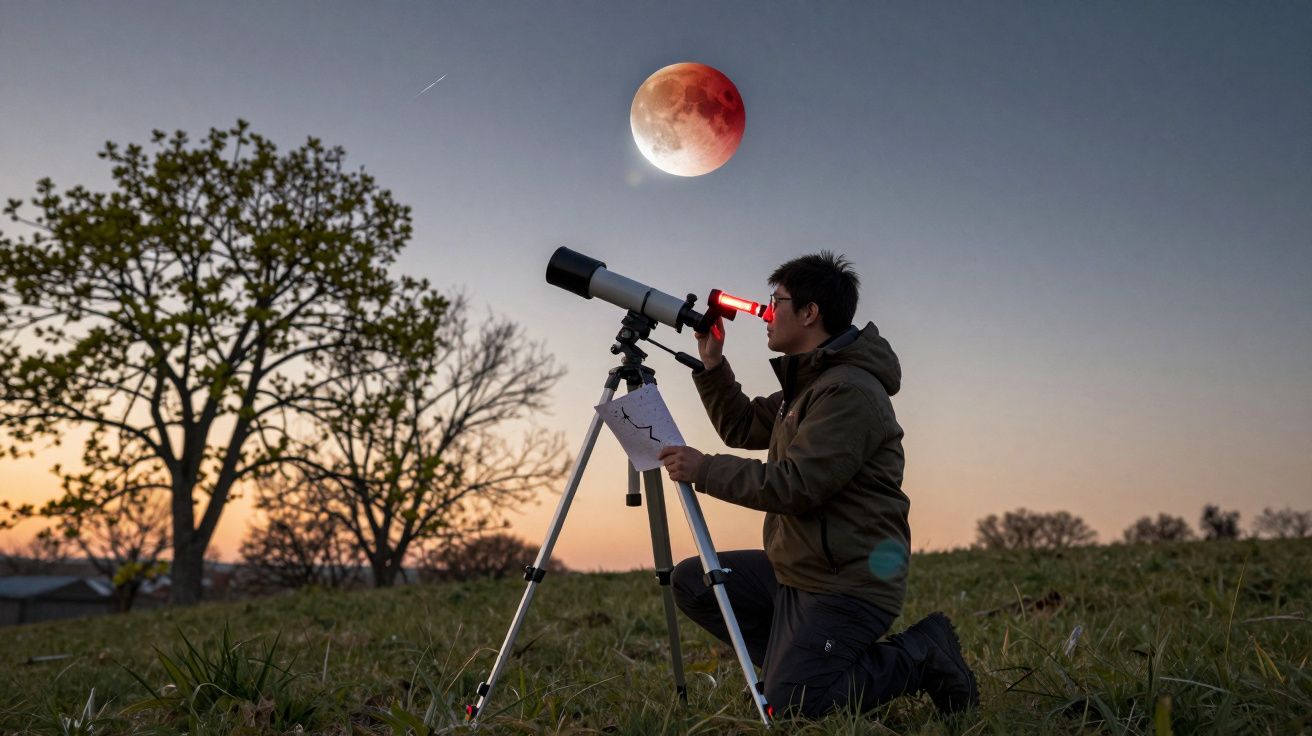
On 3 March 2026, the classic March Worm Moon coincides exactly with a total lunar eclipse, producing a short yet striking Blood Moon for much of the world-while western Europe, including the UK and France, largely misses the spectacle because the Moon is below the horizon at the crucial moments.
The Worm Moon marks the turn of the season
The March full moon comes with an unexpectedly down-to-earth title. Long before online calendars began hyping “supermoons”, many Native American communities in North America named each full moon after changes they could observe in the natural world.
As late-winter ground began to soften, earthworms reappeared in the warming soil. Birds soon followed to feed on them, signalling that the harshest cold was loosening its hold. That annual shift helped cement the name Worm Moon, a term that remains widely used in English today.
In 2026, the Worm Moon reaches its exact full phase on 3 March at 12:37 (Paris time), which is 11:37 UTC (and therefore 11:37 in the UK). To most people, the Moon will look fully illuminated from the evening before through to the morning after, but the precise moment matters for anyone tracking eclipse phases closely or planning carefully timed photographs.
The March 2026 Worm Moon is far more than a routine full moon: it lands squarely within a total lunar eclipse, turning the lunar disc a rich copper-red for close to an hour.
Why a total lunar eclipse turns the Moon into a Blood Moon
A total lunar eclipse occurs when the Sun, Earth and Moon align so closely that Earth passes directly between the Sun and the Moon, preventing direct sunlight from reaching the lunar surface.
The Moon does not disappear from view, though. Instead, it moves into Earth’s shadow and is illuminated only by sunlight that has travelled through the edges of our atmosphere. Shorter wavelengths-notably blue and violet-scatter widely. Longer wavelengths, such as red and orange, bend through the atmosphere and continue onwards, reaching the Moon.
Seen from Earth, that filtered light creates the unsettling, reddish glow commonly known as a Blood Moon. The exact colour is not fixed: a clear atmosphere tends to produce a brighter, cleaner red, while volcanic ash, desert dust, or pollution can deepen the tones and noticeably dim the Moon.
For the 3 March 2026 eclipse, totality is expected to last about 58 minutes. The midpoint-when the Moon sits deepest within Earth’s shadow-should occur at around 11:33 UTC (approximately 12:33 in Paris).
A useful extra detail for planning: because lunar eclipses unfold over hours rather than minutes, even small differences in local moonrise or moonset can determine whether you catch the beginning, the peak, or none of it at all.
Worm Moon total lunar eclipse visibility: who can see it in 2026?
This eclipse strongly favours viewers around the Pacific basin, plus parts of Asia and North America. In western Europe, the key phases occur during daylight, with the Moon below the horizon.
| Region | Chance to see totality | Notes |
|---|---|---|
| Eastern United States & Canada | Good | The Moon sets during or just after totality, low in the western sky before dawn. |
| West coast of North America | Excellent | The full sequence is visible in the pre-dawn hours, weather permitting. |
| Japan & East Asia | Excellent | The eclipse is visible during the evening or night, with the Moon higher in the sky. |
| Pacific islands & New Zealand | Very good | A generous viewing window, particularly around mid-eclipse. |
| Western Europe (including UK, France) | None | The Moon is below the horizon at totality; the event is best followed via online streams. |
From high-rise viewpoints in Los Angeles to open countryside in Japan, vast numbers of people will be able to watch the full Moon gradually dim, slip into darkness, and then glow red. Where the Moon sits low in the sky, the scene can feel even more dramatic thanks to the familiar horizon “moon illusion”, which makes the Moon appear larger to the naked eye.
Across much of western Europe, the Worm Moon eclipse is effectively a “no-show” outdoors-yet it is perfectly suited to live broadcasts from observatories around the world.
If you’re in the UK, France, or western Europe
For observers in France, the UK and nearby countries, the timing is simply unfavourable. The Moon sets before the most dramatic portion of the eclipse begins, and the peak occurs once daylight has already taken over the sky.
Even so, 3 March can still be turned into a small at-home astronomy occasion. You can step outside earlier (or later that evening) to enjoy other sights, or follow the eclipse indoors through high-resolution feeds from professional instruments.
- Watch live coverage from major observatories and space agencies, often with expert commentary and real-time close-ups.
- Use planetarium apps to simulate or replay the eclipse from locations where it is visible.
- Use the date as motivation to learn the March sky: locate Orion, the Pleiades, and bright planets visible in early March.
Other notable headlines mentioned alongside the eclipse
The original coverage also pointed readers towards a set of unrelated trending stories. Rephrased into UK English, they include:
- Severe weather update: Heavy snowfall is now officially confirmed to intensify into a high-impact storm overnight, with meteorologists expecting widespread flight disruption.
- Archaeology mystery: 3,000 coins-around 1,800 years old-have been discovered in the mountains of Germany.
- Grey hair: A haircut said to be most flattering for “salt-and-pepper” hair, according to an expert.
- Heating habits: Specialists warn that turning the heating down when you go out can involve a common mistake that harms both comfort and savings.
- Hair loss advice: A hair-transplant specialist insists a “100% natural” approach can help prevent hair loss.
- Aviation claim: A report stating that an “improper pH” dramatically reduces jet lifespan, linked to a purchase made at 57.
- Winter wildlife warning: Wet birdseed can be deadly for birds in winter-an error many gardeners reportedly make.
- Environment concern: A continent-long brown ribbon has formed between the Atlantic and Africa, and it is presented as a bad sign.
How to watch a lunar eclipse safely (and get a better view)
Unlike a solar eclipse, a lunar eclipse is safe to observe directly. You do not need special glasses, and you can watch the Moon with the naked eye throughout the event.
Binoculars can transform the experience, bringing out subtle reds and revealing surface detail. A small telescope makes it easier to see the difference between the darker central shadow and the slightly brighter edge.
For most people, the most valuable “kit” is a clear view of the horizon, warm clothing, and enough time to watch the slow transformation.
You do not need professional photography equipment either. A modern smartphone on a tripod, using modest zoom, can capture a clear, recognisable Blood Moon. With a DSLR or mirrorless camera, longer exposures can bring out richer colour-so long as the camera is kept steady.
Key terms that make the Worm Moon eclipse easier to follow
Eclipse coverage often includes technical language. These terms are particularly useful for understanding what is happening during a Worm Moon lunar eclipse.
- Penumbra: The faint, outer part of Earth’s shadow. When the Moon passes through it, the dimming can be so slight that casual viewers barely notice.
- Umbra: The dark, central region of the shadow. When the Moon is fully inside this area, the eclipse reaches totality.
- Totality: The interval when the Moon is completely within the umbra, producing the strongest Blood Moon appearance.
- Magnitude of an eclipse: A measure of how deeply the Moon travels into Earth’s shadow, influencing how dark the Moon becomes and how long the event lasts.
A busy celestial diary for 2026
The Worm Moon eclipse is only one highlight in an eventful year for skywatchers. Several other dates are set to deliver memorable views, including some that are better placed for Europe.
Major eclipses and close pairings
- Total solar eclipse – 12 August 2026: The path of totality crosses the Arctic Ocean, Greenland, Iceland and northern Spain. From France and much of western Europe, the Sun will be partially covered, creating a striking “bitten” disc-especially noticeable in the south-west.
- Blue Moon – 31 May: The second full moon in a single calendar month-a quirk of the calendar rather than a change in colour, but still a popular talking point.
- Venus–Jupiter conjunction – 8–9 June: Two of the brightest planets appear very close together, forming a vivid double “star” visible to the naked eye shortly after sunset or before sunrise, depending on location.
- Partial lunar eclipse – 28 August: Only part of the Moon enters Earth’s shadow, creating a subtle shadowed “bite” on one side of the disc.
- Uranus at opposition – 25 November: Uranus sits opposite the Sun and closest to Earth, making it easier to spot with binoculars or a small telescope as a tiny blue-green point.
Meteor showers with favourable moonlight
Several annual meteor showers align well with the lunar cycle in 2026, increasing the likelihood of darker skies and better viewing conditions.
- Perseids – 12–13 August: A new-moon period should mean darker rural skies and plenty of “shooting stars” radiating from Perseus.
- Orionids – 21–22 October: Meteors linked to Halley’s Comet, visible from both hemispheres if the weather plays along.
- Geminids – 13–14 December: Often among the year’s most active displays, with slow, bright meteors appearing to stream from Gemini.
Turning the Worm Moon into a personal sky ritual
Because the Worm Moon is tied to thawing ground and the return of visible life, it carries a strong sense of seasonal transition. Even without a direct view of the eclipse, many people treat the March full moon as a quiet marker: time to prepare the garden, extend evening walks, or simply spend a few minutes paying attention to the night sky.
Families can also shape simple traditions around it-keeping a “sky journal” with monthly Moon sketches, noting the first spring birds, or comparing how high and bright the March full moon looks year by year. The 2026 total lunar eclipse adds an unusual layer to that ritual, connecting everyday seasonal change with the precise geometry of the Sun, Earth and Moon on a truly global scale.






Comments
No comments yet. Be the first to comment!
Leave a Comment