
You shut the bedroom door on something that’s almost flawless at 9 pm: the bed is neatly made, clothes are folded, and the desk has been wiped down. The air has that faint “fresh laundry” scent - and the quiet satisfaction of a job done.
Then the next evening you step back in… and it looks as though somebody has managed to live an entire week in a single day: clothes slung over the chair, three glasses clustered on the bedside table, and assorted cables seemingly multiplying beside the bed.
You pause on the threshold, genuinely confused.
How can a room fall apart this quickly?
When a messy room is actually a system problem
If you pay attention to the spaces in your home that never stay tidy, you’ll usually spot a repeatable pattern: the same items left out, the same corner that overflows, the same “temporary” pile that’s quietly been there for half a year.
That isn’t a character flaw. It’s the room telling you, in the only way it can: “This setup doesn’t match the way you actually live.”
Rooms that reset easily tend to have one thing in common: every frequently used item has a sensible, low-effort home. By contrast, a room that keeps snapping back to chaos is working against your real routines. You may be expecting it to behave like a showroom when, in reality, it’s functioning as a laundry station, home office, snack bar, and emotional decompression zone all at once.
The chair that proves it: a messy room’s “default behaviour”
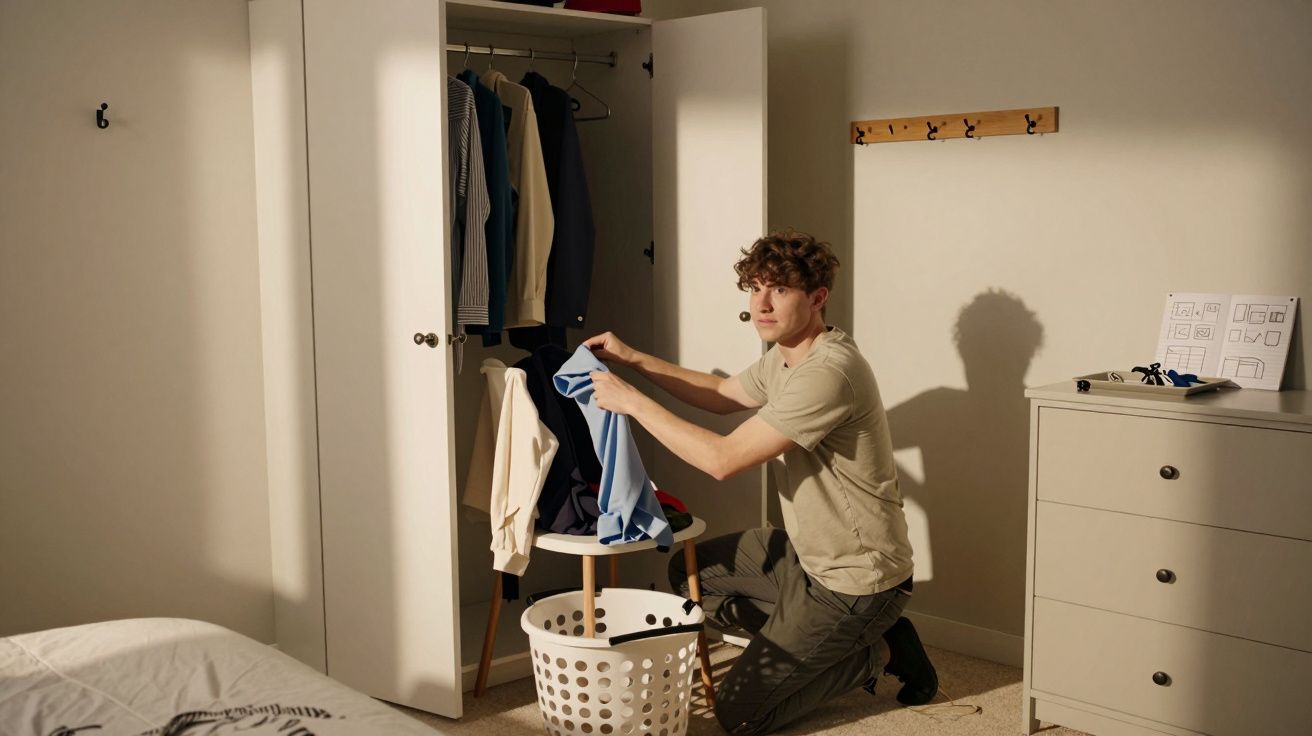
Consider the classic bedroom chair. You know exactly which one. Officially it’s a chair, but you probably haven’t seen the seat since last spring. Clean clothes get placed there “for now”, gym kit gets left there to dry, and half-worn jeans sit there because they’re “not dirty enough for the hamper”.
You can fold everything impeccably on Sunday and feel as if you’ve become a brand-new person - and by Wednesday, the chair is buried again.
The same thing happens with hallway console tables that swallow keys, post, masks, and receipts. Or children’s rooms where a freshly cleared floor becomes Lego territory again before breakfast.
None of this is random. It’s your everyday routine highlighting exactly where the room’s design clashes with reality - and reality wins every time.
Now think about how your day actually moves. You arrive home tired, phone in one hand, bag in the other, possibly juggling a takeaway or a laptop. Your brain wants the lowest-friction option available. If “putting it away” means opening three doors, pulling out a box, or walking to the far side of the room, that item will end up on the nearest surface instead.
Those rooms keep “getting messy” not because you don’t care, but because the friction is too high. Storage that’s too deep, too distant, too high up, or too hidden creates visual clutter. Spaces that stay tidy are rarely about willpower - they’re about design that forgives your real-life energy levels.
Small, sneaky shifts that stop the endless reset cycle
The rooms that finally improve are often the ones where you redefine what “put away” means. Not more discipline - less effort.
If you have a chair-that’s-really-a-wardrobe, try placing a shallow open basket or a low rail right beside it, reserved solely for “worn but not dirty” clothes. No careful folding, no fiddly hangers. One simple action: drop and go.
By the front door, give your “landing zone” a clear purpose. Use a tray for keys and coins. Add a vertical organiser for post with sections like “to pay”, “to read”, and “to bin”. Install one hook for the bag you use every day. You’re not becoming an ultra-organised person overnight - you’re simply shifting the inevitable mess about 30 cm to the left into something that contains it.
Extra friction you can’t see (and how to remove it)
A surprisingly common culprit is “invisible effort”: lids that don’t close smoothly, hangers that snag, storage that requires two hands, or drawers that jam unless you do a little shuffle. If you notice yourself avoiding a storage spot, it’s worth treating that as data, not a moral failing. A cheaper box, a different hook height, or an open-top container can outperform the “perfect” solution purely because you’ll actually use it.
Another overlooked factor is lighting. When a corner is dim, it becomes a natural dumping ground because the mess is less visually “loud”. A small lamp, brighter bulb, or repositioned light can make the space feel usable again - and can subtly discourage piles forming in the shadows.
The perfection trap
The biggest mistake is chasing magazine-level perfection in a room that’s used like a train station. You declutter ruthlessly, buy matching storage boxes, and promise yourself this time will be different. Then life shows up: a late night, a stressful week, a child off school ill, a looming deadline. Suddenly that beautiful, tightly folded system feels too delicate to even touch.
Let’s be honest: almost nobody keeps that up every single day.
Rooms that stay reasonably tidy usually rely on “good enough” habits: one laundry basket per person (even if it isn’t pretty), one drawer that’s allowed to be the chaotic junk drawer so the rest of the desk can breathe, and one five-minute reset at the same time each evening where the goal isn’t perfection - it’s “nothing on the floor that I can trip over”.
Sometimes the cleanest-looking homes aren’t the ones with fewer possessions, but the ones where every messy habit has quietly been given a designated spot.
Create “drop zones”
One tray for small items by the door, one basket for roaming objects in the living room, and one box for random cables. No shame - just containment.Use open storage where you struggle most
Choose a shelf instead of a closed cupboard. Use hooks rather than hangers. Put out a visible hamper instead of relying on a decorative chair. Reduce the number of steps between “in my hand” and “put away”.Design for your actual life, not your fantasy life
If you always work from the sofa, set that area up properly: a side table, a lamp, and a small basket for notebooks. Stop pretending you’ll start using the desk “from tomorrow”.Limit surface “parking spaces”
Every flat surface becomes a magnet. Keep some deliberately clear. One décor item per surface can act as a gentle “no pile here” signal.Make tidying part of transitions, not a separate event
Spend two minutes after brushing your teeth clearing the bedside table. Tidy the worktop for one song while dinner simmers. Small loops attached to things you already do.
The rooms that “resist” are often telling you something
Some rooms refuse to stay tidy because they’re carrying too many unnamed roles. A bedroom that’s also an office, dressing room, storage unit, and panic room for unfolded laundry will eventually rebel.
Often the better question isn’t “Why am I so messy?” but “What am I asking this room to hold for me?” That stack of books beside the bed might be less about clutter and more about wanting time to read. The craft table you can never clear might actually be your only creative space in a life scheduled down to the minute.
Changing a room that constantly collapses doesn’t always mean binning half your belongings. Sometimes it means acknowledging what the room really is, and letting go of the fantasy version you thought it “should” be. That acceptance can feel quietly tender - like admitting which season of life you’re genuinely in.
A quick detour: the unrelated headlines your brain wants to click
Summary table
| Key point | Detail | Value for the reader |
|---|---|---|
| Design beats willpower | Rooms stay clean when storage matches real habits and minimises effort | Reduces guilt and focuses on practical, sustainable fixes |
| “Drop zones” tame daily chaos | Simple trays, baskets, and hooks catch inevitable clutter | Makes mess feel temporary and manageable rather than overwhelming |
| Rooms reveal your real life | Persistent mess often points to overloaded roles or unrealistic expectations | Encourages kinder, more realistic decisions about space and possessions |
FAQ:
Why does my bedroom get messy again right after I clean it?
Because your evening and morning routines probably don’t include easy, obvious homes for the things you touch most - clothes, books, phone, glass, charger. Adjust the layout so those items have low-effort, within-reach spots that feel natural to use.Is my house just too small to stay tidy?
Small spaces do show clutter faster, but the bigger issue is often the number of items compared with the number of “homes”. Reducing what you own and using vertical, open storage typically makes a bigger difference than gaining a few extra square metres.How do I stop the “laundry explosion” in one room?
Break the process into stages. Use one hamper in the bedroom, one in the bathroom, and one dedicated spot for clean clothes waiting to be folded. Plan one short folding session linked to a regular habit, such as watching an episode of a series.What if my partner or kids don’t help and ruin the system?
Begin with ultra-simple, visible setups: labelled baskets, one hook per person, and one shared drop zone. Explain the aim - less stress for everyone. Complexity kills cooperation; clarity invites it.Do I need to declutter before changing the room layout?
You can do both together. Sometimes shifting furniture or adding a hook immediately exposes what you no longer need. Use layout tweaks to test-drive a lighter version of the room before doing major clear-outs.





Comments
No comments yet. Be the first to comment!
Leave a Comment