
At the back of countless linen cupboards, neglected sheets slowly grow older, turning yellow and tearing, while families continue to buy brand-new fabric.
A threadbare linen sheet is not rubbish at all: it is a surprisingly useful raw material. With nothing more than scissors, some thread and about ten minutes of focused effort, you can convert it into practical, attractive items that genuinely make everyday kitchen life easier.
Upcycling an old linen sheet: from “ruined” to textile gold
Linen has a habit of outlasting trends. Even when a sheet looks worn and weary, the fibre itself is often still remarkably sound. Unlike low-cost cotton mixes, good flax yarn tends to stay durable through decades of washing and drying.
Textile specialists commonly estimate that linen is about 30% more resistant than cotton. In real terms, once you cut away the weak sections, an old linen sheet can outperform some modern fabrics sold by the metre. As linen ages, the weave usually becomes softer and more absorbent-exactly the combination you want for kitchen use.
Old linen is household “textile gold”: hard-wearing, breathable, already pre-washed, and very often far too good to throw away.
This is where circular thinking becomes practical. Rather than sending worn sheets to landfill or donating them to a clothing bank, you can upcycle them into long-lasting household items. No new fabric, no extra packaging-just a handful of straightforward cuts and seams.
Step one: inspect, sort and brighten the sheet
Before you reach for scissors, give the sheet a quick check. Hold it up near a window or lamp so the light shows thin spots. The middle of a sheet often wears first, as do the fold lines from storage.
- Mark thin areas, holes and frayed creases.
- Keep the firm, dense sections near the edges and corners.
- Save original hems where you can; they dramatically reduce sewing time.
If the sheet has embroidery or a monogram, trim it out carefully and set it aside. Those decorative patches can later become appliqués for bags, napkins or tea towels, adding a personal, slightly vintage feel.
A quick whitening bath
Linen can yellow over time, particularly if it has sat in a damp or dark cupboard. This usually does not reduce strength, but brighter fabric looks and feels cleaner in a kitchen setting.
A simple brightening routine works well for most sturdy linen:
- Soak the sheet for about 24 hours in warm water with two tablespoons of sodium percarbonate.
- Rinse thoroughly, then hang outside to dry if possible.
- If you prefer a more natural option for robust fabric, hot water plus the juice of two lemons can help lift the yellow tinge.
Alongside that routine, these prompts were included as additional reads:
- I tried this slow cooker recipe and the texture turned out perfect
- Stop naming girls the same names, baby girl name trends for 2026 are bold, beautiful, and full of meaning
- People Who Sleep With The Bedroom Door Closed Share These Personality Traits
- Breathtaking new details revealed by multiple spacecraft and observatories
- Hair professionals recommend this cut for women in their late 30s with fine ends
- Father splits assets in his will equally among his two daughters and son, wife says it’s not fair because of wealth inequality
- It’s Happening Again As Earth’s Magnetic Field Distorts Near The Poles Triggering Record Aurora Activity At Lower Latitudes
- This 141-ton monster could soon fire missiles: France wants to turn its A400M transport aircraft into a real war machine
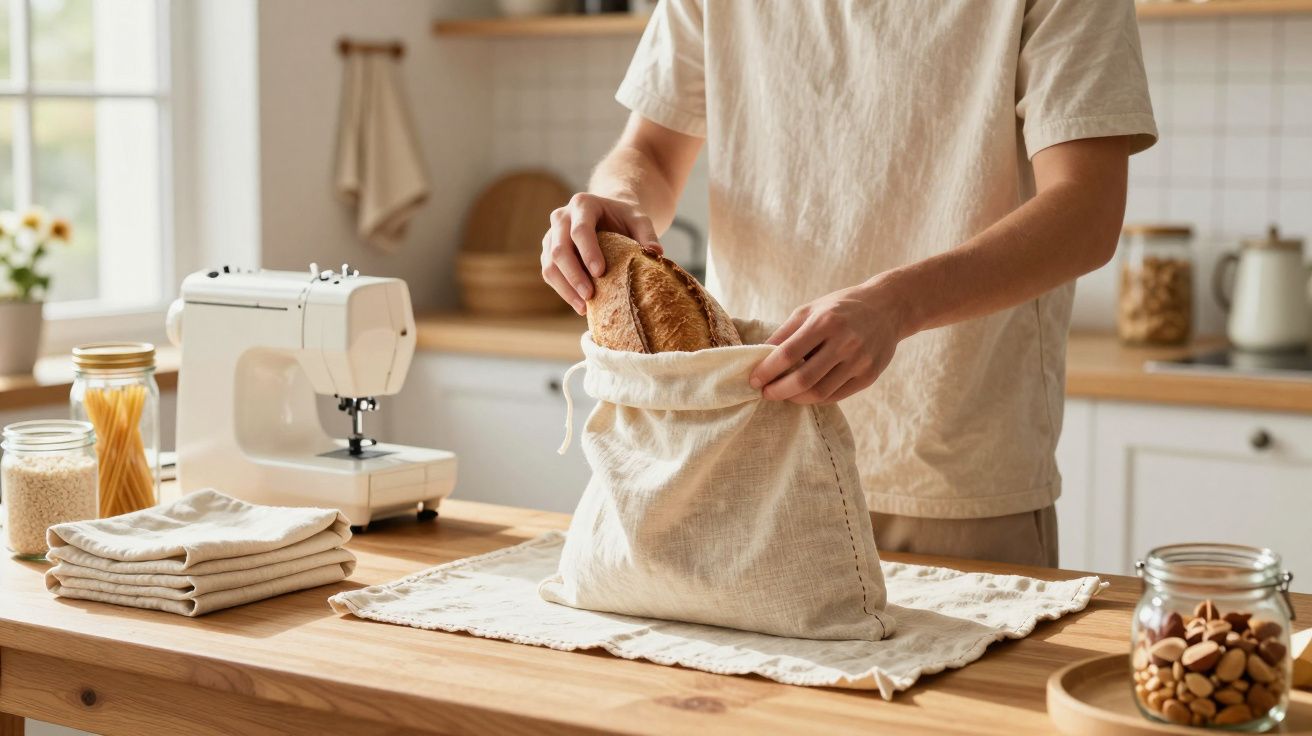
Once the fabric is dry, pick an unmarked area and cut a rectangle of roughly 30 × 70 cm. This piece becomes the main quick project: a reusable linen bread bag.
The 10‑minute DIY bread bag (linen bread bag)
The concept is straightforward: you’re making a long pouch with a drawstring at the top, and letting the linen do the hard work.
One sound 30 × 70 cm strip of linen can become a breathable bread bag that helps keep loaves crusty for longer.
What you need
- One 30 × 70 cm rectangle of solid, clean linen
- Strong sewing thread
- Fabric scissors
- Pins
- A cotton cord, ribbon or spare shoelace
- A sewing machine (or a little extra time sewing by hand)
How to sew it, step by step
- Fold the rectangle in half to create a 30 × 35 cm shape, with right sides facing.
- Pin the long edge and the bottom edge.
- Stitch those two sides, leaving the top open. If one edge already has the original hem, keep it as the future opening.
- At the top, fold the edge in by 2–3 cm to form a channel for the cord. Sew all the way round, leaving a small gap unsewn.
- Feed the cord through the channel, knot the ends, and pull to close.
Older, thicker linen can feel stubborn under the needle. A jeans needle (size 90/100) plus a 3 mm stitch length usually helps it feed cleanly and reduces puckering.
Why linen works so well for bread
Linen breathes. Its fibres let air circulate while still protecting the loaf from draughts and dust. That balance reduces condensation, which is what often makes crusts go limp inside plastic or tightly sealed bags.
In day-to-day use, many home bakers find that bread stored in a linen bag remains enjoyable for roughly two days longer than a loaf kept in a typical supermarket paper bag. The crumb stays soft, the crust stays decent, and you avoid plastic waste altogether.
| Container | Air circulation | Typical effect on bread |
|---|---|---|
| Plastic bag | Almost none | Soft, damp crust; mould develops sooner |
| Paper bag | Moderate | Crust hardens; bread dries quickly |
| Linen bag | Good, controlled | Balanced texture; slower drying |
What to do with the remaining pieces of linen
After cutting the main rectangle, you’ll usually be left with plenty of usable fabric around the weak centre. That’s where smaller, quick makes are ideal.
Bulk bags for rice, pasta and nuts
Shorter rectangles can be turned into smaller drawstring bags using the same method as the bread bag. They are useful for shopping at refill and bulk sections, and for storing dry goods at home.
- Choose untreated, uncoated linen for anything that will touch food.
- Reuse intact hems so you’re not finishing every edge from scratch.
- Keep one size for flour, another for nuts or lentils, to keep cupboards organised.
If you’re trying to reduce packaging, a small set of these quickly becomes part of the weekly shop: fill, weigh, bring home, wash when needed.
Napkins, tea towels and cleaning cloths
Clean, wide sections make excellent table napkins. Cut generous squares, then sew a narrow hem on each side-or overlock the edges. Linen softens further with every wash and feels pleasant on the skin.
Square or rectangular cuts also become dependable tea towels. Linen absorbs water effectively, dries quickly, and tends to leave less lint behind than many microfibre cloths. For a rustic finish, stitch the sheet’s original monogram onto a corner.
Even the most damaged parts can still be useful. Rough, thinned sections are ideal as cleaning rags. If you cut them with pinking shears, fraying is reduced and the rags last longer during household jobs.
Tiny scraps that look pointless can be saved in a bag and later used as filling for a cushion insert or a draught excluder. Larger worn panels can be repurposed as light frost protection for delicate plants, or as a simple outdoor play mat.
When every section of fabric is given a purpose, even the most tired sheet avoids the bin and gains several more years of useful life.
Why this quick hack suits modern habits
Turning a sheet into a bread bag might sound old-fashioned, but it aligns closely with today’s sustainability aims. Reusing what you already have cuts demand for new textiles-an industry that can be energy-intensive and water-hungry.
From a household budget perspective, the maths is simple. High-end linen bread bags can be expensive in shops. Making one from a linen sheet you already own costs almost nothing beyond thread and a short burst of attention.
It is also a gentle introduction to sewing. The seams are small and forgiving, the shapes are uncomplicated, and the stakes are low. Even if your first attempt is a bit wonky, the bread still fits-and the project still prevents waste.
Practical tips, risks and small precautions
Not every old sheet is suitable for food-related projects. If your linen has been heavily exposed to fragrance, fabric conditioner, or unknown treatments, you may need several hot washes to remove residues. Some older household linens were stored with mothballs or scented oils, and those smells can linger.
If you are uncertain, reserve questionable pieces for non-food uses such as cushion filling, plant protection or cleaning cloths. Keep fresh, neutral-smelling sections for bread bags and bulk bags.
Two linen terms that often come up are worth clarifying:
- Thermoregulation: linen naturally responds to temperature and humidity, helping stored bread avoid sweating or drying out too quickly.
- Grammage: the weight of fabric per square metre. Higher grammage linen is sturdier and well suited to bags; lower grammage linen is better for napkins or light covers.
If you like thinking in practical quantities, it helps to “map” one sheet. A standard double linen sheet-even with a worn centre-often contains enough healthy fabric for one or two bread bags, several bulk bags, a handful of napkins, a couple of tea towels, plus a stack of rags. That is essentially a small homeware set made from a textile many households would otherwise throw away.
Added guidance: caring for your linen bread bag
To keep a linen bread bag fresh, wash it regularly at 40–60°C (depending on how soiled it gets) with an unscented detergent, and let it dry completely before storing. Avoid fabric conditioner, as it can reduce absorbency over time. If you want the bag to stay breathable and crisp, line-drying is often better than tumble-drying.
Added guidance: hygiene and food safety in everyday use
Even breathable linen can pick up crumbs and moisture. If you store bread that is still slightly warm, let the loaf cool first to reduce condensation. If you ever spot mould on the fabric, wash it on a hot cycle and dry it thoroughly in direct sunlight if possible, then reassess whether the bag should be kept for food use.
Once your first project goes well, it often becomes a habit. Old pillowcases make excellent produce bags, damaged tablecloths can become aprons, and the linen cupboard starts to feel less like storage and more like a quiet, useful workshop.


Comments
No comments yet. Be the first to comment!
Leave a Comment