
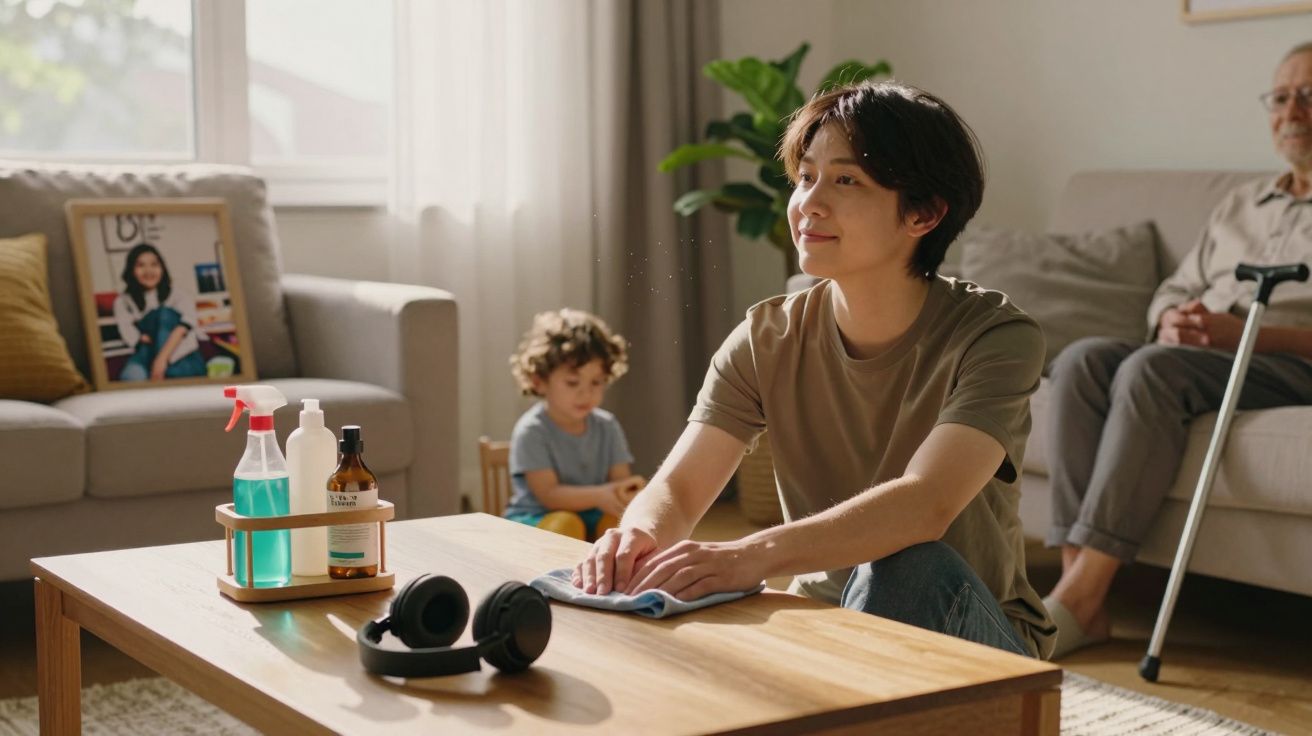
The other evening I watched my neighbour’s teenager tackle their bedroom with furious purpose: clothes hurled on to the bed, drawers thumping shut, music turned up so loud it vibrated the walls. Two floors below, an older woman in our block moved slowly, polishing the same shelf for the third time, as though she were observing a small ceremony. And in between, I found myself wiping the kitchen worktop because my thoughts wouldn’t settle until every last crumb had gone.
We were all cleaning.
Yet it was obvious we weren’t doing the same thing.
At different life stages, cleaning stops being only about hygiene and starts to reveal something quieter and deeper about who we are, what unsettles us, and what we’re trying to hold together.
In a strange way, the sponge grows up alongside us.
When cleaning is really about identity
For most children, cleaning begins as an instruction delivered from above. A parent calls down the hall, “Tidy your room before tea!”, and you comply in the quickest way possible-shoving toys under the bed and declaring victory. It feels mildly unjust and a bit silly. You don’t care where your socks end up, provided you can still locate your favourite one-eyed teddy.
Then adolescence arrives, and mess turns into a banner.
A chair disappears under hoodies, the carpet becomes a rumour, and the sink hosts a stack of instant-noodle cups like a quiet strike against adulthood. You don’t call it dirty-you call it “creative chaos”.
Or you do, at least, when you’re trying to convince yourself.
Picture a university hall on a Sunday afternoon: one person dashes about with a bin bag, rescuing missing cutlery; another is “deep-cleaning” for the first time in ages because their parents are coming to visit. You can almost taste the anxiety through the disinfectant mist.
Not long after, in your first flat, every swipe of the worktop starts to mean something else.
You buy your own sponge.
You feel oddly pleased with the washing-up liquid you chose.
There’s a private spark of satisfaction when the bathroom looks like a letting-agent photo-even if the illusion lasts barely a day. This is often the point where cleaning stops feeling purely like punishment and begins to feel like evidence that, somehow, you can manage life.
What changes isn’t the dust so much as the story your mind attaches to it. In your teens, mess can function as territory-a way of saying, “This is mine, and I won’t be managed.” In your twenties, order starts to resemble competence. A tidy studio flat quietly declares: I might be skint, but I’m not unravelled. Later still, cleaning can become a boundary around time, energy and mental health.
We don’t only clean floors.
We scrub at anxiety, shame, and the need to control at least one small corner of the world.
How life stages quietly rewrite your cleaning rituals and routines
A straightforward way to spot the shift is to notice what prompts you to clean at different ages. As a student, cleaning often arrives in sudden surges: right before an exam, a date, or someone’s visit. The mess accumulates and accumulates… until one evening you look around and blitz the lot in a two-hour frenzy. Later, when you share a home with a partner or housemates, cleaning becomes a kind of diplomacy.
You find yourself bargaining: “If I cook, will you do the washing up?”
And suddenly the state of the relationship shows up in the greasy hob and the crumbs in the sink.
Then there are the years when you may be living with young children, pets, or both. You clean in loops: pick up toys, fold laundry, wipe jam off the table-then return five minutes later to find the living room looks untouched. This is when many people develop “good enough” cleaning. One corner becomes the sacred tidy zone-the bit you’d photograph if someone asked how things are going. The rest is simply lived-in: noisy, chaotic, sticky in places.
Be honest: nobody sustains perfection every single day.
Even influencers with spotless white sofas crop the mess out of shot.
Later on-when children (if you have them) have grown up, or when you find yourself living alone again-the pace shifts once more. You’re no longer following sticky hands from room to room. You may start cleaning more slowly, with more attention. The shelf you dusted monthly becomes part of a weekly rhythm. The sound of the hoover on a Saturday morning becomes, unexpectedly, comforting.
At that stage, cleaning can start to mean continuity.
It’s a way of saying: I’m still here, this is still my home, and I’m looking after it.
The actions are familiar, but the emotional weight behind them can be entirely different.
A note on cleaning, neurodiversity and overwhelm (at any life stage)
For some people, cleaning rituals are shaped less by age and more by how their brain handles attention, sensory input and decision-making. If you live with ADHD, autism, anxiety or depression, “just tidy up” can feel like being asked to lift a car-too many steps, too many choices, too much noise and texture. In those moments, a smaller plan (one surface, one bin bag, one timer) isn’t a hack; it’s an accessibility tool.
It can also help to separate tidying from cleaning: putting items away is one type of task, and removing dirt is another. Treating them as two distinct jobs often makes both feel more manageable, especially when your energy is limited.
Turning cleaning from burden into quiet self-respect
A useful shift at any age is to make the battlefield smaller. As a teenager, “Clean your room” feels enormous, almost existential. As an adult, “deep-clean the whole flat” on a Sunday can ruin your mood before you’ve even finished your first brew. Instead, pick one small, obvious area and give it your full attention:
- the bedside table
- the kitchen sink
- the desk you use every day
Spend 10–15 minutes making that one spot genuinely pleasant. Often your brain reads a tiny island of order as a surprisingly big internal win.
Another quiet saboteur is comparison. You step into a friend’s minimalist lounge and suddenly your place feels like a storage unit. Or you visit a relative whose house smells of lemon cleaner and childhood discipline, and you leave feeling guilty about the crumbs on your own sofa. This is where age can play tricks: we judge our current reality by past or imagined future standards.
If you’re working full-time while parenting toddlers, your home will not resemble your retired aunt’s.
That isn’t a personal failing-it’s basic physics.
Cleaning at 25, 40 or 70 doesn’t happen with the same body, the same timetable, or the same priorities. The dust stays much the same; you don’t.
“Your house doesn’t need to be ready for guests. It needs to be ready for you,” a therapist once told me.
That landed harder than any cleaning checklist.
- Name your current season
Are you in a study-until-2 a.m. chapter, the baby years, or the sandwich-generation squeeze? Clean for your real life, not an imaginary one. - Pick a “non-negotiable” micro-task
One load of washing, a cleared sink before bed, a swept hallway-one signal that tells your mind: I looked after my space today. - Create one pride corner
A shelf, a coffee table, a part of your bedroom. Keep that one area consistently calm and pleasant. It becomes a reference point on messy days. - Drop the museum standard
Homes are for living, not performing. A bit of visible life is normal. Dust is not a moral failing. - Notice what cleaning soothes
Do you scrub when you’re anxious? Fold laundry when you’re low? When you recognise the pattern, you can choose whether it helps-or whether it’s hiding something.
An extra layer: making cleaning kinder to your body and your home
As life stages change, so does your physical capacity. If bending, lifting, or strong-smelling products are becoming harder to tolerate, it’s sensible-not “lazy”-to adjust the routine: long-handled tools, lighter cordless vacuums, and fragrance-free sprays can make cleaning more sustainable. Small safety habits matter too, such as keeping floors dry to prevent slips and avoiding mixing products (especially anything containing bleach).
There’s also a quieter form of self-respect in choosing methods that don’t punish you later: shorter sessions, better ventilation, and cleaning little-and-often where possible. The goal isn’t toughness; it’s continuity.
What your way of cleaning is trying to tell you
The closer you look, the more your cleaning habits start to read like a private journal. That stretch when you left dishes for days may match a season of burnout or heartbreak. The sudden impulse to reorganise the wardrobe often appears just before a big decision. And when older relatives fixate on tiny details-exactly aligned photo frames, cups arranged in a precise order-it can be their way of clinging to structure while health, mobility or relationships shift beneath them.
Most of us know that moment when wiping a surface feels easier than starting a hard conversation.
Across every life stage, one blunt truth keeps resurfacing: cleaning is rarely only about cleaning. For a teenager, it can be silent rebellion. For a young adult, it can be a performance of competence. For an exhausted parent, it can be a losing battle they keep fighting because love often looks like picking up the same toy twenty times. For someone ageing alone, it can become the last steady routine in a week that has changed too much.
Seen this way, the question stops being “Why am I not more organised?” and becomes gentler: “What do I actually need when I start scrubbing the bathroom at 11 p.m.?”
When you start listening to your own patterns, guilt loosens its grip. You may notice you clean obsessively when work feels out of control. Or that you stop cleaning entirely when sadness floods the system. Neither makes you inherently “messy” or “neat”. They’re simply chapters. The sponge, the hoover, the folded towels in the airing cupboard-these are small props in a much bigger story about growing up, shifting identity, grieving, and hoping.
And that story, unlike your floors, is never really finished.
| Key point | Detail | Value for the reader |
|---|---|---|
| Cleaning changes with life stages | From childhood obedience to teen rebellion to adult ritual | Helps you stop judging today’s habits by standards that no longer fit |
| Small zones beat total control | Focusing on one visible area creates a sense of progress | Reduces overwhelm and makes tidying feel genuinely doable |
| Mess and order carry emotions | Cleaning patterns often mirror stress, identity, or transitions | Helps you use cleaning as a signal, not just a chore |
FAQ:
- Why did I enjoy cleaning as a child but dislike it now?
When you’re young, cleaning can feel like play or shared time with an adult. Later it can take on the weight of responsibility, which can turn something light into a pressure point.- Is it normal to clean more when I’m stressed?
Yes. Many people clean to regain a sense of control when life feels uncertain. It can be soothing, provided it doesn’t become your only coping strategy.- Why does my parents’ home always seem cleaner than mine?
They may have different time, habits and standards because of their life stage. Comparing a busy early-career or child-filled home with a quieter, established one is rarely a fair match.- How can I stop feeling guilty about my messy place?
Swap the question “Is my home spotless?” for “Can I live and rest here?” Begin with one small area, and remember your worth isn’t measured in dust bunnies.- Will my relationship with cleaning keep changing?
Almost certainly. As your health, work, relationships and priorities evolve, the way you care for your space will change too-and that’s a sign of life, not failure.





Comments
No comments yet. Be the first to comment!
Leave a Comment