
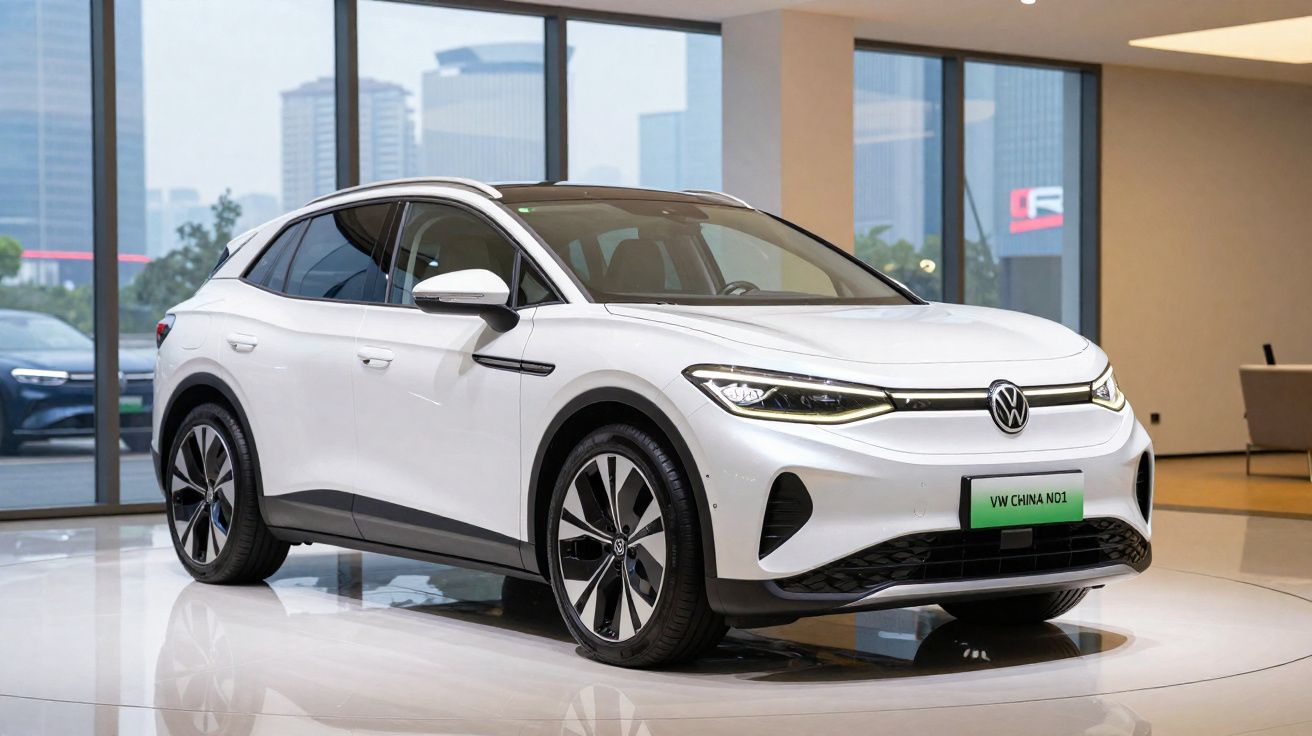
Leadership in the world’s largest car market has changed hands again. Across the first two months of 2026, Volkswagen returned to number one for vehicle sales in China, once more moving ahead of BYD. The brand that had displaced the German group in 2024 and held the lead throughout 2025 has now slipped to fourth place. In doing so, Volkswagen has reclaimed a position it held for 30 years - from 1993 to 2023.
The year has only just begun, but these early results already give a clear signal. Figures from the China Passenger Car Association (CPCA) point to a meaningful shift in the market’s balance - and that shift has a name: the end of incentives for buying electric vehicles.
The Chinese government has started to roll back some of the incentives that, for years, boosted electric-vehicle sales in what is, in absolute terms, the biggest market in the world.
After multiple warning signs in 2025, Beijing appears intent on restoring a measure of balance to China’s automotive industry. The clearest message came last summer, when Xi Jinping, President of China, publicly criticised the country’s approach. He spoke about artificial intelligence and semiconductors, but the message was widely understood: the car sector needs to bring internal battles to an end.
"The usual way of evaluating performance, looking only at how much GDP has grown or how many major projects have been launched, is no longer enough. We also need to ask: how much debt has been taken on?"
Xi Jinping, President of China
Amid these advances and reversals, two clear winners have emerged for now: Volkswagen, back at the top, and Toyota, currently in third. There is also one notable loser: BYD, down to fourth. As mentioned earlier, however, this covers only the opening months of the year. There is still a long way to go - and the "Chinese giant" is not standing still.
Volkswagen strategy or a market response?
Volkswagen’s joint ventures in China - with FAW and SAIC - delivered a combined 13.9% share of the passenger-vehicle market between January and February. With that performance, the German group is back at the head of the table in a market where, in recent years, it had been losing ground to local manufacturers focused on electric vehicles.
Just behind sits Geely on 13.8%, while Toyota - via its partnerships with GAC and FAW - holds third place with 7.8%.
To what extent is Volkswagen’s plan to regain leadership in China, presented in 2025, beginning to show practical results? We will have to wait to be sure - although even a new combustion engine is on the way. For now, it looks more like a straightforward market reaction to the removal of certain incentives, which always create distortions on both the supply and demand sides.
BYD sinks down the rankings
The standout surprise of these first months is BYD’s drop to fourth. The Chinese brand, which in 2024 overtook Volkswagen to become China’s largest carmaker - and the world’s biggest electric-car manufacturer - recorded a 7.1% share of the Chinese market in the first two months of the year, 30% less than in 2025. This is the brand’s steepest sales decline since the pandemic period.
According to Cui Dongshu, CPCA secretary-general, conventional hybrids - long a natural stronghold for Toyota, which has moved up into the TOP 3 - are winning back some buyers who previously chose plug-in hybrids or fully electric cars.
At the same time, Chinese manufacturers that rely more heavily on low-cost electric models are among those hit hardest by the reduction in state incentives. It is worth recalling that the core of the Chinese market has been electric cars priced below €10,000.
Sinking, but not standing still
BYD has already responded to the sales drop. Last week, the brand unveiled the first major update to its well-known Blade Battery, which now moves into a second generation. Energy density has increased by 5%, charging times have improved, and the company is promising lower costs.
In parallel, Volkswagen is stepping up its electric strategy in China. The German brand has recently begun series production of the first model developed jointly with XPeng, at the Hefei plant.
According to Volkswagen, more than 20 new electric models are expected to be launched on the Chinese market during this year.
A new phase in the world’s biggest market
The figures from these initial months suggest China’s car market is entering a new phase. After several years defined by price wars - the term used by BYD vice-president Stella Li was "bloodbath" - alongside heavy state intervention to accelerate electrification, the sector now appears to be moving towards stabilisation, where product positioning and industrial strategy may once again matter more than subsidies.
In that new balance, traditional brands look determined to win back ground. Mercedes-Benz also already has a recovery plan under way, and Porsche seems to have little alternative given its weak results over the past two years.





Comments
No comments yet. Be the first to comment!
Leave a Comment