
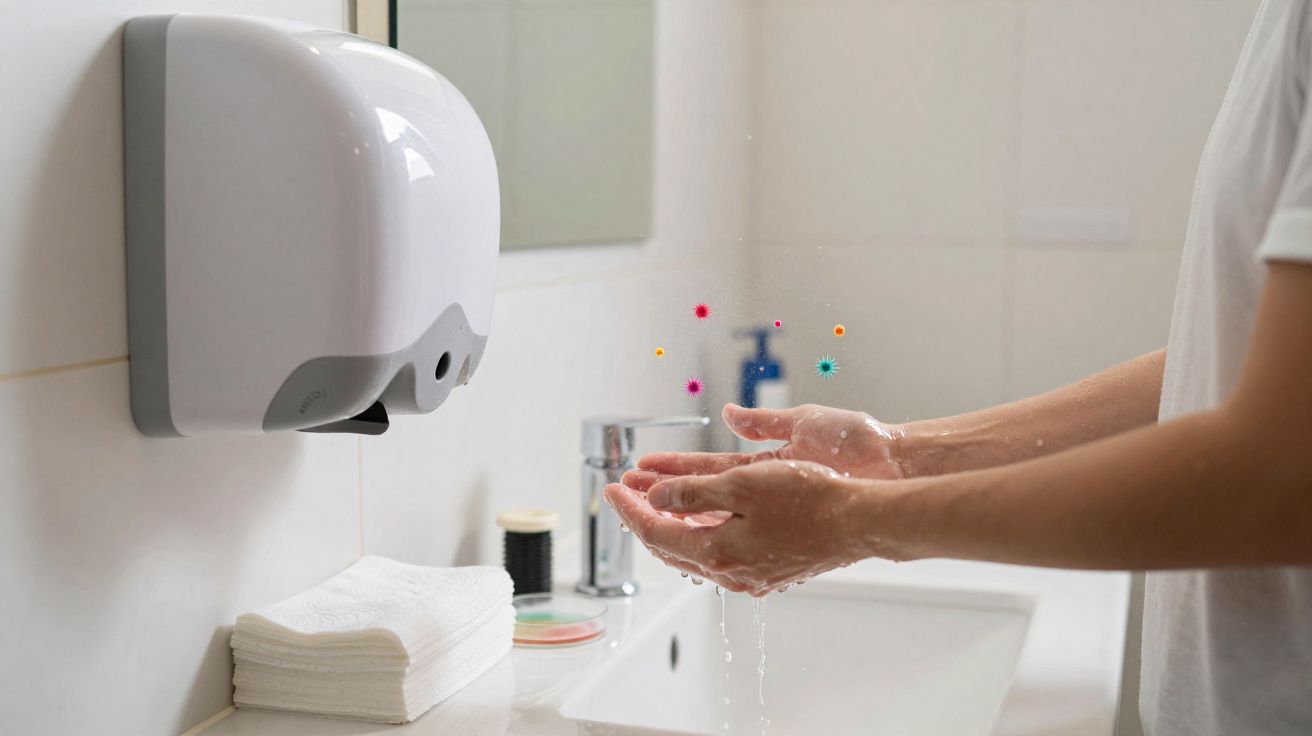
A viral lab demonstration is now suggesting something unsettling: the devices may actually do the opposite of what people expect.
More and more public toilets are ditching paper and installing electric hand dryers. Greener, touch-free, modern - that is the promise. But a UK-based scientist put the machines to the test in a laboratory setting, and the results have left many people feeling uneasy the next time they stand in the blast of air.
How a simple experiment reframed the hygiene question around hand dryers
The researcher, who shares her work online under the name “Devon Science”, set out to find what the hot or cold air jets from hand dryers are really blowing on to our skin. Rather than building a high-tech rig, she relied on a straightforward classic from microbiology: Petri dishes filled with nutrient agar.
One dish was placed directly under the air outlet of a hand dryer in a public toilet. A second dish stayed in the lab as the control - a comparison sample exposed only to clean indoor air.
After a day in an incubator, the contrast was stark. While the control dish remained almost clear, the dish from the toilet was speckled with yellow, black and white dots.
The Petri dish from the hand-dryer area was teeming with bacterial colonies - compared directly with the almost empty control sample.
The takeaway from the test is troubling: the dryers appear to stir up microorganisms present in washroom air and then blow them, concentrated, on to freshly washed hands.
Which germs show up in the airflow
The colonies that grew in the experiment can be broadly grouped into several types, including well-known problematic microbes:
- Staphylococcus aureus: Commonly found on skin and in the nose; if it gets into small cuts it can trigger inflammation, abscesses or, in extreme cases, blood poisoning.
- Escherichia coli (E. coli): A typical gut bacterium found in faeces. In toilet areas it can easily end up on surfaces and then be spread onwards.
- Fungal spores: Black dots suggest fungi. These can irritate the airways and may be an added burden for people with allergies or a weakened immune system.
So it is not just harmless environmental flora in the air stream, but a blend of potential pathogens - especially difficult to control in heavily used public toilets.
Why hand dryers can spread germs so effectively
The key issue is less that air is moving, and more the force involved - and the way the devices are designed.
High air speed as a germ catapult
Modern jet dryers can reach air speeds that feel like a gale. Manufacturers talk about up to 400 miles per hour, which is well above 600 kilometres per hour in the air stream.
That has two consequences:
- Water droplets and microbes can be dislodged from tiny gaps and surfaces around the washroom and propelled into the air.
- Anything that has previously settled on the floor, the wall or the dryer housing can be kicked back up again.
If you hold your hands directly in that jet, you are, in effect, standing at the centre of a microbial wind machine.
Dirt accumulating inside the device
In a second part of her test, the scientist used cotton swabs, wiped the inside of the dryer, and transferred the sample on to nutrient medium. The swab visibly darkened - a sign that a cocktail of contamination had built up inside the unit itself.
Inside many dryers you can find:
- Dust drawn from the surrounding air
- Deposits from splashed water and toilet aerosols
- Organic material such as skin flakes and micro-droplets from exhaled breath
When the machine runs, parts of that mixture can be broken into extremely fine droplets and blasted back into the room at high speed - right where people place their hands and, often, their faces.
Do HEPA filters and UV light actually help?
In response to criticism over recent years, manufacturers have promoted “hygienic” models designed to clean the airflow. Two approaches are usually highlighted.
HEPA filters - like those in aircraft or vacuum cleaners
HEPA (High Efficiency Particulate Air) filters are designed to trap a large share of tiny particles from the air, often down to 0.3 micrometres. Ideally, that means bacteria and many fungal spores are caught in the filter rather than ending up on hands.
The concept is reassuring, but day-to-day reality raises obvious questions:
- How often does cleaning staff actually replace the filter?
- Is the used filter disposed of properly, so germs are not spread during replacement?
- Are all air pathways truly filtered, or are there “shortcuts” where air bypasses the filter?
Some studies find that HEPA-equipped dryers perform markedly better than traditional models. Even so, the airflow still is not completely germ-free.
UV light - germ-killing, with plenty of caveats
Some newer dryers use ultraviolet light internally to damage microbes on surfaces or in the air stream. UV radiation can destroy DNA and thereby kill microorganisms.
However, effectiveness depends on practical details:
- Intensity of the radiation
- Duration of exposure
- The exact placement of the UV module inside the unit
If exposure time is too short or the airflow is too fast, many microbes will survive the pass-through. In everyday terms, UV dryers may reduce risk, but they do not remove the concern entirely.
What this means in everyday toilet use
Online, the scientist’s experiment triggered a wave of reactions - from hospital staff to parents of young children. Many commenters say they will avoid hand dryers in future, particularly in hospitals or schools.
Skipping public toilets is not realistic, but there are workable ways to lower personal risk:
- Choose paper where possible - Conventional paper towels mechanically remove some germs because they pick them up as you dry.
- Avoid contact points - After washing, try not to touch door handles and buttons with freshly cleaned fingers; use a paper towel if available.
- Wash hands properly - At least 20 seconds with soap, including between fingers and under nails. If you wash carelessly, you begin the drying step with more microbes.
- Use the dryer briefly - If you cannot avoid the air jet, keeping exposure short may at least reduce the “dose”.
- Keep your face out of the airflow - Hold hands low and keep your head as far from the outlet as you can.
When hand dryers become particularly problematic
In settings such as hospitals, care homes and GP surgeries, air dryers can represent an extra risk. These places more often contain people with weakened immune systems, and more resistant germs may be circulating.
In several hospitals in the United Kingdom and the United States, hygiene teams have already chosen to remove hand dryers from certain wards and switch back consistently to paper. The concern is that dryers could carry germs from toilet areas into corridors and patient rooms.
How germs spread so easily in the first place
One crucial mechanism happens before anyone even activates a dryer: the phenomenon often described as the “toilet plume”. Flushing can create fine droplets that rise invisibly into the air. These droplets can contain bacteria and viruses and can disperse over several metres.
If the lid is left up - or there is no lid at all - those droplets can land on floors, sinks, door handles, and also on or inside the hand dryer. They then sit there until the next user turns the machine on and stirs them up again.
People who understand these routes of transmission often start paying more attention to small habits: closing the lid before flushing, keeping hands away from the face, and not placing a phone on ledges inside the toilet.
What would need to change in the long term
Over time, a straightforward question faces councils, shopping-centre operators and restaurant chains: is eliminating paper really worth it if hand dryers increase the germ load in the room?
Possible routes to better everyday hygiene include:
- More washrooms fitted with well-maintained HEPA-equipped devices, backed by clear servicing schedules
- Offering both paper towels and dryers rather than an “either/or” approach
- Improved toilet ventilation to remove aerosols more quickly
- Clear prompts on correct hand hygiene positioned directly at sinks
Whatever the technology, one point remains constant: thorough handwashing dramatically cuts the number of germs on skin. What happens next depends heavily on how hands are dried. Hand dryers may feel convenient and up to date, but behind the warm airflow sits a hygiene issue that many people have underestimated.



Comments
No comments yet. Be the first to comment!
Leave a Comment