
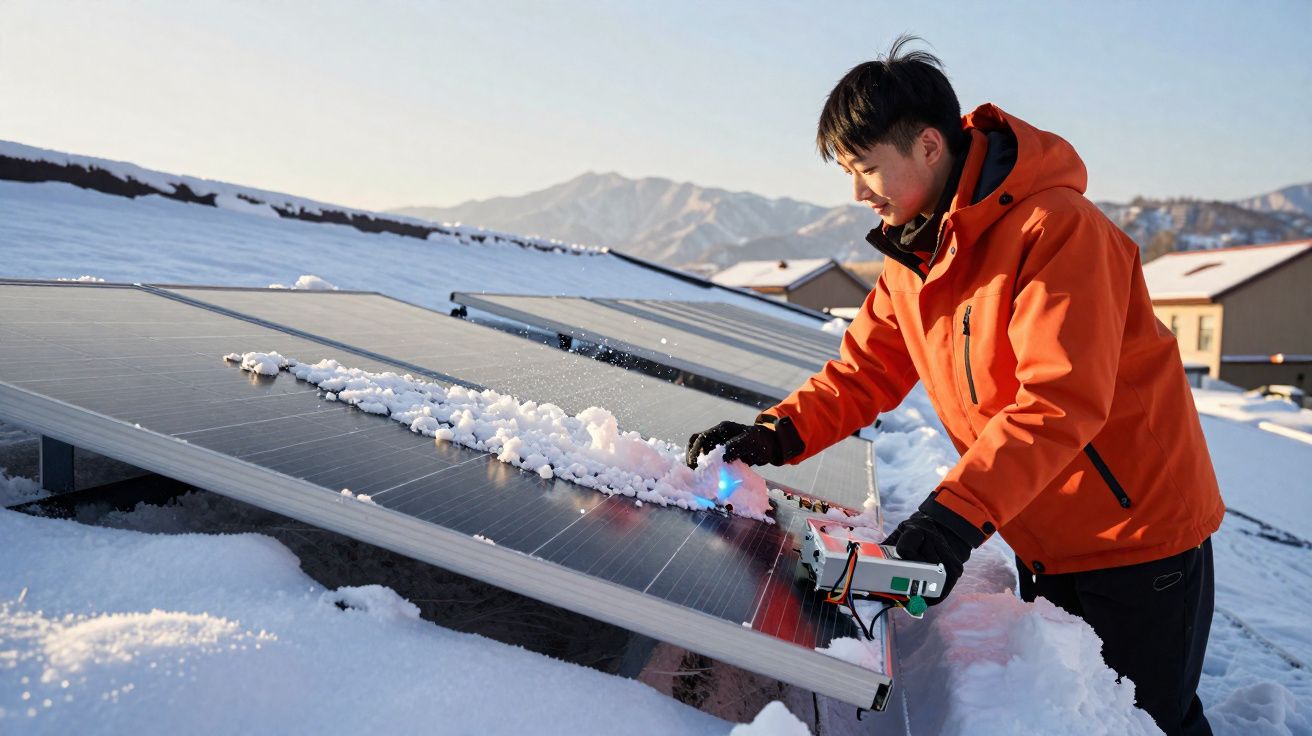
Snow: an annoying winter nuisance?
Researchers are flipping the script: of all things, snowflakes could become a new source of energy.
While many people associate snowfall with icy roads and chilly homes, engineers at the University of California, Los Angeles (UCLA) see something else entirely: an enormous resource that is largely going to waste. Their aim is to harness snowflakes so they can generate electricity-and, over the long term, even produce green hydrogen, at least in theory, for millennia.
Snow, electricity and a surprisingly simple effect
The premise sounds almost too straightforward: snow naturally becomes electrically charged. When it comes into contact with certain materials, it can trigger what is known as triboelectricity (electricity from friction/contact). That is exactly where the researchers’ system-dubbed “Snow-TENG”-comes in: a snow-based triboelectric nanogenerator.
"The basic idea: if snow already generates electrical charge on its own, that effect can be tapped technically and converted into usable energy."
At the heart of it is a simple interaction: snowflakes carry a positive charge and readily give up electrons. If the snow meets a surface with an opposite charge, electrons jump across-producing an electrical current. The underlying principle has been known for some time, but applying it specifically to falling and settling snow is new.
What “triboelectric” actually means
“Triboelectricity” may sound like cutting-edge jargon, yet it describes a very familiar phenomenon. When a wool jumper crackles with static or a plastic ruler makes hair stand on end, the same mechanism is at work: contact and friction separate electrical charges.
A triboelectric generator deliberately exploits this. Two different materials touch (or rub), then separate again. Electrons move, a voltage difference develops, and that can be drawn off as electricity. Snow-TENG transfers this concept to the contact between silicone and snowflakes.
Why silicone comes out on top
To make the effect useful, the system needs a material that can take on as many electrons as possible. The team led by Professor Richard Kaner and researcher Maher El-Kady trialled a wide range of candidates-metals, plastics and composite materials. In the end, silicone proved the best fit.
- inexpensive to manufacture
- available at scale
- flexible and easy to shape
- suitable as a thin, transparent layer
This silicone layer is the core of Snow-TENG: a clear, flexible plastic film that lets light through while also turning snow contact into electrical output.
How Snow-TENG could sit on top of solar panels
The concept becomes most compelling when paired with existing photovoltaic systems-precisely the combination the researchers have in mind. The Snow-TENG film would be placed directly over solar panels.
In practical terms:
- When the sun is shining, light passes through the transparent film and reaches the solar cells.
- When snow falls, some flakes settle on the surface and generate electrical charge as they touch the silicone.
- That charge can be collected as electricity and then processed further.
This approach tackles more than one problem at once. Solar panels often underperform in winter when modules are covered by snow; Snow-TENG could convert part of that “winter burden” into additional energy instead. At the same time, the Snow-TENG layer also adds a degree of protection for the solar cells by reducing their direct exposure to ice and precipitation.
Quiet, passive and printable
Compared with wind turbines or hydroelectric dams, Snow-TENG is almost understated. It has no moving, noisy components and runs entirely passively. The researchers highlight several advantages:
- no noise and no rotating blades
- manufacturable using straightforward 3D-printing methods
- material costs far lower than those of conventional power stations
- no extra land take if the film is applied to existing installations
That makes the technology particularly relevant for snow-prone areas where solar generation can falter at exactly the time demand tends to rise.
From snowflakes to hydrogen: energy for “millennia”
The most ambitious part of the team’s vision lies in what they intend to do with the electricity produced. Rather than using it only for lights, sensors or small devices, they want to take it a step further-towards hydrogen production.
"The electricity generated can be used directly for electrolysis: hydrogen is obtained from melted snow, a clean energy carrier."
Electrolysis uses electricity to split water molecules into hydrogen and oxygen. Under normal conditions, the process consumes a lot of energy and is often only economical when powered by fossil-derived electricity. If the required power comes from snow, the overall cycle becomes markedly more climate-friendly:
- Snow falls from the sky at no cost.
- Snow-TENG generates electricity from the friction/contact of the flakes.
- The electricity splits melted snow into hydrogen.
- The hydrogen can be stored, transported and later converted back into energy.
The researchers talk about potential spanning “millennia” because snowfall is expected to continue in many parts of the world over the long term-even if climate change reduces snow reliability in some locations. From a purely physical standpoint, the cycle can be repeated whenever water continues to fall as snow.
Where the technology would make the most sense
Snow-TENG is primarily aimed at places where winter reliably brings snow and where electricity grids may be limited. Examples include:
- remote mountain villages with rooftop solar panels
- ski resorts with high demand for lifts and snowmaking equipment
- research stations in Arctic and alpine regions
- rural areas in North America, Scandinavia or Central Asia
In these settings, Snow-TENG films could be laid over existing solar surfaces, creating hybrid systems: standard photovoltaic generation when conditions are sunny, plus additional electricity from triboelectric effects when snow is falling.
What still stands in the way
Despite promising early results, the researchers are still at an early stage. The electricity produced per square metre is currently well below the yield of modern solar modules. For large-scale deployment, several things must happen:
- further increases in material efficiency
- long-term testing of service life and weather resistance
- development of suitable storage systems for the hydrogen produced
There is also a practical question that cannot be answered in a lab alone: how does the film cope with wet, heavy snow, hail, or dirt build-up? Many concepts that work in controlled conditions fail under real-world wear and tear-so field testing is now a key focus for the teams.
Small-scale, real-world uses already in sight
Even at modest output levels, triboelectric generators can already be put to work, for example to:
- power sensors at remote weather stations
- supply small loads such as LED lights on avalanche barriers or mountain road signs
- run data loggers in winter-sports areas without relying on the grid
With higher efficiency and continued advances in materials, later versions could support larger consumers or serve as a supplementary technology alongside solar farms.
Risks, opportunities and what comes next
This technology will not replace fossil fuels in the near term. Right now, the energy yield per unit area is too low, and dependence on weather and seasons is too high. Its value is more about filling gaps where established systems struggle: cold, low-sunlight, snow-heavy periods.
For energy providers and solar operators, that means another component in an increasingly varied mix of wind, solar, hydropower, geothermal energy and storage technologies. The more seamlessly such systems can be combined, the more resilient and independent the energy supply becomes.
Snow-TENG could also become economically attractive if printing methods and material costs continue to fall. Thin films that can be rolled up, shipped easily and laid over existing installations could lower the barrier to adoption. In places where infrastructure is expensive or must withstand extreme conditions, a lightweight, passive system is particularly appealing.
One thing is clear: as long as winter keeps sending white flakes from the sky, they contain more than romance and traffic disruption. Turning every layer of snow into a miniature power source gives the idea of “white gold” an entirely new meaning.






Comments
No comments yet. Be the first to comment!
Leave a Comment