
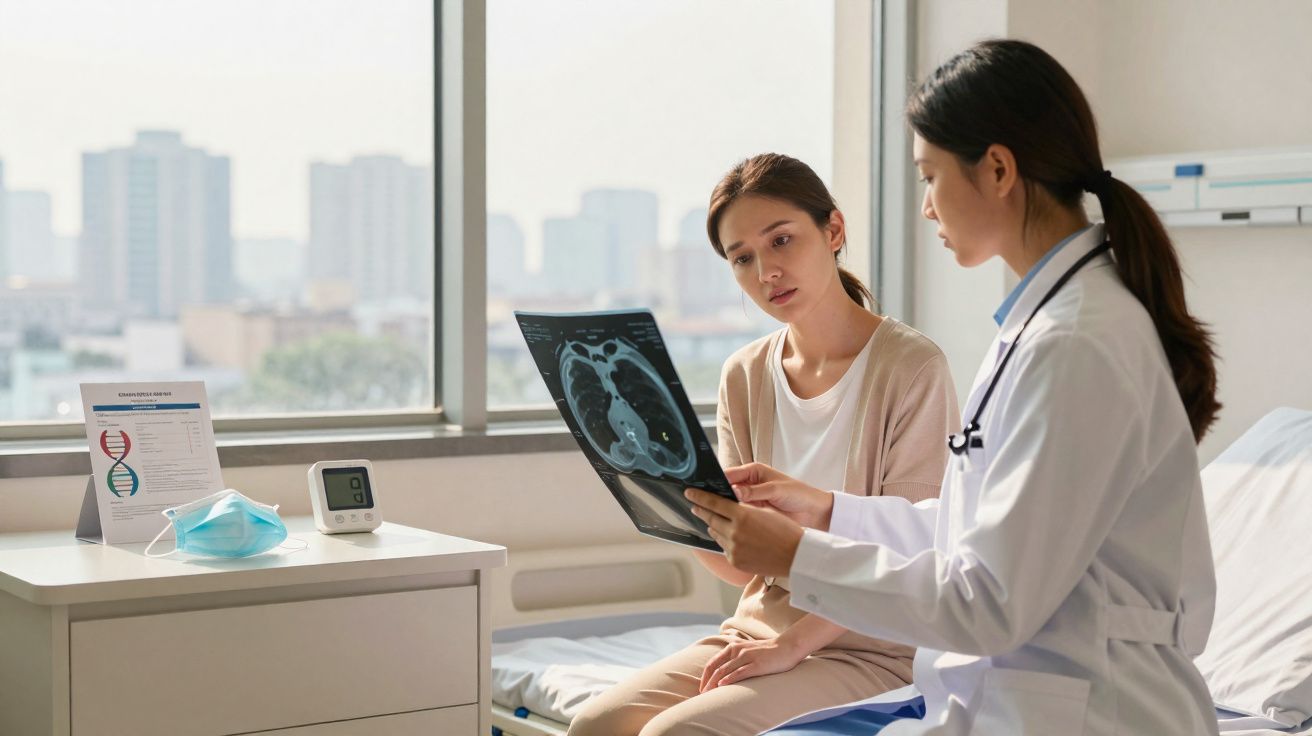
Lung cancer remains the deadliest form of cancer, and tobacco still plays the leading role. Yet clinicians have been noting a quiet shift for several years: a growing proportion of people diagnosed have never smoked. Air pollution, radioactive gases in the home and particular genetic changes are moving to the forefront - with implications for diagnosis, treatment and prevention.
Lung cancer: more than a smokers’ disease
In everyday conversation, many people simply say “lung cancer”, but in medical terms it refers to a group of different tumours. They usually develop in the bronchi and bronchioles - the airways that carry inhaled air deep into the lungs.
Doctors mainly distinguish between two broad types:
- Small-cell lung carcinoma: accounts for about 15% of cases, grows very rapidly and is strongly linked to tobacco use - in the vast majority of cases, smoking is the underlying cause.
- Non-small-cell lung carcinoma: includes the remaining tumours, typically grows more slowly and is more treatable. Around 40% of these are so‑called adenocarcinomas, which occur particularly often in non-smokers and in women.
Lung cancer is among the most common cancers overall: it ranks second in men and third in women. In France, for example, professional bodies estimate around 40,000 new cases each year. Looking specifically at people who have never smoked reveals a clear trend: about one in ten affected men and up to 40% of affected women have never actively smoked. Oncologists find this development deeply worrying.
"Lung cancer no longer affects only heavy smokers - the share of people without a tobacco history is rising markedly."
When lungs become ill without cigarettes
In smokers, toxic smoke particles primarily hit the larger bronchi. There they damage the lining, alter cells and can set cancer in motion. In people who do not use tobacco, the picture is often different: tumours more frequently arise in the tiniest air spaces, the alveoli - deeper within lung tissue.
Estimates suggest that lung cancer in never-smokers is already the fifth most common cause of cancer death worldwide. One striking feature is that women and people of East Asian heritage are affected disproportionately. Symptoms - persistent cough, shortness of breath, fatigue, sometimes chest pain or weight loss - can seem non-specific at first. Many people think of bronchitis or asthma rather than cancer, and this often delays diagnosis.
Even so, survival prospects for non-smokers are somewhat better than for heavy smokers. These tumours often grow more slowly and respond better to certain modern medicines.
Genetic features in lung cancer open new doors to treatment
In recent years, researchers have examined the tumour cells of non-smokers more closely. Distinct genetic patterns stand out: particular genes are altered, or “mutated”, in many of these tumours.
Commonly affected genes include:
- EGFR - controls cell growth
- ALK - involved in cell signalling
- KRAS - regulates signalling pathways for cell division
- Other, less frequently affected genes that are specifically tested in the laboratory
Such mutations can drive tumour growth. Oncologists use this fact therapeutically: so‑called targeted medicines can block these altered signalling pathways.
"If you know a tumour’s genetic weaknesses, you can choose treatments more precisely - a core principle of personalised medicine."
Before treatment begins, specialist laboratories are therefore increasingly analysing the genetic material of the cancer cells. If a suitable mutation is found, specific tablets or infusions may be used that act far more selectively than traditional chemotherapy. This helps spare healthy cells and can significantly improve quality of life.
Why genetic testing is gaining importance in lung cancer in non-smokers
For people without a tobacco history, a comprehensive molecular analysis is particularly worthwhile. Characteristic mutation patterns are more common in this group, and the chance of benefiting from targeted therapies is correspondingly higher. As a result, treatment can differ substantially from the standard approach used for many heavy smokers with lung cancer.
What triggers lung cancer in non-smokers?
When cigarettes are not the cause, the obvious question remains: where does the cancer come from? Research is providing early - though still incomplete - answers.
Radon, asbestos and other hidden hazards
One major factor is exposure to certain harmful substances, especially:
- Radon: a naturally occurring radioactive gas that is colourless and odourless. It can seep from the ground into basements and ground floors, particularly in areas with granite-rich or volcanic geology. After smoking, radon is considered the second most common cause of lung cancer worldwide.
- Asbestos: once widely used in building materials. When fibres are inhaled, they can cause lung cancer and mesothelioma - often decades after exposure.
- Occupational exposures: for example, certain metals, solvents or exhaust fumes in industry, construction or mining.
However, the rise in cases among non-smokers cannot be explained by radon alone. Increasingly, attention is turning to the air we breathe every day.
Fine particulate matter, diesel soot and polluted air
The World Health Organization’s international cancer research arm now officially classifies polluted outdoor air as carcinogenic. Fine particulate matter is particularly relevant - produced largely by the burning of diesel, coal and wood. These particles are so small that they can penetrate deep into the lungs and trigger inflammation.
Estimates suggest that air pollution already contributes to several million premature deaths worldwide each year. Lung cancer is only one consequence; heart attacks, strokes and respiratory diseases are also part of the toll. In regions with extremely poor air quality - for example in parts of East Asia - the high number of lung cancer cases among never-smokers is especially noticeable.
Why women are affected more often - does hormone profile play a part?
The fact that so many non-smoking women develop lung cancer is driving research forward. One line of enquiry points to female sex hormones. Oestrogens and progesterone generally promote cell division, and lung cells have receptors for these hormones - meaning they respond to their signals.
One hypothesis is that, in some people, hormones could further fuel the growth of already altered cells. Whether this effect exists and how large it is has not yet been definitively established. What is clear is that sex influences the patterns and frequency of certain lung cancer types.
How non-smokers can reduce their risk of lung cancer
The risk of lung cancer can never be eliminated completely - even with an exceptionally healthy lifestyle. Even so, there are practical steps that can reduce personal exposure:
- Avoid second-hand smoke: cigarette smoke indoors contains almost the same toxins as active smoking. If family or friends smoke, agree clear outdoor smoking areas.
- Keep an eye on air quality: on days with high fine-particulate levels, avoid intense exercise outdoors and steer clear of heavily trafficked roads.
- Have your home checked: in areas known to have elevated radon, testing is worthwhile. If levels are high, sealing measures and improved ventilation can help.
- Protect yourself at work: in jobs involving dust, fumes or chemicals, insist on suitable protective equipment and effective extraction systems.
- Pay attention to warning signs: a cough lasting longer than six weeks, recurring bronchitis, unexplained breathlessness or weight loss should be assessed by a clinician.
"Non-smokers are not automatically ‘out of danger’ - taking symptoms seriously can make an early-stage diagnosis possible."
Why early diagnosis and new therapies offer hope
Lung cancer is often detected late because it causes few symptoms at the start. The earlier clinicians spot suspicious shadows on an X-ray or a CT scan, the greater the chance of removing the tumour surgically or keeping it under control with modern methods.
For non-smokers in particular, targeted medicines and immunotherapies are opening new possibilities. Tumours with EGFR or ALK mutations often respond to specialised tablets that block cancer signalling pathways. Immunotherapies, in turn, activate the body’s own defences so the immune system can recognise and attack cancer cells more effectively.
Together with more precise imaging and steadily improving surgical and radiotherapy techniques, the likelihood is growing that lung cancer will become less often fatal in future - even though the disease remains stubborn.
Additional risks and unanswered questions
It is not yet fully understood what long-term role repeated infections, chronic airway inflammation or childhood exposure to fine particulate matter might play. Some studies suggest that persistent irritation of lung tissue could raise the risk of later cellular changes.
Inherited susceptibility may also matter more than previously thought. In some families, lung cancer cases cluster even though hardly anyone smokes. Researchers are investigating whether specific inherited variants make some people more sensitive to harmful exposures.
For everyday life, the message remains: non-smokers should not assume they are safe by default. Monitoring weight, cough and breathlessness, reducing exposure to air pollutants, and seeking medical advice early when symptoms persist can materially improve the odds - even if the disease can never be prevented entirely.






Comments
No comments yet. Be the first to comment!
Leave a Comment