
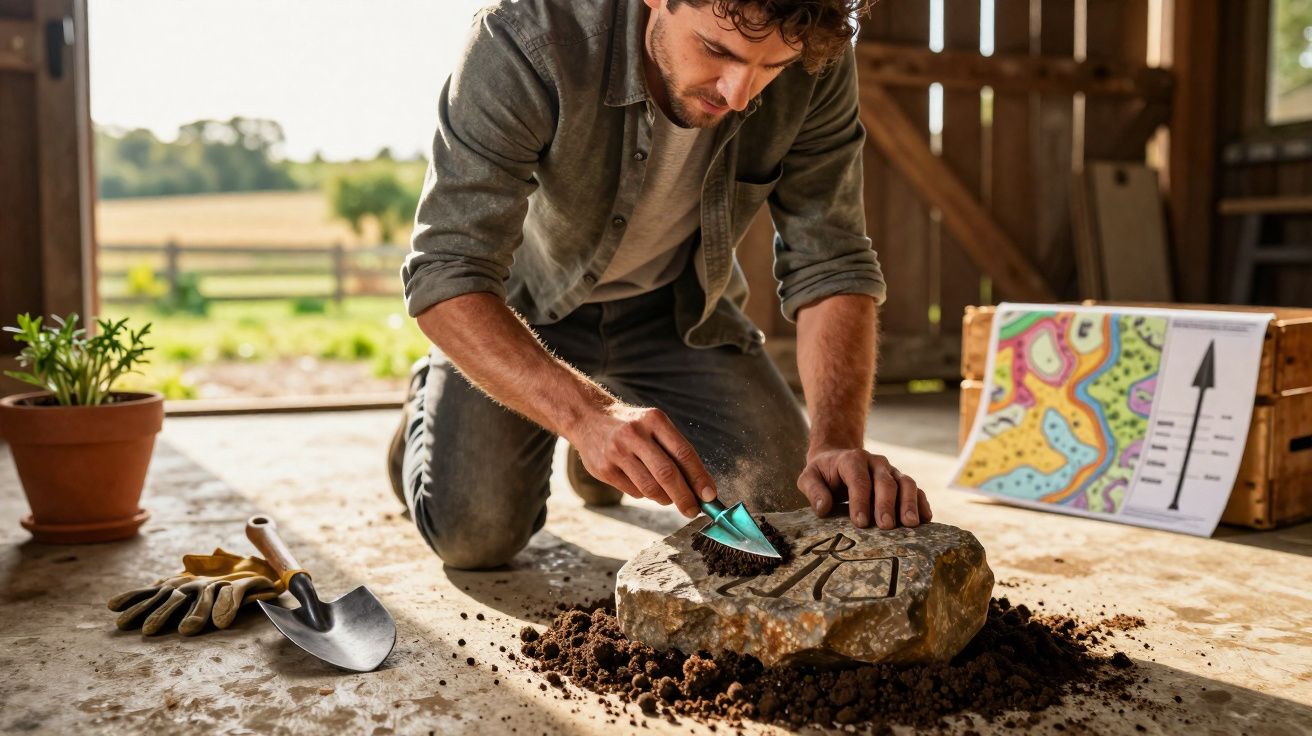
What first served as a mundane building block in a barn foundation has turned out to be a highly precise casting stone for bronze spearheads. Archaeologists see it not only as a technical tour de force, but also as tangible evidence of far-reaching trade and warfare networks in Central Europe more than 3,000 years ago.
From a barn “support stone” to a scientific sensation in Morkůvky
The story starts in 2007 in the village of Morkůvky in South Moravia (today the Czech Republic). A local resident notices a rectangular, grey stone slab protruding slightly from the soil in his garden. For years, the stone had been sitting there as a simple support within the foundations of his barn.
The slab looks unusually regular. Its edges and outlines are far too precise to be a random fieldstone. He lifts it out and sets it aside-without realising what he has actually found. Only in 2019 does he take the object to the Moravian Museum in Brno.
There, archaeologist Milan Salaš carries out the first thorough examination. It quickly becomes obvious that the “barn slab” is anything but ordinary. The stone is about 23 centimetres long, weighs roughly 1.1 kilograms, and on one face bears a neatly recessed cavity-exactly the silhouette of a bronze spearhead.
“The stone proves to be one of the best-preserved casting moulds for a bronze spearhead in all of Central Europe-and dates to around 3,300 years ago.”
A detailed academic study is not published until 2025. That leaves 18 years between a garden discovery and a specialist paper-an example of how slowly spectacular finds can sometimes make their way into research.
How the Morkůvky casting mould produced a bronze spear
The slab is only one half of a two-part casting model. The other half is considered lost, but the surviving side is sufficient to reconstruct the full manufacturing process.
How weapon production worked
- Two stone mould halves were aligned precisely against one another.
- A copper wire held the halves tightly together.
- Molten bronze was poured in from the top through a narrow channel.
- Once cooled, the craftspeople separated the halves and removed the finished point.
The engraved negative shows a so-called leaf-shaped socketed spearhead: the base of the point is hollow so that it could be fitted onto a wooden shaft. Longitudinal ribs run from the socket across the blade’s wings. They stiffen the weapon, make it more resistant to breaking, and improve penetration into the target.
Researchers also find clear traces of intense heat exposure on the stone’s surface. Cracks, discolouration, and small flakes missing from the surface show it was not used only once. Salaš and his team assume that “up to several dozen” spearheads were cast with it. In other words, this was not a one-off experiment, but unmistakable serial production.
“The find shows that, as early as the Late Bronze Age, craftspeople worked with reusable moulds capable of producing weapons in consistent quality and in large numbers.”
Geology shows the mould stone travelled a long way
Almost as striking as the mould itself is the raw material it is made from. To determine the stone’s origin, researchers used high-end analysis. Geologist Antonín Přichystal examined the slab using X-ray diffraction, a technique that analyses the crystal structure of rock.
The result: the stone is rhyolitic tuff, a volcanic rock type. Such stone does not occur in South Moravia. Known sources lie hundreds of kilometres away, including the Bükk Mountains in northern Hungary and the area around the city of Salgótarján, near today’s border with Slovakia.
That makes one point clear: the stone did not come from the vicinity of Morkůvky. Someone transported it over a substantial distance-around 3,300 years ago, long before paved roads, vehicles with metal-rimmed wheels, or accurate maps.
For the researchers, this is an unambiguous signal:
- There were organised trade routes across the Carpathian region.
- Raw materials were selected deliberately for their technical qualities.
- A connected economic zone linked what is now Hungary, Slovakia, the Czech Republic, and surrounding areas.
The mould therefore demonstrates not only craftsmanship but also logistical planning. Whether traders, itinerant craftspeople, or military patrons-someone ensured this specialist stone reached the place where it was needed.
The Urnfield culture: a network of warriors
The find can be assigned to a specific archaeological culture: the Urnfield culture. It shaped Central Europe roughly between 1300 and 800 BC. The name comes from its burial rite: the dead were cremated and the bone remains placed in clay urns.
This cultural horizon stretched from Austria through Bohemia and Moravia as far as Serbia. In this period, evidence increasingly points to clearly organised warrior elites. Weapons were no longer merely tools; they also functioned as status symbols and instruments of political power.
Standardised weapons for a warrior elite
The spearheads produced with this mould belong to a typical weapons kit of the era. Archaeologists frequently encounter in graves and hoards:
- Socketed spears with longitudinal ribs
- Metal shields
- Bronze greaves
- Swords made to standardised forms
Such standardisation is revealing: those producing these weapons were planning for larger troop groupings that needed to be re-equipped reliably and quickly. Ancient texts such as the Iliad, which describes fighting around Troy, depict warriors carrying two spears-one to throw and one kept in reserve.
“The stone mould from Morkůvky symbolises an early ‘arms industry’, in which weapons were made to a standard and distributed across regions.”
What the find reveals about Bronze Age technology and everyday workshop life
The mould also opens a window onto Bronze Age workshop routines. To make a form like this, craftspeople had to understand metal shrinkage during cooling, judge the flow behaviour of molten metal, and control the properties of the stone itself.
Rhyolitic tuff is well suited to the job: it is relatively soft to work, yet withstands high temperatures. Drilling, smoothing, and shaping such a stone with precision represents many hours of labour. The fact it was used repeatedly underlines how valuable this tool was.
At the same time, its serial character suggests that bronze equipment was not reserved solely for elites. Once casting tools remain in service for longer, unit costs fall. That makes it possible to equip more fighters with comparable weapons-an important factor in power balances and battlefield tactics.
What hobby gardeners and non-specialists can learn from Morkůvky
The Morkůvky case illustrates, very concretely, how easily remarkable finds can remain unnoticed for decades. Many archaeological objects first end up in everyday use-as doorstops, stepping stones, or garden decoration-before someone realises something is off.
If you find unusual stones or metal pieces in the garden, on farmland, or during renovation work, a few basic rules of thumb help:
- Regular shapes, smooth recesses, or sharp edges are worth questioning.
- Unusually heavy, small metal pieces could be bronze fragments.
- It is better to send a photograph to a local museum than to throw the object away.
Some countries require such discoveries to be reported. Anyone who checks the rules and cooperates can help close gaps in our knowledge of the past-just as the farmer from Morkůvky did, whose seemingly ordinary slab now provides one of the most important clues to Late Bronze Age trade and warfare networks.





Comments
No comments yet. Be the first to comment!
Leave a Comment