
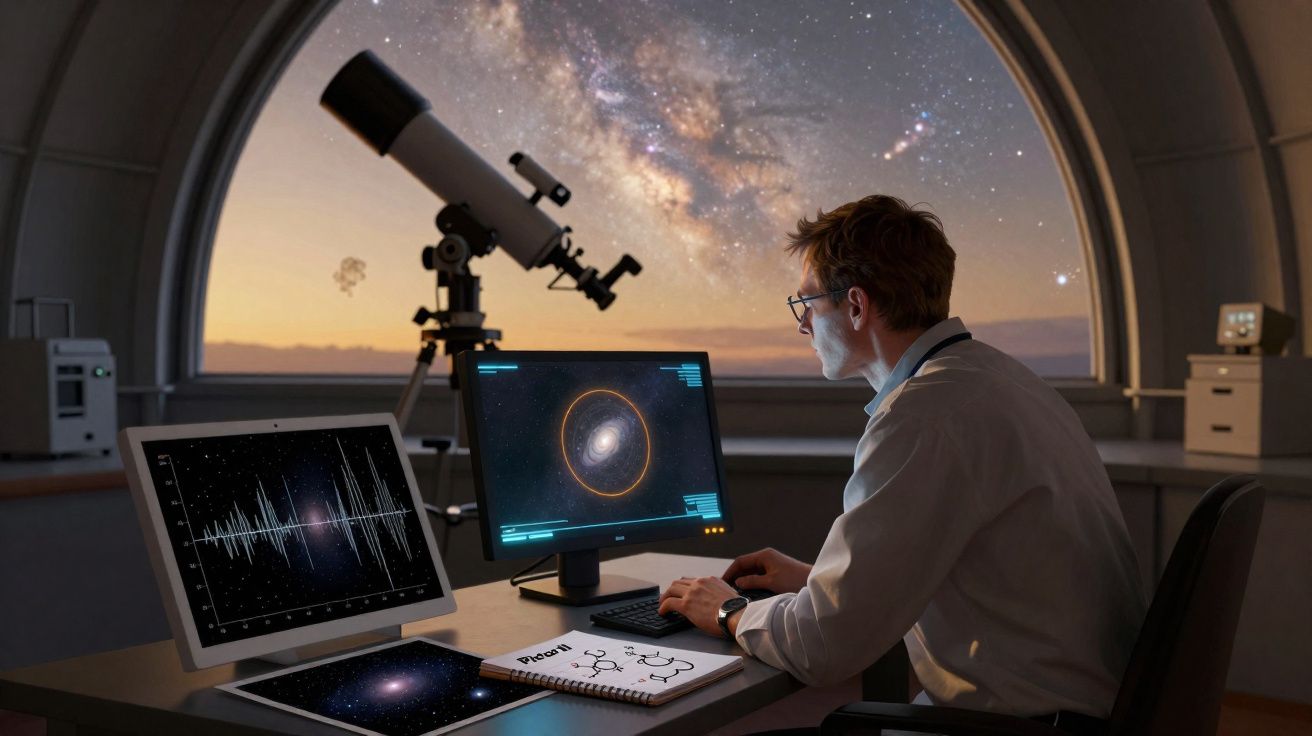
In a tiny dwarf galaxy, researchers have tracked down a star that is almost entirely devoid of heavy elements. Its chemical fingerprint looks like a preserved record from the first few hundred million years after the Big Bang - and it offers clues about how the next generation of stars formed from the very first stellar explosions.
A faint star in an overlooked dwarf galaxy: PicII-503 in Pictor II
The newly identified star goes by the matter-of-fact designation PicII-503. It orbits within the ultra-faint dwarf galaxy Pictor II, about 149,000 light-years from Earth. These small satellite galaxies of the Milky Way are often described as cosmic deep-freezers: much of their gas has remained largely unchanged since the Universe’s earliest epochs.
That is exactly why Pictor II is such a promising hunting ground for astronomers searching for ancient stars. In large galaxies like the Milky Way, gas is continually stirred, mixed, and enriched. In dwarf systems, by contrast, primordial material can persist for much longer with far less “recycling”.
"PicII-503 behaves like a frozen snapshot: its gas still carries traces of the very first stellar explosions."
On its face, PicII-503 is not impressive - its brightness is unremarkable. It becomes truly interesting only when scientists examine its spectrum, meaning its light split into wavelengths. From that, they can infer the relative abundances of different chemical elements.
Record-setting “metal-poor”: rarely has a star been so empty
In astronomy, anything heavier than helium counts as a “metal”. PicII-503 contains almost none of these metals. Its chemical analysis revealed extraordinarily low amounts of iron and calcium.
- Iron: only about 1/43,000 of the Sun’s value
- Calcium: only about 1/160,000 of the Sun’s value
- An exceptional lack of metals compared with all stars previously known outside the Milky Way
Stars like this are termed “metal-poor”. PicII-503 pushes that label into territory researchers had scarcely expected to find in such a small galaxy. A handful of stars with similarly tiny metal content do show up in wide-sky surveys, but they are usually located in the outer halo of the Milky Way.
What stands out here is the combination: vanishingly few metals, together with a highly unusual pattern in how the remaining elements are distributed.
A chemical imbalance: extreme carbon in PicII-503
While iron and calcium are almost absent, one element is conspicuously enhanced: carbon. The team measured extremely high carbon-to-heavy-element ratios.
| Comparison | Ratio in PicII-503 |
|---|---|
| Carbon to iron | about 1,500 times higher than the ratio in the Sun |
| Carbon to calcium | about 3,500 times higher than the solar ratio |
This kind of extreme carbon enhancement is widely considered a hallmark of a very early stellar population. It suggests that the gas in Pictor II was shaped by a single, distinctive event before PicII-503 formed.
"The unusual mix of near metal-free gas and a carbon surplus reflects the chemical after-echo of the first massive stars."
In specialist terms, PicII-503 belongs to the second generation of stars: it formed from gas that had already been influenced by at least one earlier star, yet it carries only the faintest trace of enrichment.
A quiet explosion: when “fallback” swallows the heavy elements
How does such a lopsided chemical balance arise? The observations point towards a supernova with comparatively low energy. The progenitor of PicII-503 was likely a very massive, first-generation star made only of hydrogen and helium.
When such a star ends its life in a supernova, it typically ejects the elements it forged into surrounding space. For PicII-503, the picture appears different: the evidence favours a fallback supernova.
- The star explodes, but the blast is relatively weak.
- Heavy elements such as iron fall back after the explosion into the newly formed compact remnant - for instance a neutron star or a black hole.
- Lighter elements like carbon are more likely to escape and mix into the surrounding gas.
PicII-503 later formed from exactly this lightly “seasoned” gas. That neatly accounts for both the extreme deficit of heavy elements and the pronounced carbon surplus. Researchers have seen similar signatures in a small number of extremely metal-poor stars in the Milky Way’s halo.
Cosmic archaeology: what the find reveals about the first stars
Astronomers often refer to this kind of work as cosmic archaeology. Instead of excavating pottery shards or bones, they “dig” spectra and faint signals out of the sky. Every exceptionally ancient or chemically pristine star offers clues about what the first stars were like and how they died.
The earliest stellar generations in the Universe were very different from our Sun. They were composed almost entirely of hydrogen and helium, were probably very massive, and lived only briefly. The heavy elements - the stuff that makes planets, rocks, and ultimately life possible - were manufactured inside these stars and dispersed through their explosions.
"Without these early stellar giants, there would be neither Earth nor humans - they produced the building blocks for all later planetary systems."
PicII-503 reads like a second chapter of that narrative: it formed from gas that was altered only once - and in a distinctly unusual way - by one of those early stars. The new study indicates that this picture applies not only in the Milky Way, but also in distant dwarf galaxies.
Why dwarf galaxies are such valuable archives
Ultra-faint dwarf galaxies like Pictor II contain only a few million stars, and some host far fewer still. Their low mass meant they experienced fewer episodes of star formation over cosmic time. As a result, their gas has been less heavily “reprocessed” than the gas in large galaxies.
That gives researchers a crucial advantage: processes from the early Universe can be isolated more cleanly. A single rare event - such as a low-energy supernova - can leave an outsized imprint on the chemistry of an entire dwarf galaxy, with traces preserved in stars like PicII-503.
With every new discovery in these systems, a more coherent picture of element formation takes shape. The striking resemblance between PicII-503 and extremely metal-poor stars in the Milky Way’s halo suggests that these early processes followed similar patterns regardless of environment.
What “metallicity” actually means
The term “metallicity” appears constantly in stellar research and can be misleading. To a chemist, carbon is not a metal; to an astronomer, it is. In astronomy, “metal” is simply a convenient umbrella label for everything heavier than helium.
Low metallicity implies:
- The star formed from highly primordial gas.
- There were few - or only very specific - supernova events before the star’s birth.
- Planet formation around such stars is harder, because dust and solid building blocks are scarce.
Our Sun, by comparison, is “metal-rich”. It was born in an environment shaped by many previous generations of stars. That helps explain why our Solar System contains so much rock, metal, and complex chemistry.
The questions PicII-503 raises for the future
Finding PicII-503 beyond the Milky Way does more than set a new benchmark; it also sharpens the agenda for upcoming telescopes:
- How common are such extremely metal-poor stars in dwarf galaxies, really?
- Were low-energy supernovae frequent in the early Universe, or are they rare special cases?
- What role did they play in the later formation of galaxies, stars, and planets?
With instruments such as the James Webb Space Telescope - and future extremely large ground-based telescopes - astronomers should be able to detect even fainter stars in far more distant dwarf galaxies. Each additional example could shift the picture, or ideally confirm that the unusual star PicII-503 is a typical messenger from the transition period between the very first stars and the generations that followed.
For readers wondering what this means in practical terms: the elements in our bones, in a smartphone casing, or in a gold ring trace their origins back to exactly such early stars and their descendants. By analysing PicII-503, researchers are ultimately reconstructing a very distant chapter of our own origin story.






Comments
No comments yet. Be the first to comment!
Leave a Comment