
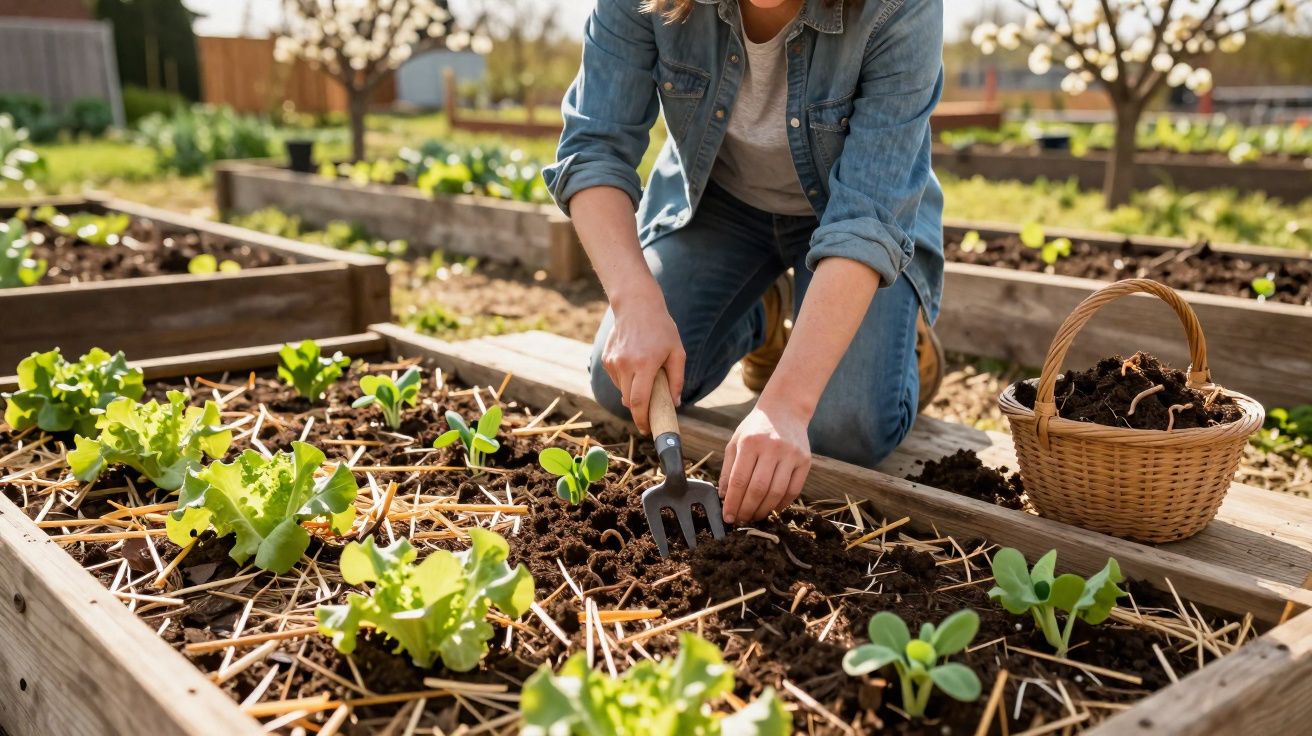
The first mild day arrives, your hands start itching and the spade is already leaning by the door: time to “dig the vegetable bed nice and deep”. For decades, that was treated as a non-negotiable job in any respectable garden. Yet modern soil science - and what seasoned gardeners have learned the hard way - suggests this tradition often causes more harm than good, throwing your soil life out of balance.
Why deep digging can really hurt your soil
Life is anything but quiet beneath the surface. In the top 20 centimetres of healthy soil, microorganisms and tiny creatures are present in huge numbers. In just 1 gram of earth, there are estimated to be between 100 million and 1 billion bacteria - alongside fungi, nematodes, minute arthropods and, of course, earthworms.
Together, they form an intricate system that releases nutrients, holds onto water and keeps soil structure stable. Crucially, each layer has its own communities: some tolerate oxygen, others do not; some prefer wetter conditions, others drier.
"Turning the soil over completely disrupts this finely tuned system and weakens it just as the growing season begins."
What typically happens when you dig in the traditional way:
- Organisms from deeper, oxygen-poor layers are brought to the surface and die off.
- Microbes and tiny animals adapted to light and air are pushed down into dark, damp depths.
- Fine root channels and stable soil crumbs are broken apart.
- After turning, the soil dries out faster and is more prone to capping and becoming waterlogged on the surface.
There’s also a factor many people underestimate: fungal networks - so-called mycorrhizal networks - are effectively torn apart by digging. These fungal threads connect plant roots to nutrients in the soil and can multiply the effective uptake area many times over. If you destroy those networks every year, you remove a key support system for your vegetables.
Gentle loosening instead of churning: how a digging fork works for vegetable beds
A far more soil-friendly option is a wide digging fork with multiple tines, commonly sold as a double digging fork or bio fork. It loosens the soil at depth without flipping the layers over.
The method is straightforward:
- Step the tines vertically into the soil.
- Pull the handle carefully towards you until the soil lifts slightly.
- Do not turn the earth over - only loosen it.
- Move on step by step, working in overlapping sections.
This creates air channels and breaks up compaction while leaving the soil horizons largely where they are. Soil organisms keep their familiar environment, and fungal networks remain intact to a large extent.
Benefits for your back and joints with a double digging fork
This approach can be a genuine relief, especially for older gardeners or anyone with a sensitive back. The fork’s levering action replaces the heavy lifting, shovelling and twisting that come with a spade. You rely more on body weight and less on brute force.
"Once you’ve got the hang of the double digging fork, you’ll usually be reluctant to pick up a traditional spade again."
A fork works best when the soil is slightly moist: not bone dry (the tines struggle to penetrate) and not soaking wet (you’ll create large clods). Many gardeners find the sweet spot is the day after a substantial spring rainfall.
Mulch instead of bare soil: the quiet revolution in the vegetable bed
Choosing the right tool is only part of the story - what you do after working the soil matters just as much. In nature, bare ground is the exception, not the rule. In woods, meadows and even along paths, there is almost always a layer of organic matter on top.
That is exactly what mulching imitates: covering the soil with a layer of organic material, such as:
- straw or hay (ideally unsprayed)
- shredded, dry leaf litter
- dried grass clippings
- wood chips from untreated branch prunings
This cover produces several effects that quickly become noticeable in a kitchen garden:
| Effect | Benefit in the garden |
|---|---|
| Moisture retention | Less watering, and plants cope better through dry spells |
| Temperature moderation | Roots are less likely to freeze at night and won’t overheat during the day |
| Protection from surface sealing | After heavy rain, the surface stays crumbly; water soaks in instead of running off |
| Food for soil life | Earthworms and microbes break down the mulch and build humus |
| Weed suppression | Fewer weeds, less time spent weeding |
For anyone who doesn’t want to spend hours bent over, the reduction in effort is obvious: fewer weeds to pull, fewer watering cans to carry, and far less hoeing. The bed stays low-maintenance for much longer.
What really happens when soil is left undisturbed
Modern soil science makes it clear that plants are not passive recipients of whatever a gardener adds. Through their roots, plants release sugars and other substances specifically to attract microorganisms. In return, those microbes supply nutrients that plants would struggle to access on their own.
A few key players in this partnership:
- Nitrogen-fixing bacteria bind nitrogen from the air and make it available to plants.
- Mycorrhizal fungi increase the effective root surface area and tap into more distant nutrient reserves.
- Earthworms pull organic material down, mix it with soil, and leave behind nutrient-rich casts.
"If you dig rarely, you encourage a stable soil system that makes vegetables tougher and less prone to problems."
Vegetables growing in such an active soil generally manage with less fertiliser and less water. They tend to root more deeply, ride out dry periods better and show nutrient deficiencies less often. Many experienced vegetable growers report that after a few years of “gentle” soil cultivation, yields tend to rise rather than fall.
A practical spring plan: what to do instead of deep digging
If you’ve been turning the bed over completely every year, you don’t need to change everything overnight. A careful transition is more than enough.
Step by step towards a soil-friendly bed
One workable routine for the coming gardening year:
- Loosen the soil with a double digging fork or a standard digging fork - do not turn it.
- Spread a layer of mature compost about 5 centimetres thick over the surface.
- Mulch beds straight away if they won’t be planted immediately.
- Later, plant or sow directly into the loosened, mulched area.
If you have very heavy, compacted clay, you may need a one-off deeper intervention to break up the “concrete slab”. The key is not to make that an annual habit - instead, move forward long-term with compost and mulch.
Common questions: slugs, cold soil and “too much mulch”
Many gardeners hesitate for familiar reasons. Three concerns come up again and again:
Do mulch layers attract more slugs?
Damp, dense heaps of mulch right next to young lettuces really can be slug heaven. Using coarser material such as straw, keeping the layer from getting too thick, and leaving sensitive young plants a little exposed at first reduces the risk significantly.Does soil under mulch stay too cold?
In early spring, bare soil does warm up faster. For very early crops, it can help to leave individual rows uncovered at first and mulch later. From late spring onwards, the temperature-balancing effect is beneficial.Can you mulch too much?
An extremely thick, airtight layer of fresh, wet grass clippings can rot and smell. Better to apply several medium layers made from mixed materials, allowed to dry a little, and top up from time to time.
Why this shift in thinking pays off in the long run
When you disturb your soil less and feed it steadily, you build a resilient system over time. You’ll see it not only in healthier plants, but also in the workload: hoeing, watering and hauling things around all decrease noticeably.
Terms like mycorrhiza or soil microbiome may sound scientific, but day to day they simply mean this: the ground your carrots, tomatoes and lettuces grow in becomes more alive with each passing year. Instead of starting from scratch every spring, you’re working with a partner that has been quietly active through the winter - your soil.
If you stop knocking that partner off balance each spring with aggressive digging and instead rely on a fork, compost and mulch, you’ll often notice after just one season that the vegetable bed runs more “smoothly”. And it quickly becomes clear why many old hands eventually stopped digging deep everywhere.





Comments
No comments yet. Be the first to comment!
Leave a Comment