
Sofa shoved up against the wall. The television wedged into a corner. A little rug marooned in the centre like a miniature island. The room wasn’t truly tiny, yet it felt cramped, cluttered - almost as if the air had been squeezed out of it.
The issue wasn’t the room’s size. It was how the space registered in the first split second.
A few weeks later, I returned. Same walls, same sofa, same windows - but the room now felt nearly twice as large. The change came down to a single decorator trick. And it’s one you can replicate in an afternoon.
The illusion decorators quietly rely on to raise the visual horizon (with curtains)
The go-to method decorators use to “stretch” a living room isn’t a miraculous paint shade or a ruthless purge of belongings. It’s subtler than that: they raise the visual horizon. In other words, they get your eye to travel higher, wider and deeper the moment you step inside.
When your gaze gets trapped down low - at the back of a saggy sofa, a low media unit, a small rug - the whole room reads as squat and stunted. When your eye keeps moving upwards - towards tall curtains, higher-placed artwork, vertical lamps, a properly generous rug - the same room suddenly feels more expansive. Identical floor area, completely different impression.
On a plan drawing, nothing has shifted. But in your body, plenty does. You find yourself standing a little taller. Breathing a little easier. You stop thinking, “How on earth do we fit people in?” and start thinking about who you might invite.
Designers do this almost automatically. They treat a room like a skyline: low, mid, high. They build in layers of height so the walls appear taller, the ceiling seems higher, and the floor feels as though it runs further. It’s psychology, not construction.
Last year I visited a New York studio where the living zone measured only about 3.0 × 3.4 metres (roughly 10 by 11 feet). Bed to one side, kitchenette to the other, and a window looking straight onto brickwork. On paper, it practically shouted “cramped”. In reality, it felt closer to a smart hotel suite.
The owner - a stylist - had mounted the curtain rod almost at ceiling height, despite the window itself being short. The curtains dropped in long, generous columns. The artwork was arranged vertically rather than dotted around. A floor lamp reached up like a sculptural piece. Even the sofa helped: slim, visible legs that let light slip underneath.
The tightness didn’t vanish, but your focus changed. Instead of measuring the room in inches, your eye began reading lines and shapes. You clocked the ceiling height rather than the floor width. You noticed the lamp’s glow more than the lack of square metres. That’s the illusion at work, right in front of you.
There’s sound reasoning behind this decorator habit. Our brains interpret rooms at speed, relying on shortcuts. Lots of low, horizontal lines tells us “broad but flat”. Strong vertical lines tell us “taller, airier, lighter”. Vertical emphasis effectively borrows height from the walls in your perception.
Our eyes also hunt for anchors. A tiny rug? The whole room feels tiny. Curtains hung low? The window reads as small. A short bookcase? Suddenly the ceiling feels nearer. Flip those cues, and the perception flips too. A bigger, well-positioned rug nudges you into believing the room is larger. Curtains hung high suggest taller windows. A taller bookcase gives you loft energy rather than snug-den energy.
So the “trick” isn’t a single item. It’s a chain of signals, all repeating the same quiet message: this room extends further than you think. That’s what decorators are actually engineering.
The single move that changes everything
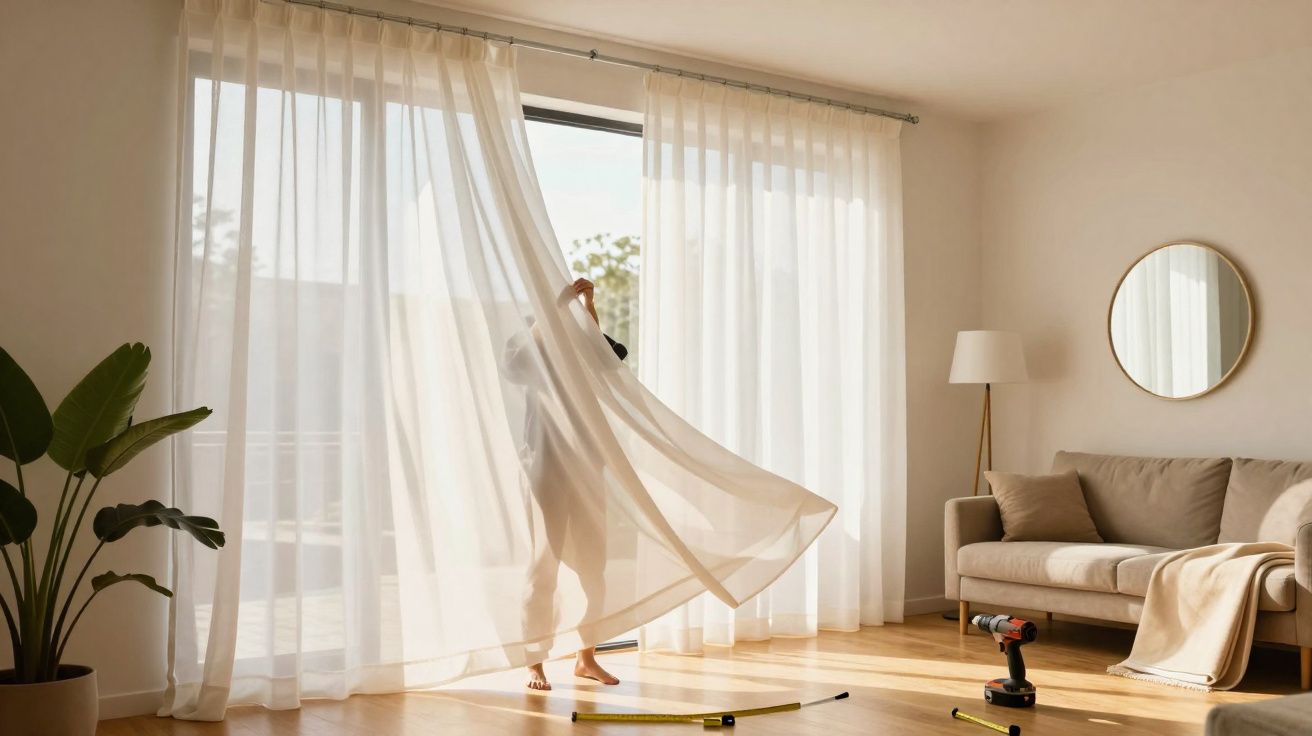
If you copy only one professional move, choose this: hang your curtains high and wide. Place the rod close to the ceiling and extend it a few centimetres beyond the window on each side. You’re not merely framing the glass - you’re redrawing the proportions of the entire wall.
The curtain fabric becomes a tall vertical column, which makes the wall appear higher. The added width nudges your brain into reading the window - and therefore the whole wall - as larger. And when the curtains are open, most of the fabric stacks on the wall rather than covering the glass, so the window feels bigger and brighter.
That, in essence, is a decorator’s favourite illusion. It works in living rooms, bedrooms, even tiny home offices carved out of a corner. Anywhere you have a window, you have the opportunity to make the whole room read as larger.
After that, you can build on the effect. Bring in one tall lamp that reaches at least eye level when you’re standing. Position artwork so its centre sits slightly higher than you’d instinctively choose. Opt for a bookcase or shelving that nearly meets the ceiling instead of stopping halfway up the wall. Every vertical line is another gentle push towards “spacious”.
This is also where the emotional shift shows up. On a difficult day, a tight room can feel like it’s evaluating you: too much stuff, too little space, not enough breathing room for you. Raise the sightlines and the room stops bearing down. It starts to feel supportive instead.
People repeat certain mistakes simply because nobody points them out. Curtains that stop just below the window ledge. Rugs that float too far from the furniture. Shelves stranded awkwardly in the middle of a wall. None of these choices are “wrong”, but they quietly make the room shrink in your mind.
Let’s be honest: nobody does this kind of thing day after day. No one wakes up thinking, “Today I shall optimise my visual horizon.” You’re just trying to fit in a sofa and a coffee table without bruising your shins. That’s exactly why decorators love this approach - it’s a small, low-effort change with an outsize payoff once it’s done.
“When I raise the curtains and oversize the rug, my clients always say the same thing,” London interior designer Amara Field told me. “They don’t say, ‘Oh, smart spatial hack.’ They say, ‘It feels calmer. I can breathe.’ That’s the reaction I’m chasing.”
To keep it useful, here’s the quick checklist designers return to when they need a small living room to feel noticeably bigger:
- Hang curtain rods 10–15 cm below the ceiling, and at least 10–15 cm wider than the window on each side.
- Pick a rug large enough that at least the front legs of your sofa and chairs sit on it.
- Add at least one tall element (lamp, plant, bookcase) that pulls the eye upwards.
- Arrange artwork in vertical groupings instead of scattering small frames everywhere.
- Choose furniture with visible legs so light can move beneath pieces.
A small space that suddenly feels like your space
Once you spot this trick, you’ll notice it all over the place: hotel lobbies that feel enormous, compact Airbnb lets that photograph like lofts, Instagram interiors where you can’t quite pinpoint why the room seems so generous. It’s the same quiet choreography of height, scale and sightline.
There’s no requirement to replicate it perfectly. Perhaps your landlord won’t let you swap the blinds - you can still add a long side panel of fabric to create height. Perhaps a huge rug isn’t an option - you can still choose the biggest bound carpet remnant your budget will stretch to. The illusion isn’t “all or nothing”; every small adjustment contributes.
On a more human note, shifting how a room feels changes how your evenings feel. You sit in a space that doesn’t constantly remind you of its limits. You might finally invite the friend you’ve been putting off. You might read on the sofa without your eyes drifting to the television corner, mentally calculating where another person could possibly perch.
We’ve all had that moment in someone else’s home: “Hang on - is this really the same floor area as mine?” Same walls, same windows, same floor - on paper, it’s identical. The difference is the story the room tells your brain. Height, light and generous gestures make it feel like the space has more to offer.
That’s why decorators’ favourite trick matters beyond looks. It’s about taking a small patch of the world and letting it expand for you, not against you. A higher curtain rod, a bigger rug, a taller lamp - small acts of defiance against the idea that you need a larger home in order to feel you’ve got room.
| Key point | Detail | Benefit to the reader |
|---|---|---|
| Raise the visual horizon | Use tall curtains, lamps, and shelving to draw the eye upward | Makes ceilings and walls feel higher without structural changes |
| Use generous anchors | Choose larger rugs and fuller curtain panels than you think you need | Helps the room read as wider and more expansive |
| Layer vertical focal points | Stack art vertically and add one or two tall accents | Creates a cohesive illusion of space in any small room |
FAQ:
- Does hanging curtains higher really make a small living room look bigger? Yes. High, wide curtains trick the eye into reading the window – and the entire wall – as taller and broader, which makes the room feel more spacious.
- What if my ceilings are already low? That’s when this trick matters most. Run the rod just below the ceiling and choose full-length panels that kiss the floor to elongate the walls visually.
- Is a bigger rug always better in a small living room? Within reason, yes. A rug that connects your main pieces of furniture makes the area feel unified and larger, rather than choppy and cramped.
- Can this illusion work in a rental where I can’t repaint or drill? Definitely. Use tension rods, clip rings, tall floor lamps, high bookcases, and leaning art to build vertical lines without permanent changes.
- How fast can I see a difference? Most people notice a change the moment high curtains go up or a bigger rug goes down. The room will feel calmer and more open almost instantly.





Comments
No comments yet. Be the first to comment!
Leave a Comment