
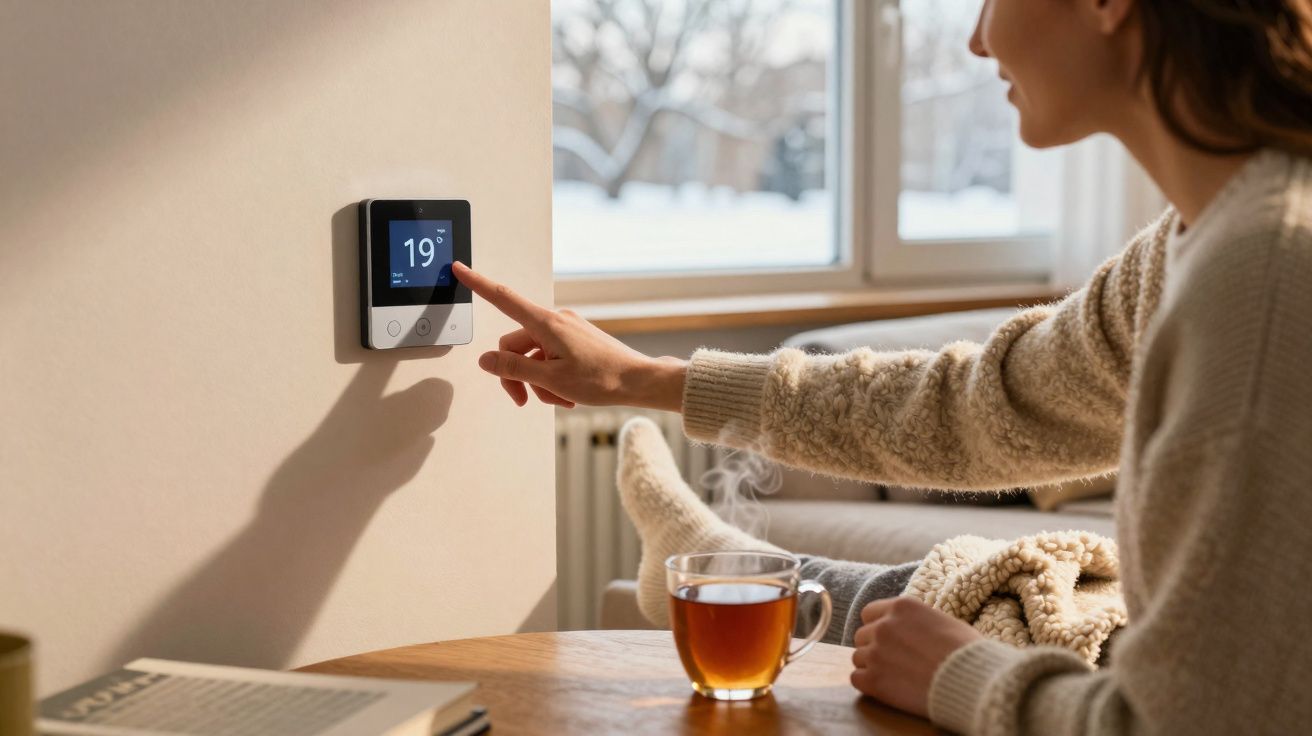
You’re after heat that feels lived-in, not wasteful. You want comfort that doesn’t punish your wallet or the planet. So what’s the ideal temperature that actually makes sense for winter 2025? And can a single degree really matter?
It’s 6:42 p.m. on a hard-frost Tuesday. The kettle is whistling, the dog has curled into a furry comma by the radiator, and someone has just inched the thermostat up wearing the guilty face of a biscuit thief. Outside, the street shines with breath-misted chat. Indoors, socks meet bare floorboards with a tiny wince. You glance at your phone: another headline about energy costs, another comment thread arguing 18°C versus 21°C. You tug your sleeves down and choose something you’ll feel for hours. One degree.
The number everyone asks for
There’s no single magic setting that fits every household. For most homes, the practical comfort zone this winter is about 19°C (66°F) in living spaces, easing back to 17°C (62–63°F) in bedrooms. The World Health Organization continues to cite 18°C as a minimum for healthy adults, with 20–21°C in main rooms if you’re older, unwell, or there’s a baby at home. That narrow range is where comfort meets common sense. It’s flexible enough to live with, but specific enough to steer by.
Picture a typical family in a draughty semi-detached in Leeds, or a compact flat in Manchester. Moving the thermostat from 20°C down to 19°C cuts heating energy by roughly 5–7% for many systems, without tipping most people into shivering. Over a long cold spell, that adds up. It can be the gap between a shrug and a sharp intake of breath when the bill arrives, between dry-air headaches at 22°C and a steadier, cosier 19°C paired with thicker socks.
So why does 19°C land as “about right” for so many people? Because thermal comfort is more than the number in the air. It also depends on radiant heat from walls and windows, draughts and air movement, humidity, and what you’re wearing. A light jumper adds around 0.3 to 0.4 clo of insulation, which can make 18.5°C register on your skin more like 20°C. When humidity sits around 40–50%, cooler rooms tend to feel kinder and your throat protests less. Push the setting higher and you often dry the air out, inviting coughs, static shocks, and broken sleep. Keep things stable, and your body adjusts without fuss.
Ideal thermostat temperature for winter 2025: set, time, adapt
Begin with a simple baseline. Aim for 19°C in the main living area from morning through evening, then drop to 17°C overnight or while you’re out. Give your home 30–45 minutes of pre-heat before you wake up and before you return, so rooms slide into comfort rather than getting a sudden blast. If you use a smart thermostat, make the most of schedules and geofencing. During the day, open curtains to catch free solar warmth; at dusk, close them to hold heat in-like putting a soft lid on a simmering pan.
Most of us know the moment: the house feels chilly and the urge is to hammer the thermostat up to 23°C. Try not to. The heating won’t warm the home faster; it usually just overshoots. Bleed radiators once at the start of the season, and keep doors shut to rooms you’re not using. In damp homes, avoid switching the heating fully off for long stretches; keeping it ticking over low can help prevent condensation. And let’s be realistic: hardly anyone checks every room with a hygrometer every day. Two or three readings a week are typically enough to stay on track.
Consistency is what gets you through winter. Adjust in 0.5°C steps and give it 30 minutes before deciding whether it helped. If someone in your household is vulnerable, keep the main room at 20–21°C and hold bedrooms around 18°C.
“Aim for small, predictable adjustments,” says a building scientist I called while my fingers were still thawing. “Comfort is a curve, not a switch.”
- Living areas: 19–20°C for most households, 20–21°C if elderly or ill.
- Bedrooms: 16–18°C with a warm duvet; raise to 18–19°C for babies.
- Humidity: aim for 40–50% to make cooler temperatures feel gentler.
- Quick wins: close curtains at dusk, draught-proof doors, lay down a rug on cold floors.
- Safety: test smoke alarms and carbon monoxide alarms at the start of the season.
What’s different in 2025, and how to make it work for you
Energy prices have softened in some areas and risen in others, but the underlying rule hasn’t changed: the cheapest degree is the one you don’t heat. More households now have heat pumps, which changes the feel of heating from short, hot bursts to slow, even warmth. If that’s your setup, stick to a steadier schedule and avoid large swings. If you’re on a gas boiler, remember that smooth, consistent flow often beats stop-start jolts. And if your home leaks heat, draught-excluding strips and heavy curtains remain the heroic double act.
The weather is still unpredictable. A changing climate brings odd swings, and cold snaps will continue to bite. This is where a simple household rule helps: one number for daytime, one for night, plus a half-degree of leeway if fingers start going numb. Try a one-week run at 19°C by day and 17°C by night, then fine-tune based on how it feels, not on panic. You’ll learn your home’s rhythm faster than any graph. Put the agreed setting on a sticky note near the thermostat so everyone pulls in the same direction.
Treat temperature like a conversation rather than a verdict. Pay attention to your rooms. Check corners for draughts. Touch the window glass at 9 p.m. and notice what it tells you. Your ideal winter number might be 18.5°C on bright days, or 20°C during a cold snap. You’ll know you’ve landed on it when evenings feel effortless, sleep improves, and the bill doesn’t sting. Comfort, in the end, is a small, straightforward promise you keep to yourself.
| Key point | Detail | Why it matters to you |
|---|---|---|
| Ideal range for 2025 | 19°C living areas, 17–18°C bedrooms; 20–21°C if vulnerable | Gives you a clear number to set today |
| Energy savings per degree | About 5–7% less heating energy per 1°C drop for many homes | Connects comfort choices to real money |
| Comfort factors | Humidity 40–50%, steady schedules, modest clothing layers | Helps cooler temperatures feel good without sacrifice |
FAQ:
- What’s the best daytime and night-time temperature? For most homes, 19°C in living areas during the day and 17–18°C at night. If you wake up cold, nudge the bedroom to 18°C and switch to a heavier duvet.
- What about babies and elderly relatives? Keep main rooms at 20–21°C and bedrooms around 18°C. Warmer clothing and stable humidity help more than chasing 23°C all evening.
- Does a heat pump change the target? Not the target, the strategy. Heat pumps work best with steady operation. Choose your number and let it cruise, avoiding big swings that reduce efficiency.
- How much does humidity matter? A lot. At 40–50% RH, 19°C feels cosy; at 25–30% RH, the same room can feel harsh and dry. A small humidifier or drying laundry indoors (with ventilation) can soften the air.
- Can I lower bills without feeling cold? Yes: drop your setpoint by 1°C, close curtains at dusk, draught-proof doors, and use timed pre-heat. Layer up with a thin base and a jumper instead of one bulky top.






Comments
No comments yet. Be the first to comment!
Leave a Comment