
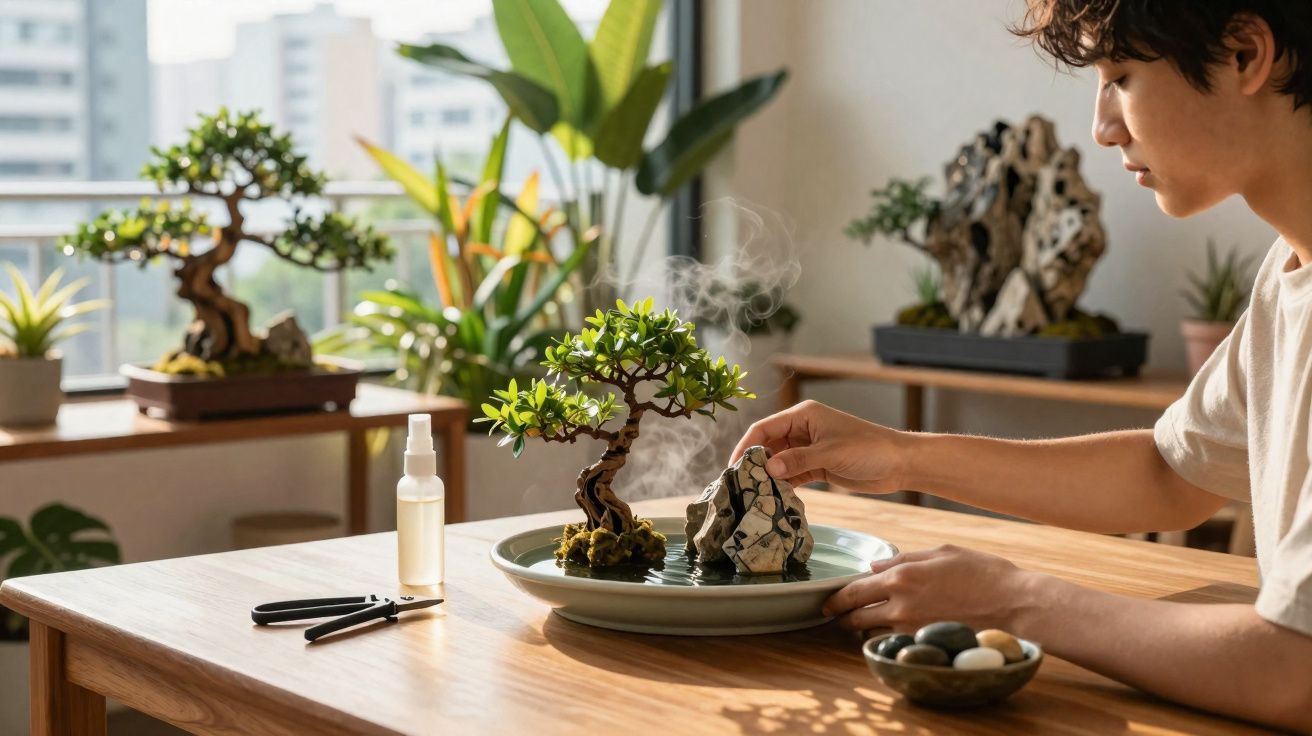
Many people who encounter Penjing for the first time instinctively think of Bonsai. A closer look makes it clear that these Chinese miniature landscapes follow their own, deeply rooted artistic tradition. The focus is not simply on small trees, but on complete worlds in miniature - with rocks, water, paths, houses and sometimes even tiny people and animals.
What Penjing really is - and why it does not imitate Bonsai
Penjing is regarded as one of Asia’s oldest forms of landscape art. The term roughly translates as “landscape in a container”: “pen” refers to a tray or pot, and “jing” to a landscape or scene. At its heart is always a living slice of nature, condensed into just a few centimetres.
“Penjing is less a single tree in a pot, and more a living landscape painting, intended to make emotions and the laws of nature visible.”
Where Bonsai can appear highly strict, stylised and tightly controlled, Penjing tends to lean into the untamed: wind-bent trunks, rugged stones, seemingly accidental shapes - yet everything is still intentionally composed. The aim is to capture a mood, such as the solitude of a mountain ridge or the calm of a riverbank at sunrise.
Many artists also use miniature figures - a lone traveller, a small house, a horse on a path - which turns the arrangement into a narrative scene. Penjing is meant to suggest a story rather than merely look attractive, almost like a still image from a dream.
From Daoist sages to design enthusiasts: Penjing’s long history
Historical sources trace Penjing back at least to the 1st century CE. At that time, Daoist scholars and mystics sought to concentrate the power of vast landscapes into reduced scenes. Anyone without access to mountains or sacred sites could bring the atmosphere of those places closer - in a sense, like “shrunk” natural sanctuaries.
Legends speak of masters who could seemingly draw whole landscapes “into” a tray by magic. Later, Buddhist monks adopted the idea and carried it to Japan. Over many centuries, a distinct tradition developed there, eventually giving rise to what is now known as Bonsai.
In China, however, Penjing remained more strongly shaped by landscape composition and storytelling. To this day it is considered a demanding art form: those who pursue it seriously often study for ten years or more with a master or in botanical gardens before their own work is seen as fully mature.
The three main Penjing forms: trees, rocks and blended landscapes
China is vast, and Penjing styles reflect that scale. There are regional approaches such as the Lingnan, Taiwan, Shanghai or Yangzhou styles. Despite this variety, specialists typically group most work into three fundamental forms.
Potted tree landscapes (Penjing): Shumu
Shumu Penjing centres on trees and shrubs arranged in a tray. The artist shapes trunks and branches through:
- targeted pruning of branches and roots
- wiring to guide growth direction
- controlled limitation of size and density
Visually, this variant can resemble Bonsai quite closely, but it often feels more untamed: groves made from several trees, rugged trunks and deliberately irregular canopies. Rather than presenting an idealised single tree, it aims to evoke the feeling of a woodland edge, a ravine or an old mountain path.
Rock and water in dialogue: Shanshui
Shanshui literally suggests “mountain and water”. In this form, one or more carefully chosen rocks take centre stage, usually in a shallow tray that either contains water or is designed to imply it.
The stones are selected with purpose: shape, grain and colour should call to mind mountains, cliffs or towering rock pillars. Artists often add small plants that read as vegetation on slopes or along riverbanks. A successful Shanshui Penjing can make the viewer forget they are looking at a tray on a table - ideally, they see an entire valley from a bird’s-eye view.
A complete scene in one composition: Shuihan
Shuihan Penjing combines tree, rock and water elements into a more complex scene. Typical components include:
- miniature trees or shrubs
- rocks representing mountains or cliffs
- water surfaces, ponds or suggested rivers
- figures such as houses, boats, animals and people
These works often hint at small narratives: a fisherman’s house by a lake, a monastery in the mountains, a solitary walker crossing a pass. The intention is not realistic model-making, but an abstracted, distilled atmosphere. One tree may stand in for an entire forest; a single stone for a whole mountain range.
Living art that never stays the same
Penjing may look static because it sits like an object on a table - but it is alive. Plants grow, weaken, die back and change shape. Water evaporates, and stones develop patina. Artists describe it as a “flowing” art form that keeps evolving.
“A good Penjing does not show only a moment, but also the passage of time: growth, age, transience.”
Contemporary artists engage creatively with tradition. Some use unusual plant species; others push further into surrealism, with rocks that appear to float or with extremely abstract forms. Yet one core principle remains unchanged: the small should make the vast feel present - “seeing the great within the small” is a frequently quoted guiding idea.
How to try Penjing at home
For most people, a classic multi-year apprenticeship in a Chinese garden is unrealistic. Even so, the spirit of Penjing can be brought into everyday life with patience, curiosity and a willingness to experiment.
First steps for beginners with Penjing
Getting started does not require a large budget. In broad terms, the essentials look like this:
- Get a shallow tray with drainage holes - ceramic or plastic is fine, as long as it is sturdy and allows water to pass through.
- Choose the right location - bright, ideally with indirect light and moderate temperatures.
- Adjust the growing medium - free-draining soil mixed with sand, pumice or lava granules.
- Select plants and stones - compact woody plants, mosses, grasses and characterful rocks.
- Decide on a scene - rather than “something pretty”, work from a clear concept: riverbank, a line of hills, a rocky island.
Many garden centres now stock miniature-suitable plants, stones and decorative elements. For inspiration, you can find countless examples in Bonsai books, forums and image platforms. The technical side overlaps in places, even if Penjing’s design approach tends to be more open and less rigid.
Common beginner problems
The biggest pitfalls are less about design and more about day-to-day care:
- Water: small trays dry out quickly. Regular watering is essential, but avoid overwatering.
- Light: too little light leads to weak growth, while too much direct sun can cause scorching.
- Pruning: many people hesitate to use scissors - but gentle pruning maintains shape and encourages fine growth.
- Impatience: a convincing Penjing usually takes years to develop, not a weekend.
If you keep these points in mind, you can create a believable miniature landscape with simple means. With each growing season, not only does the planting develop, but so does your sense of proportion and harmony.
Why Penjing fits modern everyday life so well
Many people are looking for a counterweight to screen-heavy routines. Penjing offers exactly that: calm, hands-on work paired with a direct connection to nature. You observe the seasons in miniature, watching a tiny shoot become a branch and seeing moss slowly creep across a stone surface.
Psychologists have pointed for years to the relaxing effect of caring for plants. Penjing can intensify that effect because it brings several layers together: creativity, manual precision and long-term responsibility for a living object. As you work, you also practise concentration and mindfulness without necessarily setting out to do so.
The cultural dimension is equally compelling. Penjing links horticulture, painting, architecture and philosophy. Anyone who goes deeper soon encounters Daoist and Buddhist motifs - such as the interplay of emptiness and fullness, stillness and movement, nearness and distance - all compressed into a container on a windowsill.
For many, the journey does not stop with a single arrangement. Some expand into other forms of miniature gardening, such as moss landscapes, small rock gardens or aquascaping aquariums. The principles are similar: balance, rhythm, clear visual pathways and respect for living material. In that sense, Penjing can feel like an originating idea from which much else can be derived - a quiet, patient art that continues to develop day by day without demanding loud attention.




Comments
No comments yet. Be the first to comment!
Leave a Comment