
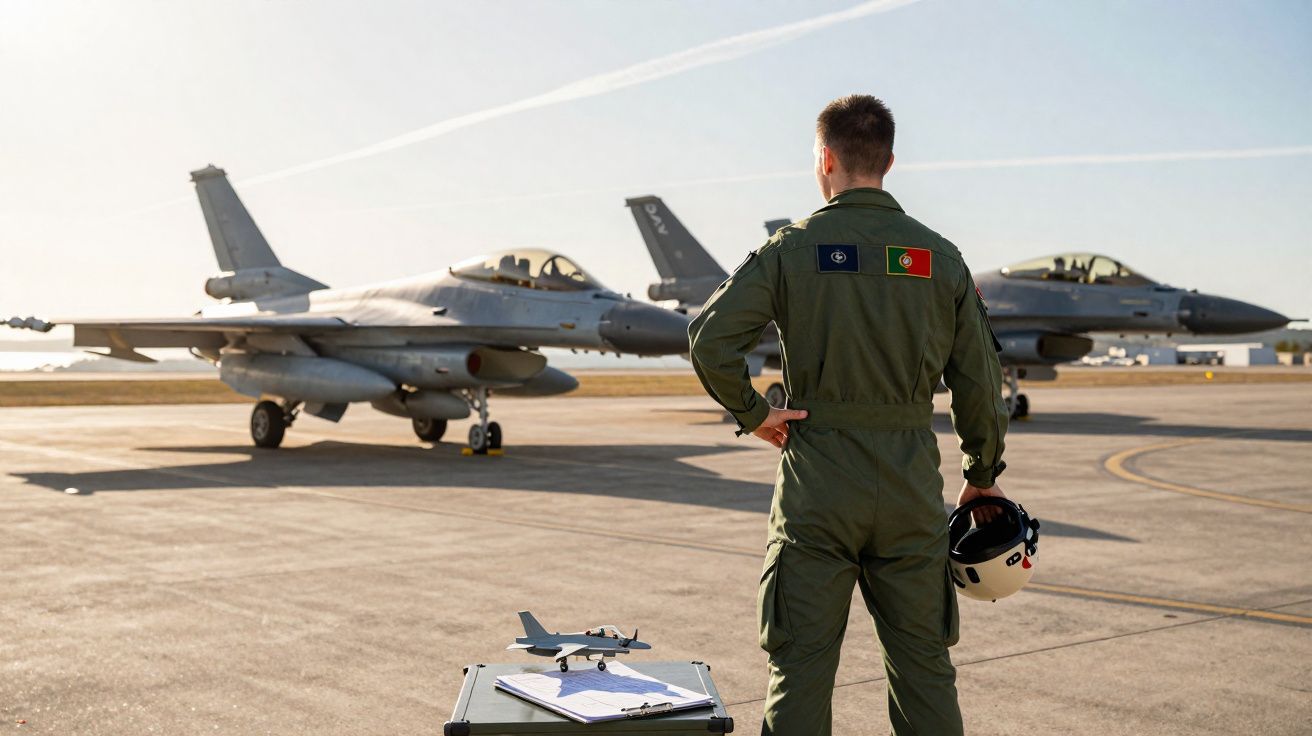
In Lisbon, a question that once sat in the “someday” column has become pressing: what aircraft should succeed Portugal’s long-serving F‑16s? Friction within NATO, lobbying by major defence firms and the accelerating evolution of air-combat technology are all forcing the issue. The decision now centres on which fifth-generation jet Portugal will choose - and what number it can genuinely pay for.
Portugal’s F-16 era is nearing its end
Since the early 1990s, the Portuguese Air Force (Força Aérea Portuguesa, FAP) has depended on 24 F‑16AM/BM fighters. Over decades, they have formed the core of Portugal’s air-defence posture, supported NATO operations and carried out routine air policing across European airspace.
FAP chief of staff General João Cartaxo Alves says Portugal is behind the curve. He notes that Portugal took delivery of its F‑16s at roughly the same time as Denmark and Norway, yet those nations began their replacement programmes around 2008–2009 - while Portugal is only now moving decisively.
Some of Portugal’s F‑16s have been in service for nearly 40 years, a record lifespan for the country’s combat aircraft.
He adds that the FAP has never kept a fighter type in service for such a long period. Even after repeated modernisation efforts, the oldest airframes are approaching four decades of use. Keeping them flying is becoming increasingly expensive, and their capabilities no longer sit at the level of likely opponents - or even of allies that have already transitioned to stealth aircraft.
Portuguese Air Force (FAP) signals a clear preference for the F‑35A
Formally, Lisbon says it is reviewing multiple fifth-generation possibilities. In reality, the FAP’s senior leadership has made its priority fairly obvious. In a recent, wide-ranging interview with the Portuguese daily Diário de Notícias, General Alves mentioned only one aircraft by name on several occasions: Lockheed Martin’s F‑35A.
As far back as 2019, the FAP had already said its F‑16s would remain in operation “until their replacement by fifth-generation aircraft”. Many interpreted that as a clear nod to the F‑35, given Portugal’s close defence relationship with the United States and the way the American jet has dominated NATO procurement choices.
General Alves now indicates the transition is no longer theoretical. The air force is in technical talks with political decision-makers and is working through the final details of the plan it intends to put forward.
The FAP is working on a roadmap that combines fifth- and sixth-generation capabilities, with the F‑35A likely at the core.
How many jets? Between 14 and 28 on the table
The key number emerging from current discussions is an initial buy of at least 14 fifth-generation fighters. General Alves says the final total could be anywhere from 14 to 28 aircraft, and that a staged procurement is being considered.
- Minimum envisaged buy: 14 aircraft
- Upper target: 28 aircraft
- Acquisition likely spread across one or two phases
If Portugal simultaneously pursues involvement in sixth-generation efforts, the general suggests a deliberately modest first tranche may make sense. Starting smaller would give the FAP time to bring the aircraft into service, adapt bases and support systems, and measure the budget impact before deciding on expansion.
The FAP also wants to keep a long-running operating principle intact: maintaining two combat-aircraft types at the same time. Many air forces use this model to reduce risk and to allow different platforms to focus on different tasks, such as air defence, strike missions or reconnaissance.
Balancing ambition and budget
For a country of Portugal’s size, acquiring as many as 28 fifth-generation fighters would be a substantial financial commitment. The F‑35 programme involves not just a multi‑billion‑euro purchase cost, but also many decades of spending on sustainment, training and supporting infrastructure.
Lisbon would have to modernise air bases, build or upgrade specialised maintenance facilities, and train aircrew and ground staff for a far more complex system than the F‑16. The F‑35’s software and logistics ecosystem also requires secure, high-capacity data connectivity.
Portugal faces a delicate equation: align with NATO’s most advanced fighter fleet without overstretching its defence budget.
European alternatives push back
Strong interest from the FAP in the F‑35 does not mean other contenders are out of the running. Defence Minister Nuno Melo has made it clear he wants American and European suppliers to compete in order to “maximise industrial and economic returns” for Portugal.
That signal has not been missed elsewhere in Europe.
Saab and Dassault move quickly
Soon after Melo publicly raised the prospect of European options, Sweden’s Saab moved to promote the JAS‑39 Gripen E/F. Saab opened discussions with Lisbon, pitching the Gripen as a cost-effective multirole fighter designed for operations from short or austere runways, while remaining straightforward to integrate within NATO frameworks.
France’s Dassault Aviation has also stepped up efforts to interest Portugal in the Rafale multirole fighter. CEO Éric Trappier told the French Senate that Dassault is actively engaging with Portuguese partners to position the Rafale as a compelling choice - particularly because Portugal has not yet signed any F‑35 contract.
Eurofighter builds industrial bridges
The Eurofighter consortium, via Airbus Defence & Space, has signed a memorandum of understanding with Portugal’s aerospace industry association, AED Cluster Portugal. The focus is on identifying areas for cooperation linked to a future fighter purchase, implicitly pointing to a possible Typhoon proposal.
| Aircraft | Origin | Generation | Key selling point |
|---|---|---|---|
| F‑35A | United States | Fifth | Stealth, deep NATO integration |
| Rafale | France | 4.5+ | Versatile multirole, mature export record |
| Gripen E/F | Sweden | 4.5+ | Lower operating costs, flexible basing |
| Eurofighter Typhoon | UK/Italy/Germany/Spain | 4.5+ | High-end air superiority, strong industrial links |
Each European option comes with its own industrial offer, potentially involving Portuguese firms in maintenance work, parts production and engineering services. For Lisbon, those industrial benefits could be a decisive factor.
Portugal eyes sixth-generation projects as an observer
Alongside the F‑16 replacement, Portugal is also looking further ahead and wants involvement in the next wave of European air power. Nuno Melo has indicated Portugal aims to take part - at least as an observer - in one of Europe’s two principal sixth-generation fighter initiatives.
One is the Franco-German-Spanish Future Combat Air System (FCAS/SCAF). The other is the Global Combat Air Programme (GCAP), led by the UK, Italy and Japan. Both are broader than a single aircraft, seeking to create connected systems that combine crewed fighters, uncrewed platforms and advanced sensors.
Lisbon hopes early involvement in a sixth-generation programme will give Portugal a head start on technologies that will shape air combat after 2040.
At this stage, Portugal would not join as a full development partner. Even so, observer status could provide entry into technical discussions, visibility of industrial plans and potential opportunities for Portuguese companies. It would also help the FAP understand how its force structure should evolve after the F‑35 era - or after any European fighter chosen today.
Military judgment vs political choice
General Alves has been clear about how he believes the decision should be divided. In his view, the armed forces should propose the best option purely on military grounds, after which political leaders weigh cost, diplomacy and industrial consequences before making the final decision.
That division mirrors broader pressures seen across NATO, where defence ministries must balance alliance priorities, domestic industrial interests and constrained budgets. For Portugal, the United States remains a pivotal NATO ally, yet recent political uncertainty in Washington has intensified interest in European alternatives.
What fifth-generation really means
“Fifth-generation” does not simply mean a newer aircraft with improved engines. The label generally refers to a combination of characteristics delivered in one platform: low-observable (stealth) shaping to reduce radar detection, powerful computing, advanced sensors and the ability to fuse data into an intelligible operational picture for the pilot.
The F‑35, for example, functions almost as an airborne sensor hub. It draws information from radar, electro‑optical systems and its electronic-warfare suite, then distributes that data to other aircraft and to forces on the ground via secure networks. This ability to share high-quality information is a major reason many NATO members have selected the jet even when European alternatives are available.
What this shift could mean for Portugal and NATO
If Portugal proceeds with an F‑35A order of 14 to 28 aircraft, it would become part of the expanding group of European F‑35 operators, including Italy, the Netherlands, Denmark, Norway, Belgium, Finland and Poland. That would ease combined training, enable shared maintenance arrangements and simplify NATO mission planning.
Choosing a European-built fighter, by contrast, could deepen industrial ties within the EU and potentially provide greater room for technology-transfer arrangements. For Portuguese workers and engineers, this could mean more domestic jobs and skill development over many years.
Whatever Lisbon selects will also influence how Portugal contributes to NATO operations. A fifth-generation fleet would increase Portugal’s value in air policing, deterrence and crisis-response missions on the alliance’s eastern flank or around the Mediterranean. It would also bring higher expectations for readiness and for investment in compatible weapons stocks, including modern air-to-air missiles and precision-guided munitions.
For readers tracking the debate, two phrases matter. “Air superiority” means having sufficient control of the air so opposing aircraft cannot operate effectively. “Multirole” aircraft - like those Portugal is weighing - are designed to perform both air-to-air combat and ground-attack missions, allowing smaller air forces to do more with fewer platforms.
As Lisbon moves closer to a decision, the F‑16s will continue to patrol Portuguese and NATO skies. But the replacement effort is no longer a distant concept. For the FAP’s leadership, the fifth-generation transition needs to begin with at least 14 new fighters - and preferably more - if Portugal intends to stay aligned with its allies and protect its airspace over the next three decades.






Comments
No comments yet. Be the first to comment!
Leave a Comment