
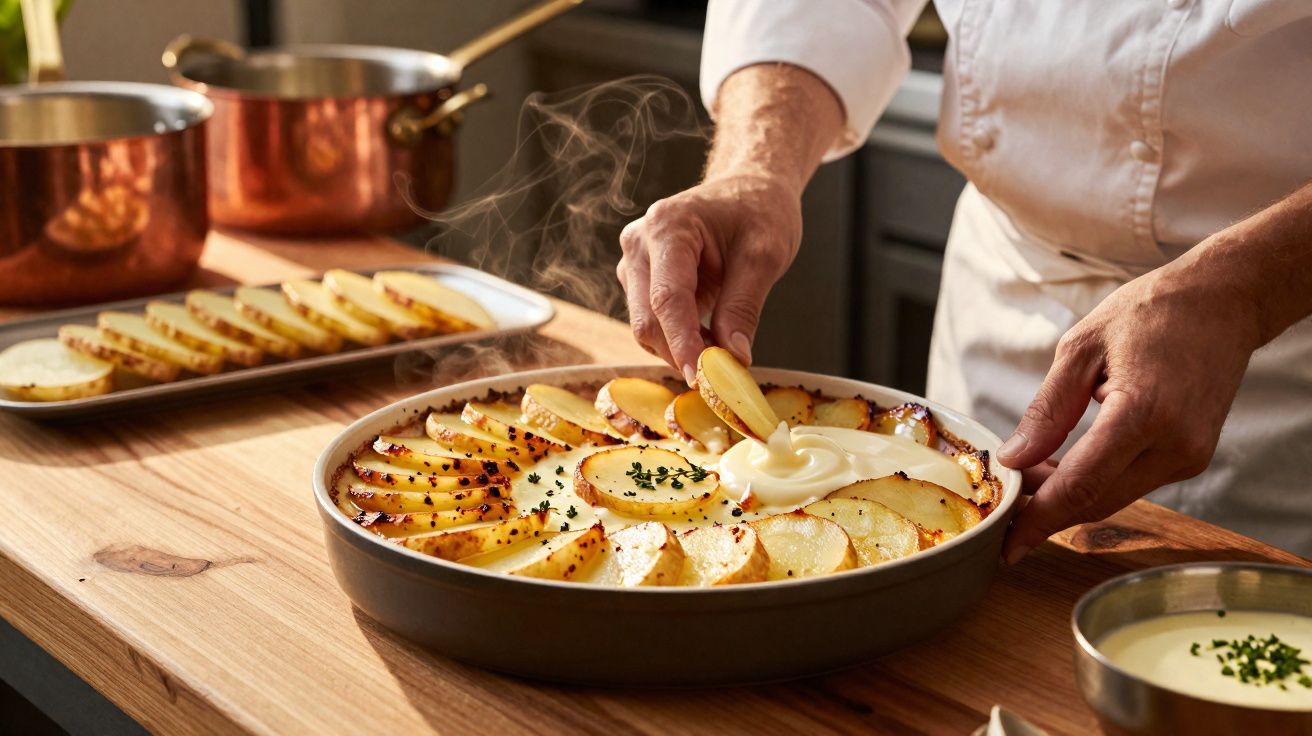
A leading French chef shares his way of making a classic potato gratin that feels both comforting and surprisingly refined. The secret is not unusual ingredients, but technique, timing and a handful of clear rules that turn an everyday dish into a real centrepiece for the family table.
Why this potato gratin isn’t your usual bake
Most people know potato gratin as a heavy, cheese-laden affair-half grated cheese, half double cream. Philippe Etchebest takes the opposite route. The Michelin-star chef goes back to the basics, building a traditional gratin with potatoes, milk, cream, garlic and herbs-deliberately leaving out both egg and cheese.
"The aim: soft and creamy inside, with a crisp, golden-brown top-without any baked-on cheese."
He describes it as the kind of family dish that wins over children and adults alike. The method stays manageable, yet the finished result looks like it belongs in a smart restaurant. That balance-simple, but executed with professional discipline-is exactly what makes his approach so useful at home.
Ingredients: what you actually need for six people
Etchebest relies on straightforward, easy-to-find ingredients. What matters isn’t novelty, but quality-especially when it comes to the potatoes.
- 10 g butter, for greasing the dish
- 1.2 kg potatoes (waxy or slightly floury)
- 5 garlic cloves
- 40 cl milk (whole milk gives more flavour)
- 40 cl single cream
- 2 sprigs fresh thyme
- coarse salt
- freshly ground black pepper
- optional: 1–2 bay leaves, for extra aroma
Even from this list, the point is obvious: no cheese, no egg, no breadcrumb topping. The creaminess comes solely from potato starch combined with milk and cream.
Step by step: how the Michelin-star chef makes his potato gratin
Preheat the oven and build the aromatic base
The opening steps are simple, but they set the pace for everything that follows. Heat the oven from the start to about 200 °C (conventional oven / top and bottom heat), so it’s fully ready once the dish is layered.
Next, make the flavour base:
- Peel the garlic cloves, then crush or finely chop them.
- Pour the milk and cream into a saucepan.
- Add the garlic, thyme and (optionally) the bay leaves.
- Warm the mixture gently until it reaches a light simmer.
- Turn the heat down and let it infuse briefly so the herbs release their flavour.
"The milk-and-cream mixture becomes a flavour bomb: later it carries the aroma through the entire gratin."
Prepare the potatoes - the overlooked key
While the dairy is infusing, move on to the potatoes. This is where everyday shortcuts often lead to disappointing texture and taste later on.
A professional approach looks like this:
- Peel the potatoes and place them straight into a bowl of cold water so they don’t discolour.
- Slice them very thinly-around 3 mm-using a sharp knife or a mandoline.
- Spread the slices on a clean tea towel and pat them dry.
One detail matters: after peeling, the potatoes should not be rinsed under running water or soaked for a long time. You want starch to remain on the surface. That starch is what helps the liquid thicken as it cooks, keeping the gratin creamy rather than watery.
Layering like a restaurant (Philippe Etchebest’s potato gratin technique)
This is the stage that lifts the dish visually and in terms of eating quality.
Prepare the dish properly
Generously butter an ovenproof dish-not just the base, but the sides as well. The butter does more than stop sticking; it also encourages richer roasting flavours around the edges.
Arrange the potatoes in a rosette pattern
Instead of tipping the slices in and hoping for the best, the chef overlaps them into a rosette-like layout. This creates a more even thickness, and it helps the hot cream mixture coat every slice consistently.
Key steps:
- Lay down a first layer of potato slices, slightly overlapping.
- Season with coarse salt and freshly ground black pepper.
- Continue with more layers, seasoning each one again.
"Every layer gets salt and pepper-so the gratin tastes evenly bold from top to bottom."
The pour, baking time, and getting the perfect crust
Before the dish goes into the oven, add the infused liquid. Remove the herbs from the milk-and-cream mixture, then pour it evenly over the potatoes until everything is well covered-but not overflowing.
Bake at about 200 °C for roughly 1 hour. The exact timing depends on your oven and the size/depth of the dish. Use these cues:
- The top should be golden brown and lightly crisp.
- A knife should slide through the potatoes with almost no resistance.
- The edges can colour, but they shouldn’t turn black.
Once it’s out, it’s worth letting the gratin rest for a few minutes. The sauce settles slightly, making it easier to cut neat portions.
Common mistakes - and how the chef avoids them
Many home cooks wonder why their potato gratin ends up dry or crumbly despite using plenty of cream. Etchebest’s method makes it clear where the classic traps are.
| Mistake | Result | Better approach |
|---|---|---|
| Washing the potatoes until the water runs clear | Too little starch, sauce stays thin | Only a brief soak to prevent browning; don’t rinse the starch away |
| Slices cut too thick | Uneven cooking, hard patches | Slice to about 3 mm |
| Oven not preheated | Takes longer; the top turns leathery | Bring the oven fully up to temperature first |
| Too little seasoning between layers | Bland flavour in the middle | Salt and pepper each layer deliberately |
How to pair the gratin intelligently
This potato gratin works brilliantly as a side for meat and poultry, but it can also stand alone as a main with a simple green salad. If you want more texture on the plate, serve it with:
- quickly fried mushrooms with garlic and parsley
- green vegetables such as beans or broccoli
- a crisp leaf salad with a light vinaigrette
As a main course, you may need less than you expect, because milk and cream make it quite rich. For a multi-course meal, it’s sensible to keep portions modest.
Why no cheese and no egg - and what you gain
Many recipes use egg to help bind the liquid, and cheese to add flavour and create a crust. Etchebest intentionally leaves both out, and that choice changes the result in several ways:
- The texture stays silkier, more like a creamy bed of potatoes than a heavy bake.
- The potato flavour becomes the focus, rather than the cheese.
- The crust forms through fat, starch and heat-not through melted, browned cheese.
If you love cheese, you can always shave a little matured hard cheese over the plated portion. That keeps the oven-baked version close to the original approach and can feel more elegant, especially alongside finer cuts of meat.
Who this method suits best
The Michelin-star chef’s technique is ideal for home cooks who want to elevate everyday classics without spending hours in the kitchen. It’s easy to plan: make the infused cream, slice the potatoes, layer, bake-then the oven does the rest.
For holidays or big family meals, this style of potato gratin brings calm to kitchen scheduling. You can assemble the dish ahead of time and slide it into the oven shortly before guests arrive. It comes to the table ready, while the hosts can focus on their company.
Anyone who cooks regularly will also take broader lessons from the method: working with starch on purpose, understanding why even slicing matters, and learning how to infuse milk and cream properly. Those principles carry over to other dishes-from creamy potato bakes with vegetables to savoury gratins with fish or poultry.





Comments
No comments yet. Be the first to comment!
Leave a Comment