
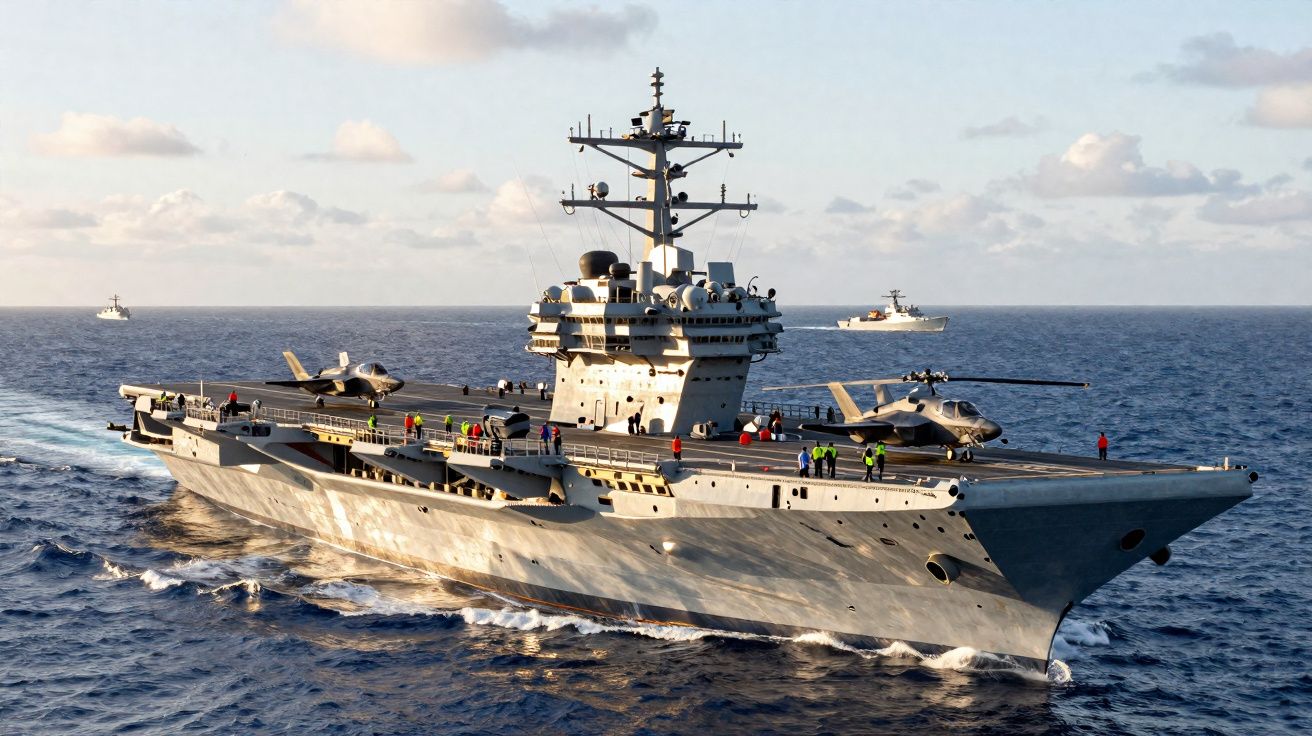
After several years of construction and preparation at the Newport News yard, the second nuclear-powered aircraft carrier of the new Gerald R. Ford class has taken a crucial step towards its future handover to the United States Navy (US Navy). Yesterday, the future USS John F. Kennedy (CVN-79) departed Newport News Shipbuilding in Virginia for the first time to begin what are expected to be its initial sea and navigation trials-an eagerly anticipated milestone within the programme designed to replace today’s Nimitz-class aircraft carriers.
The development, first reported by multiple specialist outlets, was later confirmed by Huntington Ingalls Industries (HII) on its social media channels. HII stated that the future CVN-79 left the shipyard to start the “builder’s sea trials”, an early phase intended to assess-at sea for the first time-the performance of the carrier’s principal systems, equipment and components.
A vital first assessment for the USS John F. Kennedy (CVN-79)
These sea trials will make it possible to check the operation of critical systems such as the nuclear propulsion plant, electrical power generation, navigation, ship steering and platform control, before moving on to later and more demanding stages. It is a progressive process in which the aircraft carrier John F. Kennedy will undertake different voyages and technical evaluations, ahead of its formal delivery to the US Navy for acceptance trials and the subsequent integration of its Carrier Air Wing.
HII, for its part, stressed that this first trip to sea signals the start of a new phase for CVN-79’s build, with attention shifting from the controlled conditions of the shipyard to real-world validation of capability in operational environments.
A programme shaped by adjustments
The start of sea trials for the USS John F. Kennedy follows a lengthy period of final work, refinements and delays linked, in part, to lessons learned from the class’s lead ship, USS Gerald R. Ford (CVN-78). Compared with the Nimitz class, the new class brings major changes, incorporating technologies such as EMALS electromagnetic catapults, the AAG arresting gear system, a redesigned island and a new electrical architecture.
While these innovations are intended to boost operational efficiency and reduce costs across the ship’s life cycle, their initial integration created technical challenges that affected testing timelines. In CVN-79’s case, many of these systems have already been installed with modifications and improvements drawn from earlier experience, which should ease the certification and acceptance process.
The John F. Kennedy’s role in the future US Navy fleet
Once the various testing and certification phases are completed, USS John F. Kennedy will become the second operational aircraft carrier of the Gerald R. Ford class, which is intended to form the backbone of the US Navy for the coming decades. The new ship will also be prepared to operate fifth-generation F-35C Joint Strike Fighter Lightning II aircraft and the new Enterprise air surveillance radar.
With this first departure to sea, John F. Kennedy begins a path that-after further trials and assessments-will see it fully integrated into the United States’ surface fleet. Barring changes, the aircraft carrier is scheduled to be delivered to the US Navy in March 2027, replacing the aircraft carrier Nimitz (CVN-68), which has already begun its retirement process after more than fifty years of service.
You might also be interested in: *The aircraft carrier USS Abraham Lincoln is already in the Middle East to operate under US Central Command*






Comments
No comments yet. Be the first to comment!
Leave a Comment