
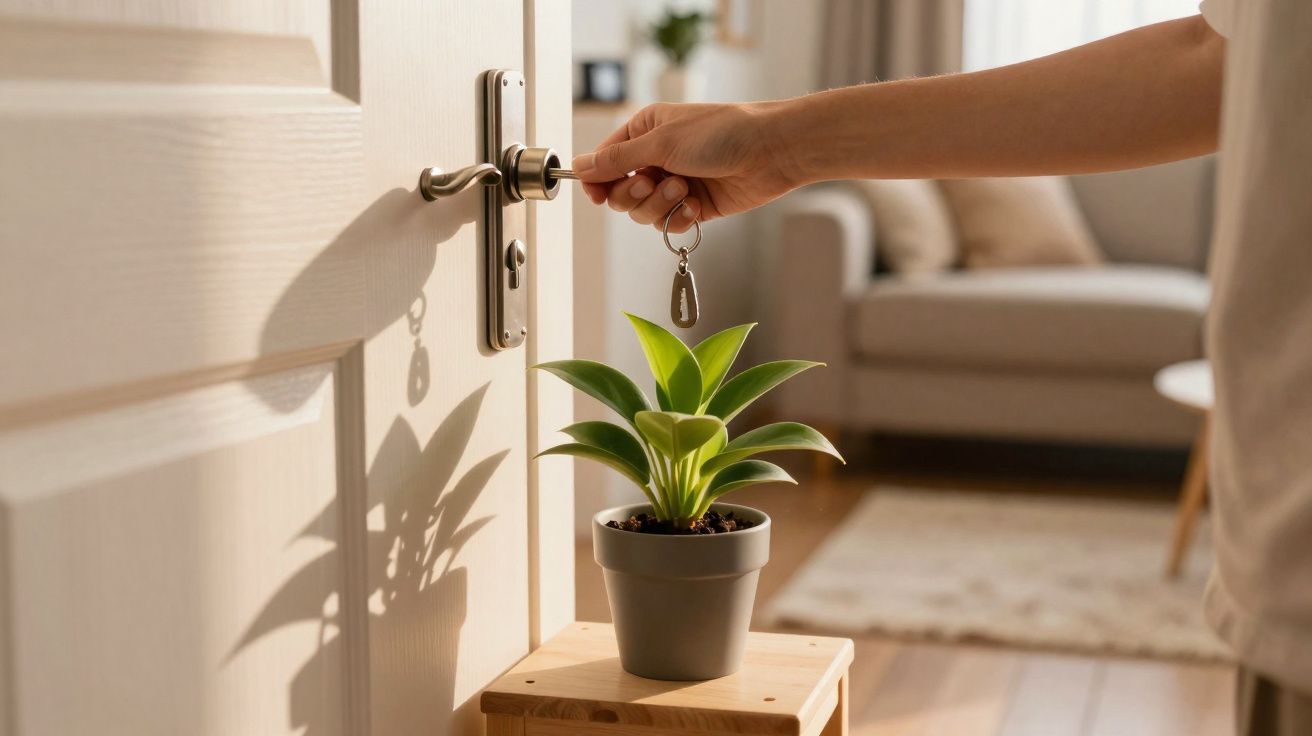
You open the front door with that familiar end-of-day heaviness sitting in your shoulders. The hallway is dim, your bag is sliding down your arm, and half your mind is still stuck inside an email you never wanted to answer. Outside is all engine noise, traffic, and somebody having an argument on their phone pavement-side. You push the door wider and then, right there, exactly where your eyes naturally fall, a tiny patch of green is waiting on a low stool. Just a £2 plant in a chipped terracotta pot, catching the last of the light.
Your body reacts before your mind has a chance to explain why.
Your shoulders loosen. Your breathing softens by half a beat. Your brain says, “Home.”
One inexpensive plant. One carefully chosen sightline.
A surprisingly strong mood shift.
The strange power of the first thing you see in the entryway
Step into any home and notice where your gaze lands first. For some people, it’s a heap of shoes. For others, it’s a gloomy corridor, a stack of unopened post, a television blazing in the background, or a coat stand swallowing half the doorway. That first image sets the atmosphere before you have even put your keys down.
You do not consciously think, “This clutter is making me tense.” Your nervous system simply notes, “We are not fully settled yet, there is still more to manage.” The day does not stop at the front door. It spills indoors.
Now replace that first image with something living. Soft leaves. A touch of green. A modest plant that says very little and yet tells your brain: here, we slow down.
A friend of mine, Ari, discovered this by accident. She bought a scruffy little pothos from a supermarket for about £2, mostly because it looked a bit lonely on the shelf. She placed it on a chair in her hallway, exactly where her eyes landed when she walked in. Then she forgot about it for a week.
A few days later she paused and said, “I do not know why, but coming home feels calmer.” At first she thought it was the new candles, or perhaps the podcast she had started listening to. Then she realised she was greeting the plant. Not deliberately, not out loud, but there was a tiny mental nod: there you are.
Three weeks on, she had watered it twice, repotted it into a second-hand pot, and rearranged the hallway so the plant kept that prime line of sight. She did not transform the whole house. She simply defended that one first view.
There is also a broader reason this works. In darker months, especially in British homes where light can be limited, the entryway often becomes a kind of emotional threshold. If the first thing you meet is harsh clutter or a shadowy corner, the brain reads the space as another job to complete. A small plant interrupts that pattern with something gentler and more alive.
Environmental psychologists call these early visual signals arrival cues - the first messages your brain takes in when you step into a space. In that brief scan, your body decides whether to stay braced or begin to let go. A dark passage with clutter, sharp angles, and glaring light looks a lot like a to-do list. Your brain remains in task mode.
Greenery, softer shapes, and a clear route read as lower threat. Your heart rate eases, your breathing deepens a touch. That does not fix your life, of course. But it does nudge your body away from fight-or-flight and towards something more like, “I may be alright here.”
A plant is, in effect, a biological shortcut. It seems to say, There is life here, not just chores. Your brain registers “living thing, familiar pattern, no danger” and, without ceremony, your mood shifts a little towards something softer.
How to place a cheap plant so it actually lifts your mood
Begin with a simple test: tomorrow, when you arrive at your front door, stop for a moment before you open it. Picture the door swinging inward. Then ask yourself: what is the very first thing my eyes hit? Not what you hope they see. What they truly see.
That exact spot - that precise line of sight - is where the plant belongs. Perhaps it is a corner of a shoe cabinet, a small stool, the top of a radiator, a narrow shelf, or even a wall hook with a hanging planter. Do not aim for perfection.
Buy the cheap plant from the supermarket or the DIY store. Choose something resilient: pothos, spider plant, snake plant, or a small peace lily. Put it squarely in that first-hit visual zone. Then leave it there for a week and quietly notice how you feel when you walk in.
Most people miss the point not because they dislike plants, but because they hide them. A plant behind the door, in a dim corner, or on the floor behind a pile of boots has very little emotional effect. Technically it is in the hallway, yes, but your brain does not recognise it as an arrival cue. It becomes part of the background.
We have all seen the entryway turn into a dumping ground: coats, rucksacks, delivery boxes, and the scooter somebody promised they would fold up. Your little plant has no chance if it is acting as a traffic cone.
If you can, give it a bit of a stage: a crate, a chair, a step, an upside-down basket. Raise it slightly into your eye line. You are not decorating for the sake of it. You are teaching your own brain: when I cross this threshold, something living is waiting for me.
Sometimes a £2 plant is less about style and more about a very basic human message: you deserve a gentler landing when you step through your own front door.
If this already feels like too much effort, take a breath. To be honest, hardly anyone maintains this with Pinterest-level care every day. Aim for “good enough, most of the time.”
To keep it simple, use these three rules:
- Keep the first sightline clear. No permanent piles exactly where the plant sits.
- Choose the plant for your light, not your fantasy. If the space is low-light, go for a snake plant or pothos.
- Link watering to something you already do, such as weekend coffee or taking the bins out.
A single small habit that you can actually maintain will always beat a dozen abandoned “home refresh” ideas.
What changes when your home greets you first
Try this experiment for ten days. Come in, let your eyes find the plant, and pay attention to your own small reactions. You may not feel any grand transformation. It could be as subtle as your jaw unclenching a fraction earlier, or you taking one fuller breath before checking your phone. That still counts.
Over time, that brief pause starts to build. You may find yourself setting your bag down more gently. You might be less inclined to open your laptop immediately. Because a living thing is already “holding” the entrance, you do not need to fill it with urgency, noise, or drama.
Some evenings you will ignore the plant completely. That is fine. It is not there to perform. It is simply a softer opening line to the story of your night.
In colder weather, the effect can be even stronger. A little green in the doorway stands out against grey skies, wet coats, and the general weight of the season. If you notice the leaves gathering dust, give them a quick wipe now and then; that tiny bit of care keeps the plant looking alive and makes the whole corner feel more intentional.
| Key point | Detail | Value for the reader |
|---|---|---|
| Choose the first sightline | Place the plant exactly where your eyes land when the door opens | Turns an ordinary hallway into a gentle “welcome home” signal |
| Use a simple, inexpensive plant | Pick hardy species that cope with low light and irregular care | Creates a low-pressure habit you are more likely to keep |
| Protect the plant’s “stage” | Keep clutter away from that one small area | Prevents chaos from becoming your daily first impression |
FAQ
Question 1: Does the plant have to be real, or would a fake one do the same job?
A living plant usually has a stronger effect because your brain recognises it as genuinely alive, but a well-made artificial one is still better than staring at a pile of bills as your first sight.Question 2: What if my entryway gets no natural light?
Pick very hardy plants such as snake plants or ZZ plants, or place a small lamp nearby on a smart plug so the area feels warm and deliberate when you come in.Question 3: I always forget to water plants. Is this worth trying anyway?
Yes, as long as you choose forgiving species and connect watering to something you already do, like your Sunday routine or bin day.Question 4: Can I use flowers instead of a leafy plant?
Of course. Just bear in mind that flowers need replacing more often, whereas a simple green plant quietly does the job for months.Question 5: Will this really change my mood if my life is extremely stressful?
It will not remove the stress, but it can give your body a small, dependable cue that you have crossed into a different space - and that subtle shift can ripple through the rest of your evening.




Comments
No comments yet. Be the first to comment!
Leave a Comment