
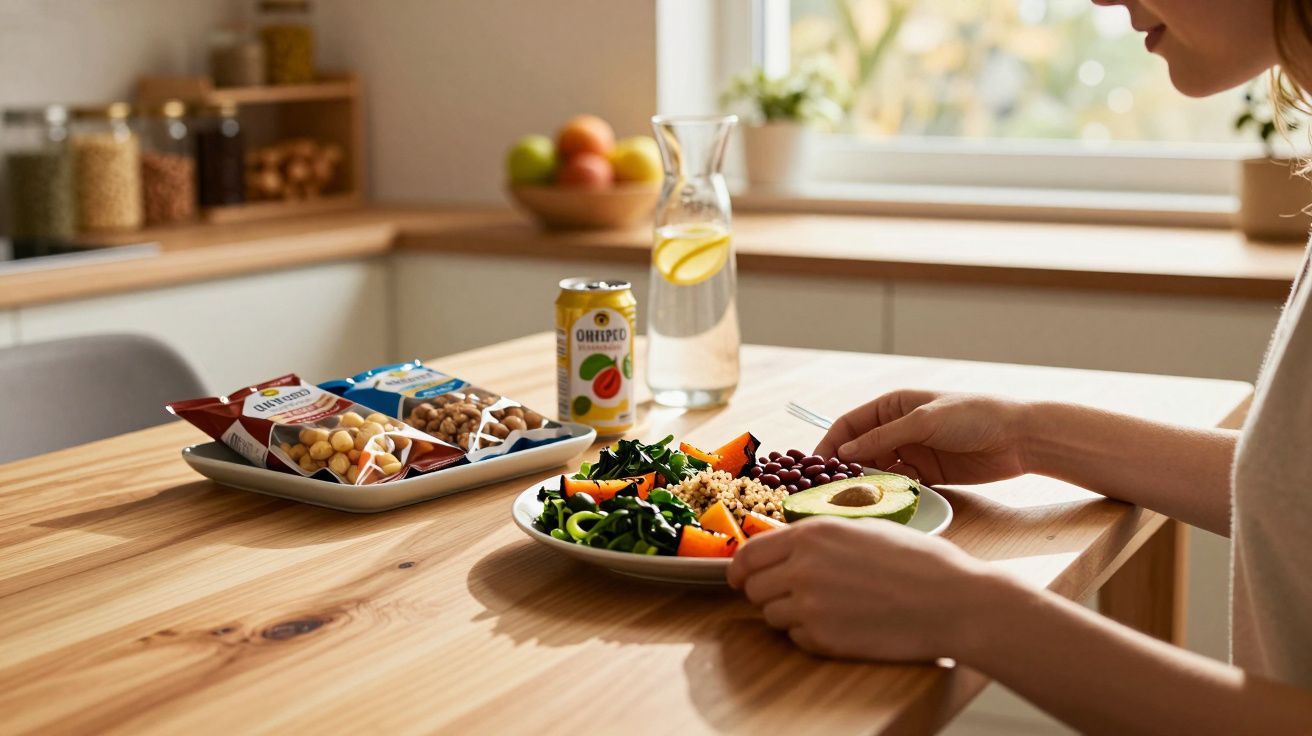
When people think about dieting, they often picture smaller portions and stretches of fasting. However, fresh analysis of recent research suggests there may be another route: keeping normal meal sizes - or even eating a larger volume of food - while still meaningfully reducing how many calories you consume.
The crucial factor appears to be choosing unprocessed wholefoods, such as fruit and vegetables, instead of ultra-processed foods (UPFs) that make up a large share of many modern diets. A more natural pattern of eating seems to reduce the likelihood of inadvertently taking in too much energy, even when people are allowed to eat as much as they want.
University of Bristol reanalysis of the ultra-processed foods (UPFs) trial
The new work, led by researchers at the University of Bristol (UK), is based on a reanalysis of data from a 2019 clinical trial. That original trial was designed mainly to measure how much extra energy people consume when their diet is dominated by ultra-processed foods.
In the month-long study, 20 participants were assigned at random to one of two diets - an unprocessed diet or an ultra-processed diet - with a simple rule: they could eat as much as they liked. Halfway through the month, the diets were swapped so that each participant experienced both approaches.
When the team revisited the data, a striking pattern stood out. On unprocessed wholefoods, participants ate more than 50% more food (by amount) than they did on the UPF diet, yet they still consumed around 330 fewer calories per day on average.
Food choices, fullness, and “nutritional intelligence”
This follow-up analysis focused on which foods people selected within the diet they were given, and how those choices influenced overall energy intake.
Psychologist Jeff Brunstrom (University of Bristol) noted that, when offered unprocessed options, people appeared to gravitate towards meals that combined enjoyment, nutrition and a strong sense of fullness - while still bringing total energy intake down. He added that our eating decisions may be more purposeful than often assumed when food is presented in a natural form.
The researchers’ broader question was: why would an unprocessed-food diet lead people to eat a bigger volume of food but take in fewer calories?
One important feature of the earlier trial was that participants could mix and match foods to build their meals rather than being forced to eat fixed dishes. The team argues this supports the idea that humans have a built-in “nutritional intelligence” - an intuitive drive that can be thrown off when ultra-processed foods (UPFs) dominate the food environment.
Micronutrients versus calories: a trade-off UPFs may disrupt
The proposed mechanism is that, when people eat foods in their natural, unprocessed state, they tend to prioritise items rich in micronutrients - particularly vitamins and minerals - such as fruit and vegetables. Previous research suggests the body may instinctively try to balance energy from fat and carbohydrates against the need for vitamins and minerals.
With UPFs, this internal “read” of what food contains may be distorted. These foods are often energy-dense and are also commonly fortified with the very vitamins and minerals they would otherwise lack. As a result, it may become easier to fill up on calories without eating as much food.
Psychologist Annika Flynn (University of Bristol) warned that this combination could be problematic: UPFs may deliver both high energy and micronutrients at once, potentially leading to calorie overload because they remove the beneficial tension between seeking energy and seeking micronutrients. By contrast, wholefoods preserve that competition, nudging people towards micronutrient “powerhouses” (like fruit and vegetables) rather than higher-energy choices such as pasta and meat.
What this adds to the healthy-eating debate
These findings contribute to ongoing discussions about dieting and healthy eating by suggesting the main issue is not always simple overeating. Instead, the authors propose that ultra-processed foods (UPFs) can “nudge” people towards choices that raise overall calorie intake.
At the same time, the researchers acknowledge that UPFs have brought genuine benefits, including convenience, longer shelf life and certain food-safety improvements. Even so, concern about potential health harms continues to grow, with UPFs being linked in prior work to obesity and even early signs of Parkinson’s disease, among other outcomes.
Practical implications (and an important nuance about processing)
For day-to-day eating, the results imply that focusing on unprocessed wholefoods may help people feel satisfied with a larger volume of food while naturally limiting calories - especially if meals are built around fruit and vegetables, pulses, and other minimally processed staples. In the UK, this aligns with the general direction of the Eatwell-style approach: emphasising high-fibre, nutrient-rich foods and using more processed items as occasional additions rather than the base of the diet.
It is also worth noting that “processed” is not automatically synonymous with “unhealthy”. Many foods that are processed for practicality - such as frozen vegetables, plain yoghurt, tinned beans, or oats - can still support a wholefoods-based pattern, particularly when they are low in added sugar, salt, and heavily modified ingredients typical of ultra-processed foods (UPFs).
Limits, next steps, and why portion size isn’t the whole story
The authors stress that more research is needed to establish how widespread this nutritional intelligence is, whether it is truly innate, and how strongly it is shaped by social and environmental factors. Even so, the analysis reinforces a key point: successful weight loss is not always just about cutting portion sizes, and it highlights another drawback of a diet that relies heavily on UPFs.
Study author Mark Schatzker (food writer in residence at McGill University, Canada) added that if participants had eaten only the most calorie-rich foods available to them, the results suggested they would have failed to meet requirements for several essential vitamins and minerals, eventually developing micronutrient shortfalls. Those gaps, he said, were covered by lower-calorie fruit and vegetables.
The research was published in the American Journal of Clinical Nutrition.






Comments
No comments yet. Be the first to comment!
Leave a Comment