
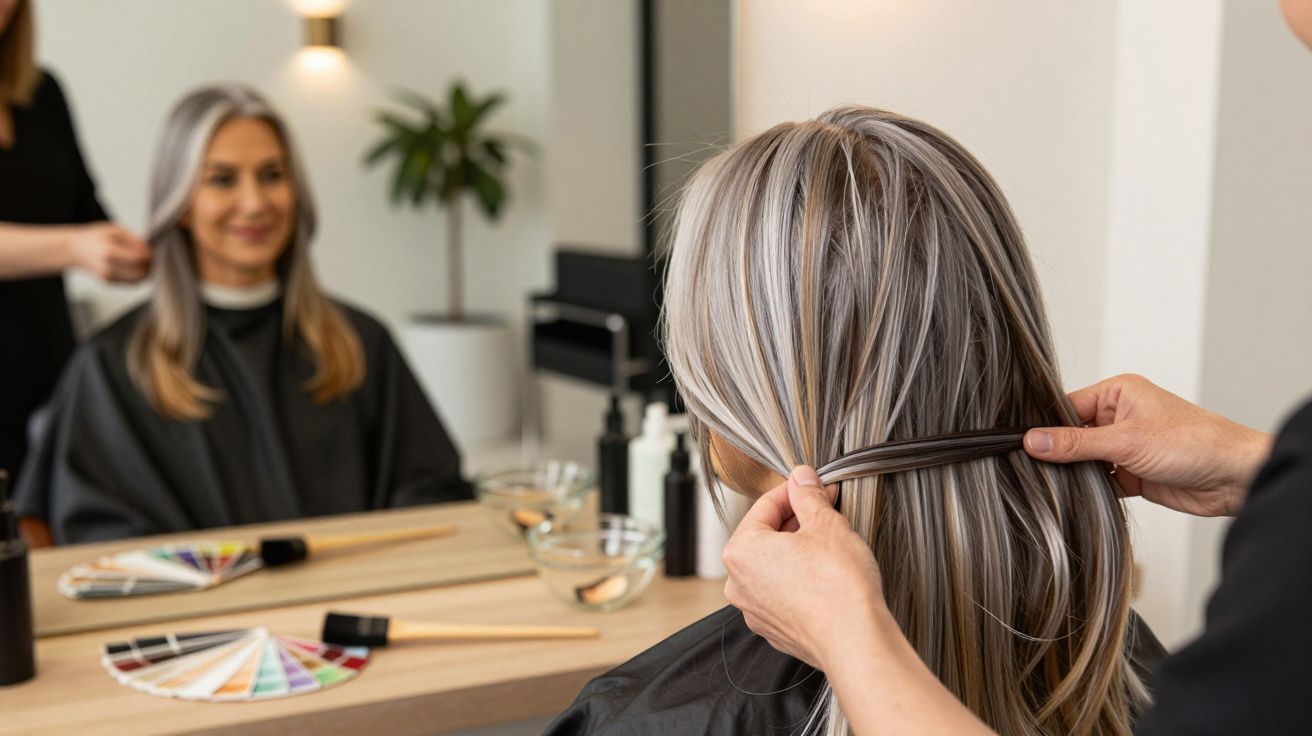
Grey streaks edging in, yesterday’s colour clinging on, and that awkward salt-and-pepper limbo that can drag out for months.
The High-Low balayage trend offers a genuinely smart in-between option, turning the “grow-out” phase into a considered, flattering finish rather than something you simply put up with.
What is High-Low balayage on salt-and-pepper hair?
Classic balayage tends to bring to mind beachy blondes and a sunlit, holiday feel. High-Low balayage uses the same freehand, painted approach, but with a different purpose: it deliberately balances light against dark so grey looks intentional.
Salt-and-pepper hair is, in effect, a mosaic. Some hairs have lost pigment entirely, others still hold your natural shade, and plenty sit somewhere in between. That mix can read as patchy or flat-particularly at the temples, around the hairline, and along the parting.
High-Low balayage places both lighter and darker pieces so grey hair blends through the rest, creating depth rather than stark contrast.
In practice, colourists paint two key elements:
- Lighter pieces (highlights) that mirror emerging grey and lift brightness around the face
- Darker lowlights that nod back to your original colour and restore dimension
The outcome isn’t a single, solid colour block. It’s a multi-tonal, layered blend that allows your natural greys to stay-just edited into a more polished pattern.
Why High-Low balayage flatters greying hair
As natural pigment reduces, hair can appear finer and less reflective. A one-note, all-over colour can exaggerate that effect. High-Low balayage is designed to counter it.
By introducing shadow and contrast in the right places, hair tends to look denser and more textured. Instead of the eye fixing on one bright white streak, it reads a softer, more even distribution of tones throughout the lengths.
The goal isn’t to disguise your age; it’s to make every stage of greying look deliberate, modern and well-finished.
It’s also ideal for anyone exhausted by frequent root touch-ups, yet not fully ready to go completely natural. Think of it as a step-down plan: less upkeep than full coverage colour, more control than leaving it entirely untouched.
Cool vs warm tones for High-Low balayage: what actually works?
US colourist Rachel Bodt, known for popularising the technique, emphasises that tone matters just as much as placement. The shades you introduce should either enhance the cool, steely quality of your greys-or soften them so they sit more gently against your complexion.
| Goal | Tones to favour | Effect on salt-and-pepper hair |
|---|---|---|
| Emphasise grey, make it stand out | Cool tones (ashy, pearl, silver) | Greys look crisper, more metallic |
| Keep it soft and natural | Soft warm tones (beige, soft gold, sand) | Greys melt more seamlessly into the rest |
| Blur harsh regrowth from previous dye | Neutral brondes, mushroom browns | Grow-out looks gentler with less of a visible line |
If your skin has a cooler, pink-leaning undertone, icy highlights and smoky lowlights often look most harmonious. If you’re warm-toned or olive, a touch of beige or soft gold can stop the overall effect from looking washed out.
The same High-Low idea can read bold and silvery on one person, and soft and sunlit on another-purely based on tonal choice.
Who benefits most from High-Low balayage on salt-and-pepper hair?
This approach suits a particular phase of greying: when your hair is clearly salt-and-pepper, but not yet predominantly white. For some people that starts in their thirties; for others, much later.
It’s especially useful if:
- You have concentrated grey at the front, temples or parting
- You’re fed up with root retouches every 3–4 weeks
- You like the idea of grey, but still want brightness and refinement
- You work in a public-facing role and want a smoother transition
The technique translates across many hair types-from wavy bobs to long, straight lengths-so long as there’s some movement or texture to show the tonal shifts.
Very short crops can still suit High-Low balayage, although the result is typically more diffused-less “ribboned” and more like a soft veil of tone.
How a High-Low session typically works
Consultation first: the step that makes or breaks it
A skilled colourist will assess three essentials: your natural base colour, how your greys are distributed, and your skin undertone. You’ll also be asked about your maintenance comfort level-are you happy visiting every eight weeks, or would you rather come in once or twice a year?
From there, they’ll map out:
- How many lighter pieces to place near the face and along the parting
- Where lowlights should sit to support your base shade
- Which areas of grey should remain completely natural
The painting process
Rather than foiling every strand, the colourist works in panels and ribbons. Lighter strokes are usually concentrated where grey is most visible (often around the face). Deeper shades may be placed underneath, or threaded between brighter sections, to stop white pieces from looking stark.
Often, the most silvery strands are left alone because they function like ready-made highlights. The added colour is there to balance them-not to smother them.
Maintenance: how often and how much?
A major reason people choose High-Low balayage is the comparatively low maintenance versus full coverage dye.
Because the greys aren’t completely painted over, regrowth doesn’t announce itself as sharply. And because placement is hand-painted, you don’t get the same hard line as the hair grows.
- Salon visits: typically every 3–6 months for tweaks and rebalancing
- Toning glosses: around every 6–8 weeks if you want extra shine or to keep warmth under control
- At-home care: use purple or blue shampoo once weekly to reduce brassiness in lighter pieces
Moisture becomes essential. Grey hair can feel drier and more porous, and lightener increases that need. Plan on regular masks, leave-in conditioner and consistent heat protection.
Added consideration (UK): price, patch tests and timing
In the UK, a High-Low balayage appointment is usually priced more like a bespoke colour correction than a simple highlight top-up, because it involves balancing multiple tones. Expect longer appointment times too-often half a day, depending on length and density.
Also remember the practicalities: reputable salons will require a patch test before certain colour services, and it’s worth booking your consultation well ahead of a big event so there’s time for adjustments if the tone needs refining.
Key terms you might hear in the salon
Salon language can sound vague-or oddly technical-so it helps to decode a few common phrases:
- Lowlights: darker strands added to restore depth and mimic natural shadow
- Toner / gloss: a translucent colour applied after lightening to perfect tone without heavy coverage
- Cool tone: blue/green/violet-based shades that help neutralise orange or yellow
- Warm tone: gold/copper/red-based shades that add glow but can turn brassy if pushed too far
Knowing the terminology helps you request “cool lowlights to support my grey” or “a beige gloss-not too yellow” rather than keeping it all guesswork.
Real-life scenarios: moving from full dye to High-Low balayage
Picture someone colouring their hair dark brown every month. Underneath, roughly 40% of their hair is now white, especially at the hairline. Stopping colour instantly can feel extreme. High-Low balayage offers a more gradual exit.
A colourist might soften overly dark mid-lengths, add smoky lowlights, and let the natural grey at the roots mingle in. Over the course of a year, the artificial pigment can be reduced at each visit. Instead of a stark band of regrowth, the salt-and-pepper effect becomes a nuanced blend.
Another common situation: someone has already grown out their natural grey but feels the overall tone looks flat or has started to yellow. A few cool, silvery strokes plus soft charcoal lowlights can sharpen everything-like swapping a basic outfit for the same look with better tailoring.
Risks, limitations and when to pause
High-Low balayage is still a chemical service. If hair is fragile, over-processed, thinning, or already breaking, adding lightener can make damage worse. A strand test and an honest discussion about condition are essential.
There’s also an expectations issue. Some people want a filter-like result-perfect, instant, and maintenance-free. High-Low is more grounded than that: it elevates what you have, but it won’t recreate the density or pigment of your mid-twenties.
It works best when the aim is enhancement and acceptance, not pretending the grey never showed up.
For anyone ready to treat salt-and-pepper hair as a style advantage rather than a problem to solve, High-Low balayage is a contemporary, flattering way to make the transition feel intentional-and genuinely chic.


Comments
No comments yet. Be the first to comment!
Leave a Comment