
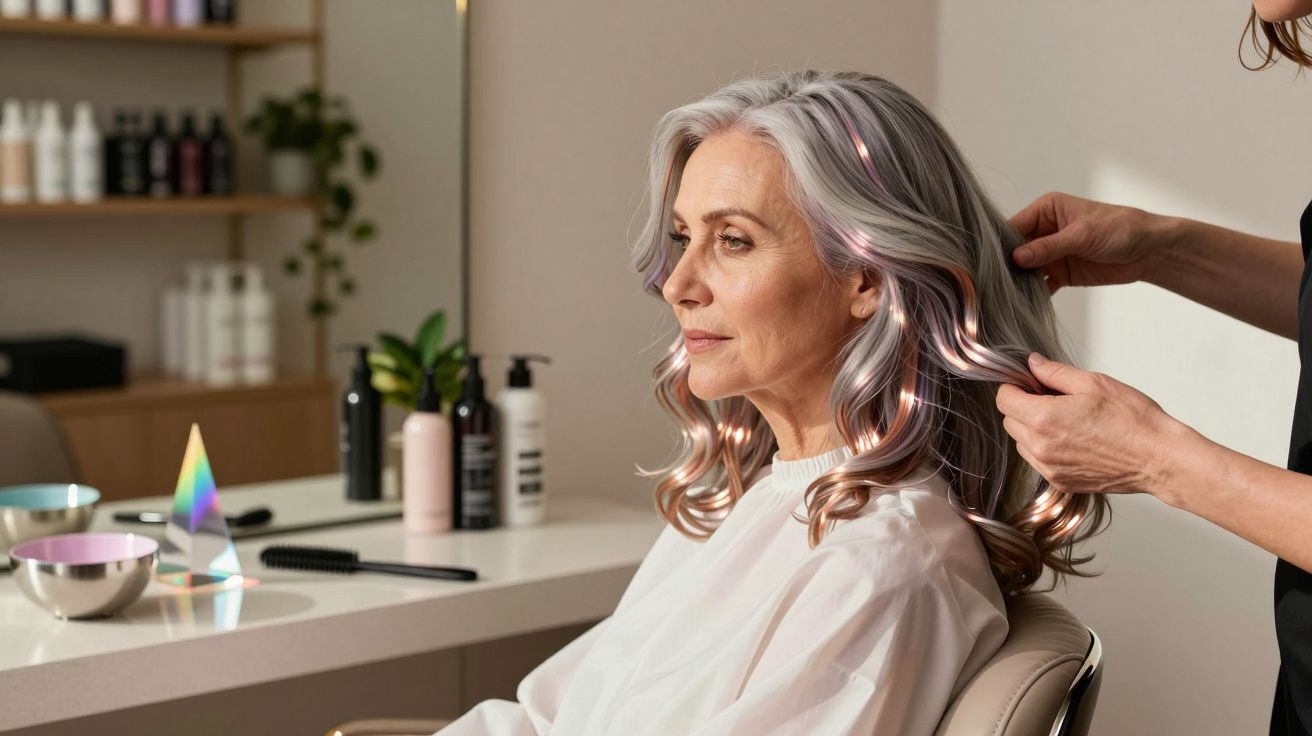
Grey strands are showing up sooner, salon bills keep climbing, and plenty of people feel stuck between total coverage and letting their hair turn naturally silver.
Somewhere between aggressive permanent dye jobs and a dramatic “cold turkey” grow-out, a softer, more wearable option is taking off: stained glass hair. It’s designed to blur grey rather than wipe it out, and it often comes with unexpectedly low upkeep.
Stained glass hair: what it looks like in real life
The phrase nods to the earlier “glass hair” obsession, when mirror-like shine and a laminated finish were everywhere. Stained glass hair keeps that light-catching, luminous feel, but shifts the focus from pure gloss to how colour is placed.
Stained glass hair uses ultra-fine, translucent highlights and lowlights to blur grey hairs so they blend into the rest of your colour.
Instead of chunky streaks, colourists weave in micro-sections-almost like threads-that sit just a touch lighter and a touch deeper than your base. Because the contrast is deliberately subtle, what you notice is movement, shine and dimension, not stripey highlights.
The intention isn’t to pretend grey never existed. The method works by acknowledging that silvers are there, then arranging the surrounding tones so your eye stops locking onto individual white hairs.
The shift in mindset: from hiding grey to highlighting it
Stylists say attitudes towards ageing hair are changing fast. Rather than “get rid of every grey at all costs”, more clients are asking for hair that still looks polished, believable and expensive-looking two months later.
Grey is softened and showcased, rather than blasted with solid dye from roots to ends.
London colourist Marcos Verissimo puts it simply: the difference between your natural base and the brightening pieces needs to stay minimal. Push the contrast too far and you’re no longer diffusing grey-you’re just doing obvious highlights.
A useful way to picture it: you’re adjusting the lighting in a room rather than repainting the walls. A little brightness placed where grey is most concentrated, combined with slightly deeper tones where hair looks washed out, creates a “filter” across the whole head.
Why actors over 50 are choosing stained glass hair
Red carpet colour has quietly become one of the best adverts for this technique. Verissimo notes that many actors over 50-such as Jennifer Aniston and Naomi Watts-leave a whisper of grey showing, but surround it with extremely fine, refined colourwork.
That mirrors what’s happened in aesthetic treatments more broadly. Ten years ago, frozen foreheads and exaggerated volume were everywhere. Now, heavily “done” results are falling out of favour, replaced by subtle tweaks that still move naturally. Hair colour is following the same direction.
Stylists say the real measure of a luxury colour is how polished it looks 45 days after the appointment-not just on day one.
Because stained glass hair isn’t trying to fight every millimetre of regrowth, the transition between coloured lengths and natural roots stays soft. Many people find they can stretch appointments to six or even eight weeks without feeling untidy.
How stained glass hair is created in the salon
The technique, step by step
Every colourist will tailor the plan, but a typical appointment usually includes:
- Reviewing your natural base colour, the percentage of grey, and where grey is most concentrated
- Placing ultra-fine brightened strands to catch the light and visually “surround” grey hairs
- Adding slightly deeper lowlights where hair reads too pale or lacks depth
- Rinsing, then finishing with a translucent gloss or toner to unify tone and boost shine
The formulas used are often sheer and gel-like-more like skincare serums in texture than old-fashioned, opaque dyes. That transparency is the whole point: the underlying hair (including some greys) can still be seen, which keeps the outcome natural and credible.
Face-framing stained glass hair that lifts and defines
Artistic director Zoë Irwin highlights another benefit: placement can gently sculpt the face. As we get older, the jawline can soften and facial contrast may appear less defined. Building dimension with tone-rather than relying on a severe cut-can subtly help.
Carefully placed light and dark around the face restores contrast where bone structure has softened with age.
Irwin points to Gwyneth Paltrow as a good example of a blonde using precise face-framing colour. A blanket of pale streaks can drain the jaw and temples; a stained glass approach keeps brightness near the cheekbones while adding depth where structure is needed.
Jennifer Aniston is another common reference: bright enough to read youthful, but threaded with deeper pieces so the hairline and jaw don’t disappear into the skin tone.
Choosing the right salon approach (and what to ask for)
If you’re booking in, it’s worth looking for a colourist who’s confident with micro-placement work-think ultra-fine weaving, subtle lowlights and controlled toning. Photos can be helpful, but the clearest request is functional rather than visual: ask for sheer, stained glass style colour with visible grey, plus a plan that will still look intentional at the six-to-eight-week mark.
It also helps to discuss your day-to-day styling. Heat tools, frequent washing and hard water can all dull shine faster-so the salon formula and at-home routine should be chosen to keep that translucent, reflective finish for as long as possible.
At-home care: keeping the stained glass effect luminous
When the salon finish starts to fade, you don’t necessarily need a full recolour straight away. The trick is to top up shine and transparency rather than restarting the entire process.
Many brands now sell glosses and glazes that behave a bit like lip oils: a sheer tint, high reflection, and low commitment. Most fade out gradually over a few weeks.
| Product type | Main role | How often |
|---|---|---|
| Clear gloss | Boosts shine, seals the cuticle | Every 2–4 weeks |
| Tinted glaze | Refreshes tone, softens brassiness | Monthly or as needed |
| Pigmented conditioner | Maintains warmth or coolness between visits | Every few washes |
At home, keep things simple: a gentle shampoo, a moisturising conditioner, and an occasional in-shower gloss. Because the colour is translucent, heavy-duty clarifying products and strong anti-dandruff shampoos can strip it faster-so use them sparingly and only when you truly need them.
Who stained glass hair suits best
This technique is especially well suited if:
- You’re around 20–60% grey and the white hairs are scattered rather than concentrated in one solid patch
- You dislike harsh, obvious root regrowth lines
- You want to move from full-coverage dye towards a softer, more natural-looking transition
- You prefer reflective, expensive-looking hair over bold, fashion-led colour
If you’re already almost completely white, you can still request a stained glass version. In that case, your colourist might apply a veil of beige, pearly or smoky tones to add depth-while leaving plenty of natural silver visible.
Common terms you might hear in the chair
Salon language around this trend can sound a bit technical. These are worth knowing before you book:
- Translucent colour: dye that lets light pass through so the underlying hair shows, rather than covering it completely.
- Gloss / glaze: semi-permanent (often ammonia-free) treatments that add shine and a hint of tone without dramatically changing your natural colour.
- Babylights: ultra-fine highlights designed to mimic naturally sun-kissed strands in children’s hair; often used within stained glass techniques.
Understanding these terms makes the consultation easier. If you specifically ask for “sheer, stained glass hair colour with visible grey”, you’re clearly signalling that you don’t want traditional, opaque full coverage.
Risks, limits and realistic expectations
No colour appointment is entirely without risk. Even gentle formulas can irritate sensitive scalps, so a patch test is still a sensible step. Translucent dyes usually rely on lower peroxide levels than strong permanent tints, but they can still alter the hair fibre to some degree.
There’s also an emotional adjustment. Moving from solid coverage to stained glass hair means accepting that grey will be seen. For some people that feels freeing; for others, the first few weeks can feel strange. If you’re unsure, try a semi-permanent gloss first, or start with the technique just around the face to see how you feel about the effect.
For anyone balancing work expectations, caring responsibilities and personal style, stained glass hair offers a practical middle route: not committing to an overnight grey grow-out, and not staying trapped in a block of opaque colour either-just a softer, more modern way to wear grey that looks intentional as it grows.



Comments
No comments yet. Be the first to comment!
Leave a Comment