
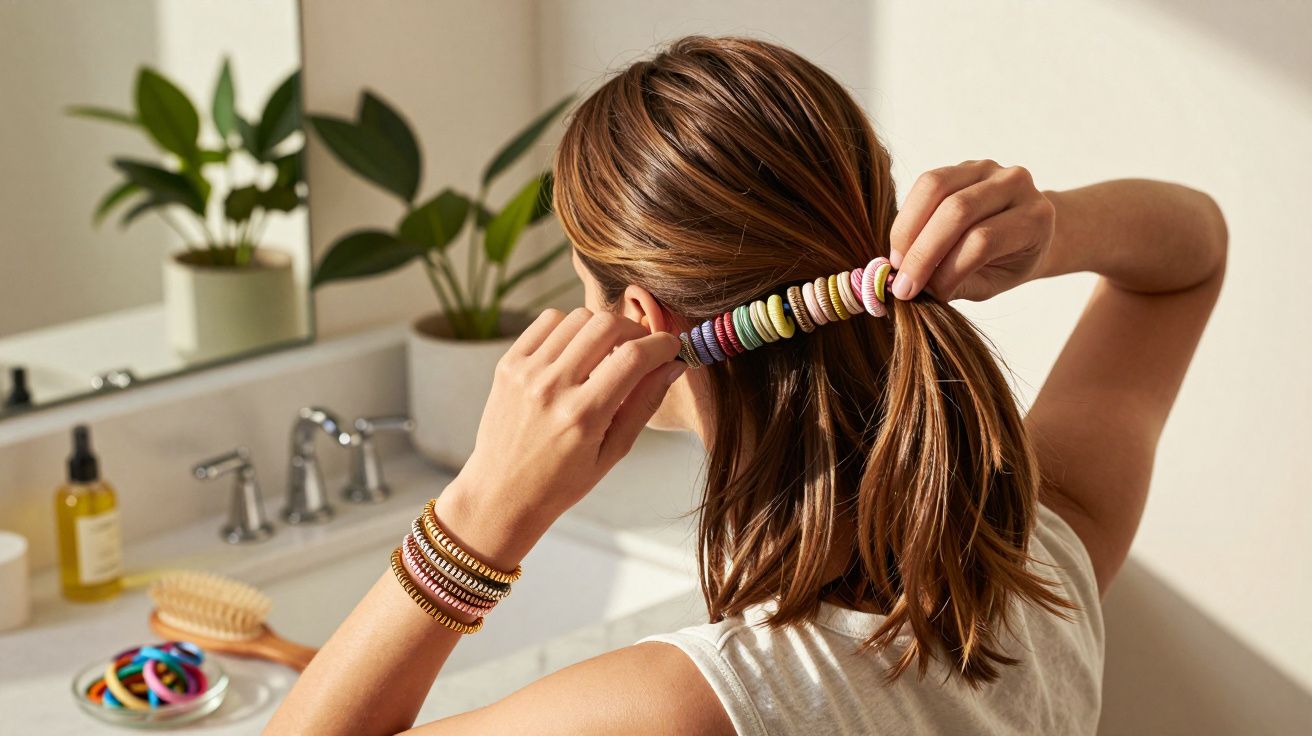
From gym bags to red carpets, a small, brightly coloured hair tie has been popping up almost everywhere, transforming a plain ponytail into something that looks intentionally styled.
At the centre of this quiet takeover is Kknekki: a deceptively simple woven elastic that’s become a go-to for hairstylists, influencers and anyone who wants their hair up without the usual headache, pulling or breakage.
What is Kknekki, and why is everyone talking about it?
Originally popular in Scandinavia, Kknekki is now sold internationally and is reported to have reached 10 million units sold in a single year. At a quick glance it resembles a cute, textured scrunchie-just without the ruffle. Look closer and you’ll see a compact ring made from tightly braided threads wrapped around a stretchy inner core.
The pitch is uncomplicated: strong hold, a soft grip, no harsh creases, and noticeably less damage than a standard elastic band. For anyone used to hair ties snapping, knotting, or leaving that obvious “ponytail dent” in a fresh blow-dry, that promise is hard to ignore.
Behind the viral hype is a surprisingly technical item: more than 60 finely woven threads wrapped around a high‑performance elastic, designed to grip without tearing.
A Kknekki hair tie built like a premium accessory
Despite being “just” a hair elastic, the team behind Kknekki argues it shouldn’t be grouped with everyday mass-produced bands. The brand-now owned by the Scandinavian group Bon Dep-puts emphasis on careful sourcing and manufacturing choices that are more traditional than you might expect.
High-quality materials at the core
According to the company, each component is selected to meet strict quality standards, from glue imported from Germany to the yarns used in the outer weave. The construction centres on more than 60 ultra-fine threads braided around an internal elastic that provides the tension.
That dense braid creates a smoother exterior. In practical terms, the tie distributes pressure across many tiny contact points rather than concentrating it in one narrow strip. The result is less friction and less “biting” into delicate lengths, compared with a thin rubber band.
The smooth surface is intended to reduce breakage, help prevent slipping, and keep styles secure without leaving sharp dents.
Made on vintage 1960s weaving machines
One of the more unexpected details is how they’re made. Kknekki elastics are reportedly produced in China and Vietnam using older weaving machines dating back to the 1960s. These slower, mechanical looms can create a very tight, uniform braid that modern high-speed systems often struggle to replicate.
This isn’t presented as nostalgia for nostalgia’s sake. The brand’s claim is that these machines produce the rounded profile and surface finish that helps prevent snagging-and gives Kknekki its recognisable, rope-like look when worn on the wrist.
Why Kknekki sold 10 million units
Hair ties are the ultimate everyday item, and very few ever become “a thing”. Kknekki has managed it by pairing functional benefits with a look that works for both minimalists and maximalists.
Less damage for everyday hairstyles
If you’re dealing with breakage, thinning, or colour-treated hair, the way a tie grips matters. Traditional elastics can create stress at one tight point on the ponytail. Over time, that repeated friction may weaken the hair shaft and contribute to a visible “break line”.
Kknekki’s braided construction and softer edges are intended to reduce that effect. It stretches generously, then contracts evenly so it hugs the hair rather than cutting into it. Many users with fine, curly or fragile hair report fewer tangles on removal and less snapping through the day.
A hair accessory that can hold a high ponytail for hours yet comes off without that dreaded last-second yank is genuinely uncommon.
From ponytail to wrist: an accessory that looks like jewellery
Practicality alone doesn’t explain the obsession. Kknekki leans heavily into style, offering around 750 designs-from understated neutrals to glittery finishes, shimmers and bold colour pairings. Many look more like woven bracelets than hair ties.
That matters because plenty of people keep an elastic on their wrist “just in case”. A plain black band can look sloppy with a suit or a dress; a glossy, braided Kknekki can pass as a casual bracelet, especially worn as a pair.
- Typical price per piece: around £3 (often sold individually or in small sets)
- Designs: roughly 750 colour and texture combinations
- Who it’s for: all hair types, including fine, curly and damaged hair
- Core promise: secure hold, minimal marks, reduced breakage
How Kknekki changes everyday styling
Because it combines grip with stretch, Kknekki works across a surprisingly wide range of hairstyles-whether you prefer clean, minimalist looks or something more playful and layered.
Quick styles with one or two Kknekki elastics
With a single Kknekki, you can make simple styles look more finished:
- Low, sleek ponytail: smooth hair down and secure at the nape. The braided texture adds a subtle detail without dominating the look.
- Messy bun: twist hair loosely and wrap the tie twice. The hold helps stop the bun collapsing, even with lots of layers.
- Half-up, half-down: gather the top section and tie at the back of the head. A metallic or glitter finish adds a small but noticeable highlight.
With two or three, the effect becomes more graphic:
- Bubble ponytail: tie at the base, then add more ties every 5–7 cm to form rounded “bubbles”. Contrasting colours make the shape stand out.
- Stacked braids: secure the top and the end of a loose braid with matching ties for a polished-but-relaxed finish.
- Colour-block high pony: place different shades along the ponytail for a playful, almost Y2K-inspired feel.
Why stylists and colourists like this type of accessory
Professionals tend to value anything that protects the work they’ve done. A balayage appointment or keratin treatment can be slowly undermined by daily mechanical stress from rough elastics.
A tie that reduces friction supports long-term hair condition. It can also help blow-dries and smooth styles last better: deep creases from tight bands often push people to use more heat the next day to “iron out” the dent. Fewer sharp marks can mean fewer straightener passes.
Who benefits most from a gentle elastic?
A premium hair tie isn’t essential for everyone. Some people with thick, untreated hair can use basic elastics without obvious damage. However, certain groups tend to gain more from a softer, less abrasive grip:
- People with bleached or highlighted hair: chemical processing can weaken the cuticle, making strands more prone to snapping.
- Curly and coily hair types: curls can tangle at tight pressure points; a smoother, rounded surface helps reduce snagging.
- Those with fine or thinning hair: a harsh elastic can pull out multiple hairs each time it’s removed.
- Children: softer ties generally mean less discomfort-and fewer battles at brushing time.
For these users, paying a couple of pounds more per elastic can feel preventative: fewer broken ends, less frizz from compromised cuticles, and less pain when undoing updos.
How Kknekki fits into a gentle hair-care routine
Switching to a kinder hair tie is only one piece of the puzzle. People trying to improve hair condition typically combine small habits that add up over time.
Helpful complementary choices include sleeping on a satin or silk pillowcase to reduce overnight friction, applying heat protectant before blow-drying, and brushing from the ends upwards to avoid tightening knots. Adding a Kknekki-style elastic reduces stress during the day-when hair gets pulled back for work, exercise or childcare.
Healthy-hair routines rarely depend on one miracle product; they’re usually the result of many tiny, low-effort decisions that gradually tip the odds in your favour.
What “no marks” and “no breakage” really mean
Hair accessory marketing can be vague, so it’s worth being clear about these claims.
When a brand says “no marks”, it usually means you’re less likely to get the deep, sharp ridge created by a tight band sitting in the same spot for hours. With a braided elastic you might still see a gentle wave, but the dent is typically softer-especially if the style wasn’t pulled extremely tight.
“No breakage” doesn’t mean hair will never snap. It means the design aims to minimise mechanical damage during normal use. If you rip the tie off dry hair or twist it far beyond its tension limit, you can still catch strands. The difference tends to show up in day-to-day wear: over months, less friction and a gentler grip can mean smoother ends and fewer short, broken hairs around the hairline.
Getting more life out of a Kknekki (and avoiding common mistakes)
Even a gentle elastic performs best when it’s treated well. If it gets coated in product, oil or sweat, the fibres can become less grippy and the tie may feel “looser” sooner.
To keep it in good shape, many people simply rinse it occasionally in lukewarm water with a little gentle cleanser, then leave it to air-dry fully. It’s also worth avoiding wrapping any elastic around soaking-wet hair for long periods, as wet strands stretch more easily and are more vulnerable to mechanical stress.
A small accessory that’s become oddly essential
For anyone who wears ponytails and buns several times a week, small design differences can change how hair looks and feels over time. Kknekki may be just a compact, colourful ring on the wrist-but for millions of users it has quietly earned a place alongside the hairbrush and serum as a daily essential.
Comments
No comments yet. Be the first to comment!
Leave a Comment