
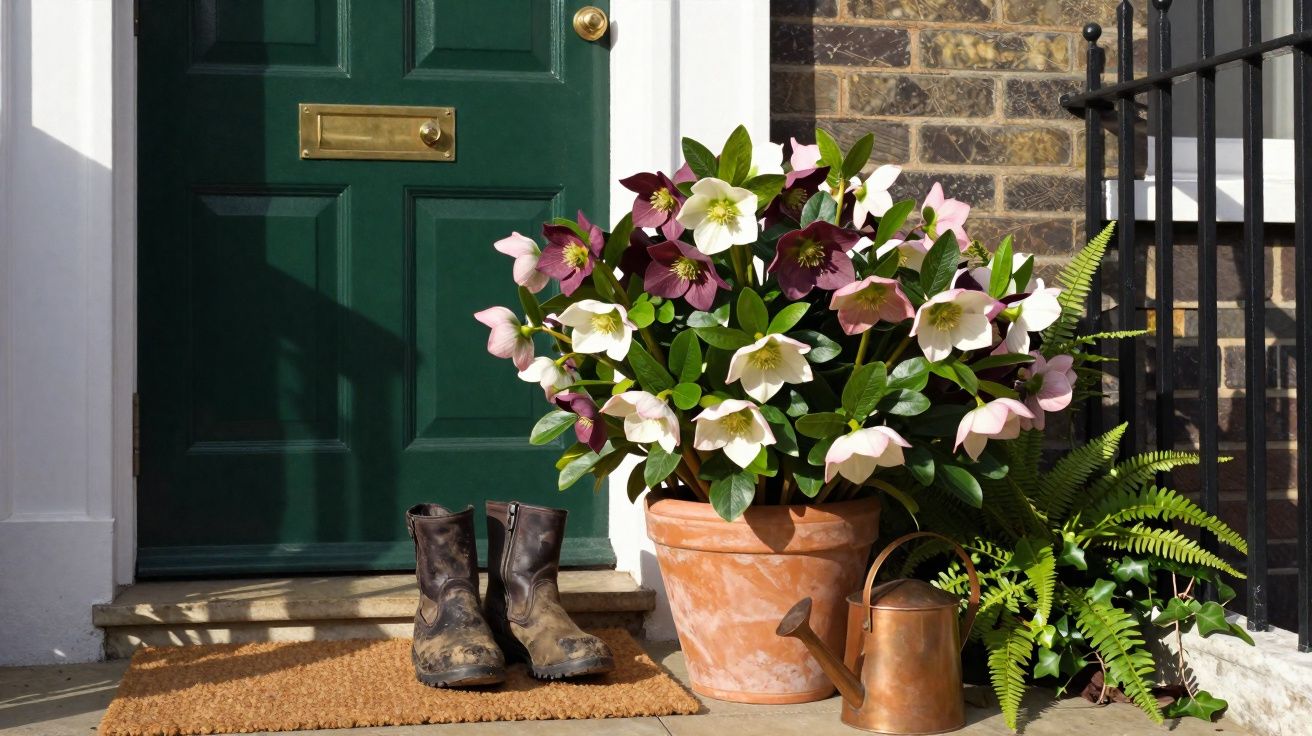
As neighbours tug their coats closer and hurry past leafless hedges and rain-dark lawns, one confident flash of winter colour can make them pause. This is how a plant I picked almost on impulse turned an ordinary front step into the most talked-about entrance on the street.
The winter my London front door stopped looking tired
February used to drain the life out of my small London terrace. The hanging baskets sat empty, the box hedge looked miserable, and the step had the bleak feel of a rental photo taken under a flickering bulb. Whenever I tried to brighten things up, it usually ended in disappointment: pansies that looked bedraggled (and were promptly nibbled by slugs), or a cyclamen that collapsed the moment a proper frost arrived.
One gloomy Saturday, wandering around a garden centre with no real plan, I spotted a low bench of plants that were quietly getting on with flowering while everything else seemed half-dormant. Little nodding blooms in soft pinks, greens and near-black purples pushed up through cold compost as if winter were nothing more than gossip.
One pot came home with me, largely on a whim. Within a few weeks, that single choice changed the entire mood of the entrance.
The label said Helleborus orientalis - more commonly called the Lenten rose. I’d seen the name mentioned in gardening columns, but I’d never paid it much attention. I did after that.
Meet the hellebore (Helleborus orientalis): the plant that performs when everything else has given up
Why this flower dominates late winter
The hellebore pulls off what most plants won’t even attempt: it flowers properly in midwinter, rather than merely clinging to the last tatters of the previous season. While roses are being cut back and hydrangeas sit sulking beneath their old stems, hellebores send up sturdy stalks topped with elegant blooms that last and last.
By a front door, the impact is instant. You get real colour at eye level at the exact time of year when coats are zipped to the chin, the sky hangs low, and daylight feels rationed.
Where other doorsteps had nothing more than a bare mat, mine suddenly had a small, steady winter display that looked as though it had been styled on purpose.
Unlike many winter bedding plants, hellebores aren’t designed to be thrown away. They’re hardy perennials, returning year after year and slowly forming clumps that tend to get better with age. That durability turns one purchase into a long-term feature - in the same way a good porch light or door knocker becomes part of the house’s character.
The colour range that makes designers quietly obsessed
The usual idea of a “winter flower” is something loud and overly bright battling against the grey. Hellebores don’t do that. Their colours are calmer, more sophisticated - the sort of shades that wouldn’t look out of place on an interiors mood board.
- Creamy whites that sit beautifully against black or navy doors
- Dusty pinks and blush tones that soften brick and stone
- Smoky plums and near-black flowers that look sharp and contemporary
- Soft lime and chartreuse blooms that brighten shaded steps
Some varieties are freckled, some have petals outlined with a fine contrasting edge, and others are double-layered like miniature roses. The overall effect feels less “garden centre bargain bench” and more “small florist with taste”.
Low-effort, high-impact: why my laziest winter choice worked best
The plant that forgives busy schedules
Once the hellebore had settled into its pot by the front door, it demanded very little. No weekly deadheading, no constant feeding, and no late-night panic about protecting it from frost. It mainly wanted decent compost and excellent drainage.
If you can manage a watering can occasionally and a quick tidy of old leaves, you can grow a hellebore.
For anyone who travels, works long hours, or simply forgets plants exist between November and March, that toughness is a genuine advantage. Hellebores take low temperatures that would wipe out geraniums or tender herbs overnight. They don’t collapse in relentless rain, and they’re not easily bullied by wind. They’re built for the very months most of us try to endure.
How I planted it (and what I’d do exactly the same again)
Hellebores hate having their roots sitting in water, so the container mattered more than the decorative finish. I chose a heavy pot with a broad base so it wouldn’t topple in bad weather, then paid close attention to what went into it.
| Step | What I did | Why it helped |
|---|---|---|
| 1. Drainage | Put a thick layer of gravel in the bottom | Prevented water pooling and root rot |
| 2. Soil mix | Mixed garden soil with compost and leaf mould | Created a rich base that holds moisture but still drains freely |
| 3. Planting depth | Set the crown level with the soil surface | Stopped the plant sulking and refusing to flower |
| 4. Watering | Watered once after planting, then relied on winter rain | Avoided the sogginess hellebores dislike |
Now the only routine job is a quick trim of tired, leathery leaves towards late winter, so the new flowers can be seen properly. It takes under five minutes and makes the whole display look instantly sharper.
A small seasonal tweak that makes the pot look “finished”
One extra habit made the container look far more intentional: I topped the surface with a thin layer of fine gravel after planting. It helped the pot look tidier through wet weather, reduced compost splashing during heavy rain, and made the flowers look as though they were growing out of a deliberately designed arrangement rather than a hurriedly filled container.
Pairing hellebores with clever companions at the front door
The small “plant team” that made guests comment
A single hellebore will lift a doorstep all on its own, but adding a few well-chosen companions turns the space into a miniature winter garden. I found the trick wasn’t piling on colour - it was mixing leaf shapes, textures and heights.
- Heucheras tucked around the base added bronze and silvery foliage that picked up the hellebore tones.
- Snowdrops in a low bowl near the step brought bright little bells that nodded beneath the larger blooms.
- Evergreen ferns in a side pot introduced soft, arching fronds that broke up hard lines.
- Trailing ivy spilling over the rim softened the container and made the whole thing feel less rigid.
The result looked so deliberate that visitors assumed a professional had designed it. In reality, it cost less than plenty of doormats.
By early spring, these plants overlapped neatly with new bulbs emerging and nearby shrubs starting to bud, which meant the entrance never slipped back into looking empty.
Keeping the doorstep attractive after flowering
Hellebores don’t vanish when the flowers fade. The foliage continues to provide structure, and the seed heads stay attractive for a while if you leave them in place. If you want the pot to look smart right through spring, it helps to plan for that transition: keep an evergreen companion (such as a fern or ivy) in the mix, and allow room for small bulbs to appear later without crowding the hellebore’s crown.
What new gardeners should know about hellebores
A quick glossary to make plant labels less baffling
Garden centre labels can read like code, so these terms are worth knowing:
- Perennial: returns year after year rather than dying after one season.
- Evergreen: keeps its leaves in winter, so the container doesn’t look bare after flowering.
- Partial shade: a position with some direct light (often morning sun), but shelter during the harshest part of the day.
- Crown or collar: where stems meet roots; with hellebores this should sit at soil level, not buried.
Hellebores are mildly toxic if eaten, like many common garden plants. That means teaching children not to put leaves or flowers in their mouths, and placing pots where pets aren’t likely to graze. In rare cases the sap can irritate skin, so wearing gloves when trimming foliage is sensible.
If you want to copy this effect on your own street
Picture a small, north-facing porch with a plain concrete step and a dark front door. Add one large, simple container holding a deep purple hellebore, then underplant it with pale heucheras and a ring of snowdrops. Put a second, smaller pot on the other side with an evergreen fern and trailing ivy. The costs stay reasonable, watering is minimal, and the view from the pavement changes completely.
Now imagine a suburban semi with a south-west-facing entrance. A wide container filled with cream and blush hellebores, backed by a low evergreen shrub, softens the brickwork and frames the doorway. On cold evenings, the flowers catch the porch light, and dog walkers slow down for a proper look.
In both cases, the change doesn’t come from grand landscaping - it comes from one smart plant choice doing the heavy lifting in the bleakest months.
For anyone who’s sick of apologising for their front step every winter, that quiet reliability becomes oddly addictive. Once a hellebore has proved itself, bare entrances start to feel less like the norm and more like a missed opportunity.



Comments
No comments yet. Be the first to comment!
Leave a Comment