
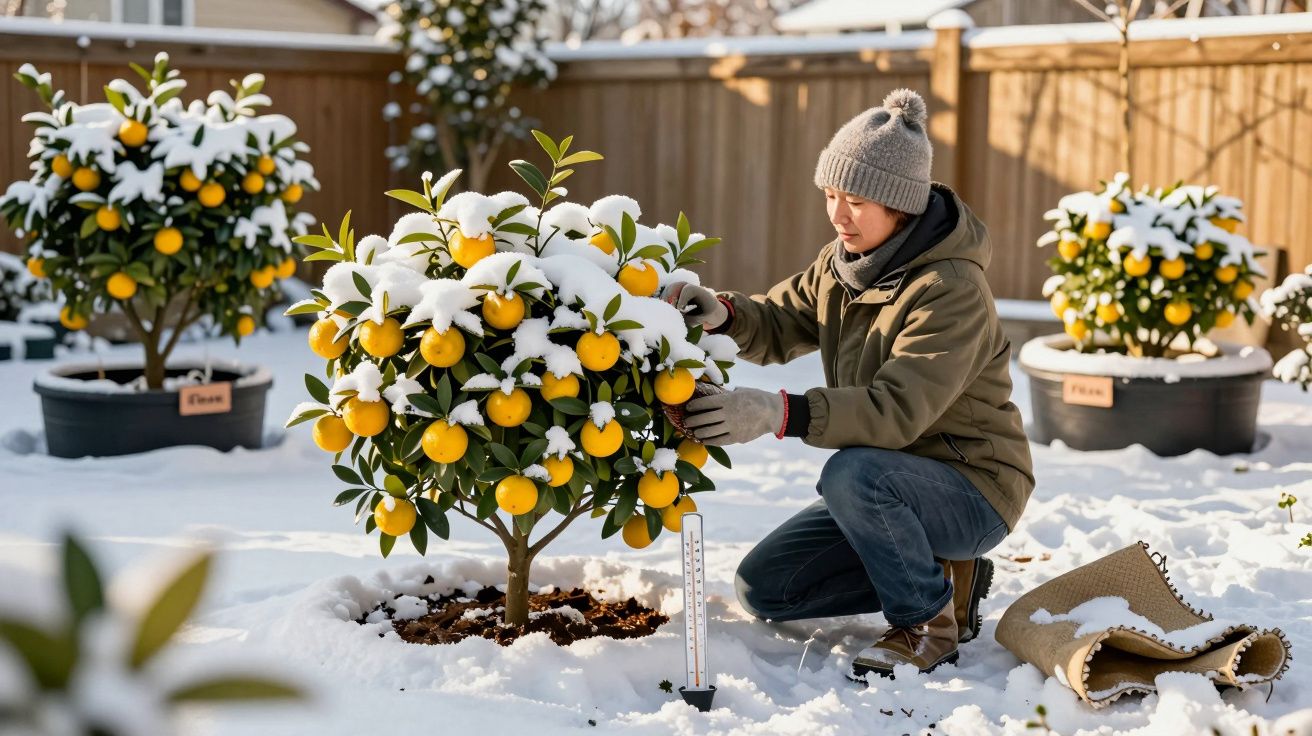
Many gardeners picture bowls of bright yellow fruit right by the front door-only to watch a lovingly chosen lemon tree turn black after the first frosty night. Citrus has a reputation for being temperamental, almost “Riviera-only”. That idea is only partly true. A number of citrus plants cope with surprising levels of cold and, in the right spot, can stay outdoors even in more exposed areas.
What frost hardiness in citrus plants really means
Nursery labels often promise something like “hardy down to –12 °C”. It sounds reassuring, yet it’s also a common source of disappointment. In most cases, that figure assumes:
- a fully established, mature plant,
- a deep, well-developed root system,
- free-draining soil that never sits waterlogged,
- a short cold snap rather than weeks of sustained sub-zero weather.
It’s also important to remember that wood, leaves and fruit do not respond to frost in the same way. A Yuzu tree may survive a brief dip to around –12 °C, but the fruit often split and spoil at notably higher temperatures. Kumquat is similar: the shrub can pull through, while the fruit can show obvious damage from roughly –5 °C.
Frost hardiness is not a fixed number; it’s always a combination of variety, age, location, soil conditions and how long the cold lasts.
Broadly speaking, citrus plants fall into three frost groups:
- very robust types: down to about –15 °C, with a few exceptions reaching around –20 °C,
- moderately robust types: roughly –8 to –12 °C,
- sensitive classics: already at serious risk at around –3 to –5 °C.
Location comes first: the best place for frost-hardy citrus plants
Even a genuinely tough variety will struggle in the wrong position. The most reliable set-up is:
- a full-sun, heat-reflecting wall (south or south-west facing),
- shelter from cold easterly winds,
- a slightly raised bed or a slope so cold air can drain away,
- free-draining, slightly sandy soil with effective drainage.
Hardiness ratings are very often quoted for well-drained soil. If your garden has heavy clay, it’s usually worth improving the planting area with sharp sand, grit and compost, or growing on a raised bed. If water sits around the roots, frost damage arrives faster and is far more severe.
The quiet star: the exceptionally frost-hardy three-leaved orange (Poncirus trifoliata)
The botanical name of this cold-resistant species is Poncirus trifoliata, commonly called the three-leaved orange (also widely known as the hardy, thorny citrus used for rootstock). In many nurseries it appears mainly as the rootstock beneath grafted citrus varieties-an unseen “engine” supporting the fruiting variety above.
| Feature | Details |
|---|---|
| Latin name | Poncirus trifoliata |
| Common name | Three-leaved orange / thorny hardy citrus (often used as rootstock) |
| Size | about 3–5 m tall, 2–4 m wide |
| Position | sun, sheltered spot, free-draining soil |
| Frost hardiness | down to about –20 °C in well-drained ground |
| Leaves | deciduous; very thorny |
This plant is often treated as the benchmark. If it dies back badly in your garden, most other citrus are unlikely to thrive there long-term. The fruit are small, yellow and extremely bitter-more of a culinary curiosity than a mainstream crop, though they can look very decorative. Because it is deciduous, it generally rides out deep winter conditions more comfortably than evergreen citrus types.
Edible citrus varieties that can genuinely take the cold
If you want more than an ornamental “exotic” and would also like fragrant, usable fruit, there are several frost-hardy citrus options that have performed well outdoors in sheltered spots-particularly in mild coastal areas, protected city gardens and warm wall positions in the UK.
Yuzu (Citrus junos): aromatic citrus for cold gardens
Yuzu has near-legendary status with professional chefs. Gardeners value it because it can tolerate around –12 °C, provided the soil drains well and the plant is protected from wind. It typically grows as a bushy shrub, forms plenty of thorns, and carries small yellow fruit in winter with intensely aromatic oils in the peel.
The juice tastes like a blend of lemon, mandarin and grapefruit. It works particularly well in:
- marinades for fish and poultry,
- salad dressings,
- delicate desserts and sorbets,
- tea or sparkling water as a flavouring.
Ichang lemon: larger fruit with better resilience
The Ichang lemon comes from crosses involving Poncirus, inheriting some of that toughness. It copes with cold winters far more calmly than the standard lemon tree and produces large yellow fruit with plenty of juice-ideal for homemade lemonade, marmalade, or baking.
Satsuma mandarin (Citrus unshiu): sweet, seedless and cold-tolerant
The Satsuma mandarin is particularly appealing for family gardens. It can handle temperatures around –11 °C and ripens early: the fruit are usually seedless and can often be harvested in autumn. In sheltered, urban microclimates in the UK-especially with some winter protection-it can remain outdoors in the ground.
Kumquat ‘Meiwa’: small fruit, big impact
Kumquat ‘Meiwa’ is considered comparatively cold-tolerant within the kumquat group. Established plants can manage around –8 to –9 °C. The small orange fruit are eaten whole; the peel tastes sweeter than the flesh. Whether in a front garden or in a large container, it adds striking winter colour.
Hybrids with caviar lime: exciting, but check the details
Some newer hybrids involving caviar lime can cope with roughly –10 °C. However, performance varies widely by cultivar. If you’re tempted, check the specific hardiness claim on the label and ask where the reported figures come from (local trials matter far more than marketing).
If you want citrus permanently in the ground, rely on documented frost figures for the exact variety-general statements are not enough.
The classics in a cold test: mandarin, clementine, lemon and orange
Many gardeners reach first for familiar names: mandarin, clementine, orange, lemon, grapefruit. These widely sold types are usually much more frost-sensitive than the specialists listed above.
- “Standard” mandarin trees generally cope only to about –8 °C.
- Clementine trees are commonly around –7 °C.
- Typical lemon trees, sweet orange and grapefruit often show visible damage from roughly –5 °C.
In very mild coastal locations or exceptionally sheltered, heat-retaining gardens, these trees can sometimes remain in the ground with careful protection. In much of the UK, it is usually safer to keep them in large pots and move them into shelter for winter.
How to protect sensitive citrus plants from frost damage
If you still want to show off warmth-loving citrus outdoors, you need a clear plan for cold nights. The following measures are widely proven:
- Overwinter bright but cool: a conservatory, a bright frost-free hallway, or an unheated spare room is ideal. 5–10 °C is more than sufficient.
- Outdoor winter protection: during short cold snaps, horticultural fleece can prevent freeze burn. Wrap it loosely around the canopy so air can circulate.
- Insulate the root zone: a thick layer of bark mulch, leaf mould or straw helps protect roots from deep ground cold.
- Reduce watering: cold, wet compost increases frost damage. In winter, water only enough to stop the root ball drying out completely.
- No feeding in winter: soft, fresh growth is the first to be killed by frost. Resume feeding in spring.
A practical extra step-especially in borderline locations-is to track your own garden’s extremes. A simple min–max thermometer near the planting spot quickly shows whether your “sheltered corner” truly stays a few degrees warmer than the rest of the garden, which can make the difference between success and failure.
What beginners should consider before buying citrus plants
If you’re planting citrus for the first time, starting small usually pays off. A young tree or shrub is easy to manage in a pot, can be moved to test the best position, and can be shifted into winter shelter quickly when needed.
A sensible approach is to begin with a robust exotic such as Yuzu or Satsuma mandarin, then add more sensitive types later.
Beyond frost hardiness, fruit ripening time matters. In cooler regions, summer may not be long or warm enough for late-ripening varieties to develop full flavour. If you choose early-ripening types, you can harvest in autumn before the harsher frosts arrive.
One more detail worth checking is whether the plant is grafted-and what it is grafted onto. Citrus on Poncirus trifoliata rootstock often has improved cold tolerance and can be better suited to outdoor experiments than plants on more tender rootstocks.
Real-world scenarios, risks and worthwhile combinations
In city gardens, courtyards and terrace-house plots, walls and buildings create a helpful microclimate. Frost-hardy citrus trials often work better there because:
- masonry stores warmth and releases it slowly overnight,
- wind is reduced,
- cold air is less likely to sit heavily as it does in open ground.
To lower risk further, you can pair citrus with other robust, Mediterranean-looking plants-such as figs, hardy herbs like rosemary and thyme, or an olive on a hardier rootstock. Visually, you still achieve a Mediterranean feel even if one specimen struggles after an unusually severe winter.
The biggest hazard isn’t always mid-winter cold, but late frosts. Many citrus plants break into growth early after a mild February. If temperatures drop well below freezing again in March or April, young shoots can be lost quickly. A light fleece cover-or growing in a large pot that can be pulled under cover on a patio-often provides the decisive margin of safety.
When you understand the different frost levels and match variety, site and care accordingly, it’s possible to harvest citrus well north of the Riviera-from bitter Poncirus trifoliata grown for ornament to fragrant Yuzu fruit in a winter city garden.





Comments
No comments yet. Be the first to comment!
Leave a Comment