
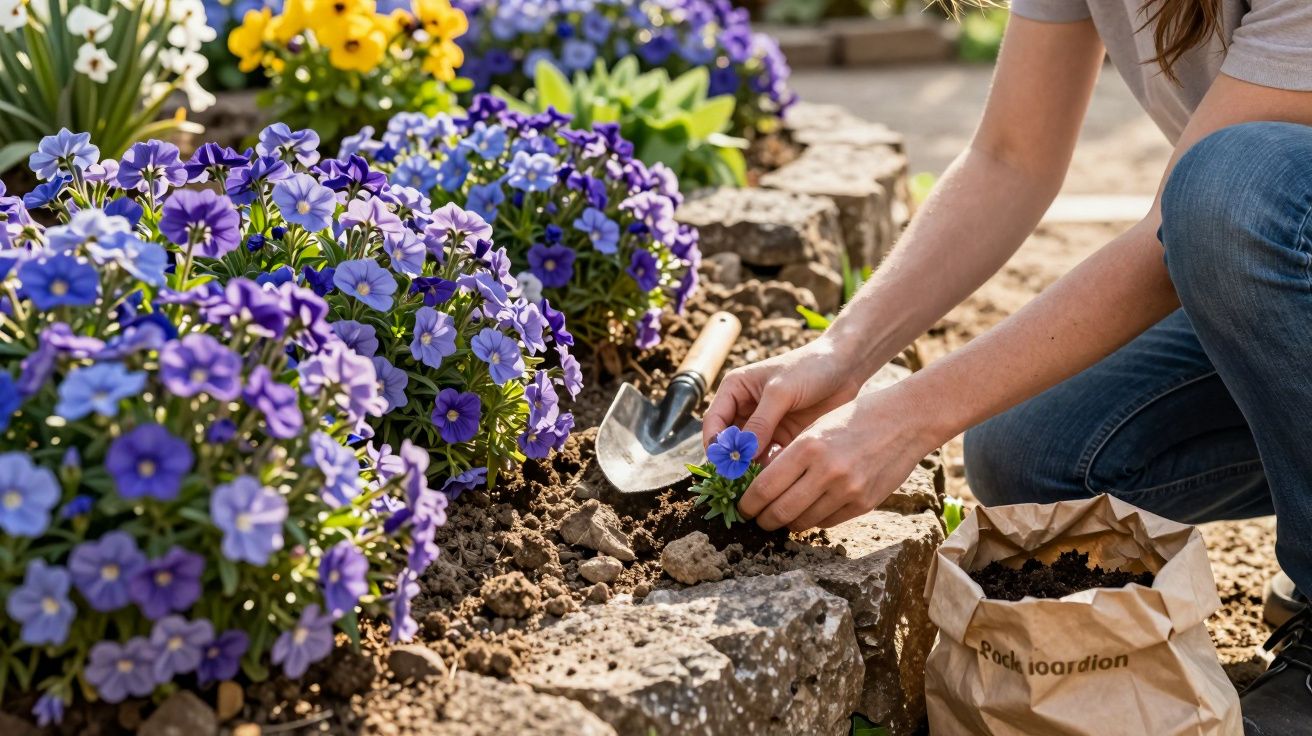
Many amateur gardeners get fed up with drab retaining walls: they do their job of holding back a slope, but visually they can ruin the whole area. The good news is that this awkward spot can be turned into a lively feature with surprising ease-using a perennial that thrives on bare stone, shrugs off drought and puts on a striking display in spring.
Why Aubrieta (blue cushion) loves bare retaining walls
The quiet star of many rock gardens is Aubrieta, often known as blue cushion. Botanically, it’s one of the classic cushion-forming perennials from mountainous regions. In its natural habitat it settles into rock crevices, stony slopes and dry banks-exactly the conditions you typically find on and around a retaining wall.
Blue cushion stays very low, usually only 10–15 cm tall, but spreads strongly sideways. Over time it forms dense, evergreen cushions that drape across stone like a living carpet.
In spring, blue cushion turns a bare stone face into an almost continuous layer of small violet flowers.
From roughly mid-April through to early summer, it blooms so profusely that the foliage is nearly hidden. The colours range from pale lilac to rich purple, and there are also cultivars with pink or bicoloured flowers. For many gardeners, this is the “wow” moment when the wall stops looking like a piece of hard landscaping and starts resembling a naturally weathered rocky outcrop.
The best position on a retaining wall
Blue cushion prefers it hot, sunny and free-draining-conditions that cause many ornamental plants to give up. It performs particularly well in:
- the top edge of the wall
- joints and small pockets between stones
- a south- or west-facing position
- a thin layer of loose growing medium with a high mineral content
The aim is simple: the roots sit securely in a bit of soil, while the shoots can hang freely over the edge. Little by little, you get the signature cascading effect, with cushions “flowing” down the wall.
Which soil works best
Blue cushion does not want rich, heavy garden soil. In fact, overly fertile, water-retentive composts can weaken the plant. A reliable mix is:
- standard garden soil
- plenty of sand or fine gravel
- a small proportion of well-rotted compost
Keep the texture loose and crumbly so water drains quickly. If you have a solid concrete retaining wall with virtually no joints, it’s worth creating a narrow planting strip just behind the top course of stones-so the cushions can later spill over the edge.
How to plant blue cushion on a wall for the best results
If you want quick impact, use young pot-grown plants rather than relying on seed. The method is straightforward, but a few details determine whether those small tufts become a proper violet curtain.
The best time to plant
Two planting windows work well:
- spring, once hard frosts are no longer likely
- a mild autumn, so plants can root in before winter
In spring, perennials usually put on a noticeable growth spurt. If you want visible change on the retaining wall as soon as possible, plant in April or May.
Step by step to a flowering cascade
- Clear a small pocket for soil between stones, or just behind the top row of the wall.
- Fill with the loose sand–gravel–soil mix and firm it gently.
- Position the plant so the root ball is stable and the shoots point towards the wall edge.
- Water thoroughly once, so soil settles around the roots.
- Afterwards, water less often but deeply-avoid waterlogging at all costs.
Spacing can be relatively tight: 20–25 cm between plants is fine. Within a few years the cushions will knit together into a continuous band.
Care: low effort, high impact
Once established, blue cushion needs surprisingly little attention. A simple care routine for a retaining wall planting looks like this:
- No regular feeding; a light sprinkle of compost in spring is plenty.
- Water only during longer dry spells, especially in the first year after planting.
- Lightly trim the cushions after the main flush of flowers.
Cutting back straight after flowering in May or June has two benefits: it encourages branching so the plant stays compact, and it prompts fresh, healthy growth. Leave it too long and the cushions can become bare in the middle and look patchy.
A quick annual tidy with shears is often enough to keep a retaining wall looking cohesive for years.
On taller walls, it can look better if the plants don’t all hang to exactly the same length. Slight variation in trailing shoots makes the planting appear more natural.
Blue cushion cultivars that suit a retaining wall
Alongside the familiar violet forms, there are many cultivated varieties with different shades and flowering habits. Useful selection criteria for a retaining wall include:
- Colour: from pale violet through blue-violet to deep purple
- Growth habit: strongly trailing or more cushion-shaped
- Flowering period: many varieties flower in a concentrated burst, while some give a lighter follow-up later
If you want more movement and depth, mix several colours in one band. On a slope, this creates a relaxed pattern that feels far more alive than a single, uniform strip.
Companion plants for a retaining wall that looks good year-round
Blue cushion delivers its big spring performance, then mostly sits back as a neat green cushion. To keep the wall interesting throughout the year, pair it with tough plants that enjoy the same conditions.
Good options include:
- houseleek (Sempervivum) for bold, architectural rosettes
- Sedum species, many of which keep colour into autumn
- other cushion perennials such as creeping phlox or candytuft
If you want clearer structure, place these partners along the top edge and let blue cushion dominate the visible face of the wall. That way you create distinct planting “zones” without the wall ever looking bare again.
Durability, risks and practical benefits
Because blue cushion belongs to the rockcress family, its roots can lightly stabilise loose joints without forcing the wall apart. It doesn’t push stones out of place; it simply occupies existing cracks. Even so, it’s wise to check the wall first-if mortar is already crumbling badly or stones are loose, make sure the structure is sound before planting.
Many garden owners appreciate another advantage: the flowers attract plenty of wild bees and butterflies, while slugs tend to ignore the tight cushions. Deer and rabbits also rarely browse it, which can make it especially useful in rural areas.
For households with children or pets, there’s generally little to worry about. Blue cushion is not regarded as poisonous, and it isn’t a tempting snack either-making it a sensible choice for greening walls and slopes that might occasionally be used as a climbing route.
Two extra tips for long-term success on walls and slopes
Weeds can be harder to deal with once the cushions have knitted together. Before planting, remove perennial weeds thoroughly and consider topping the planting pockets with a thin layer of grit: it discourages weed seedlings and keeps the crown of the plant drier in winter.
Also think about water run-off from above. If rainwater pours over the wall edge in one place, it can erode planting pockets and leave roots exposed. Spreading the flow-by adjusting the ground level behind the top row or adding a discreet gravel strip-helps the planting last longer and keeps the wall face looking evenly covered.
For renters with a small front garden or a terraced house plot, blue cushion on a retaining wall has a particularly useful side effect: with minimal space and budget, you get a strong design impact that lifts the entire entrance area. A handful of carefully placed plants can make the whole slope look thoughtfully landscaped, even if only a narrow strip has actually been planted.





Comments
No comments yet. Be the first to comment!
Leave a Comment