
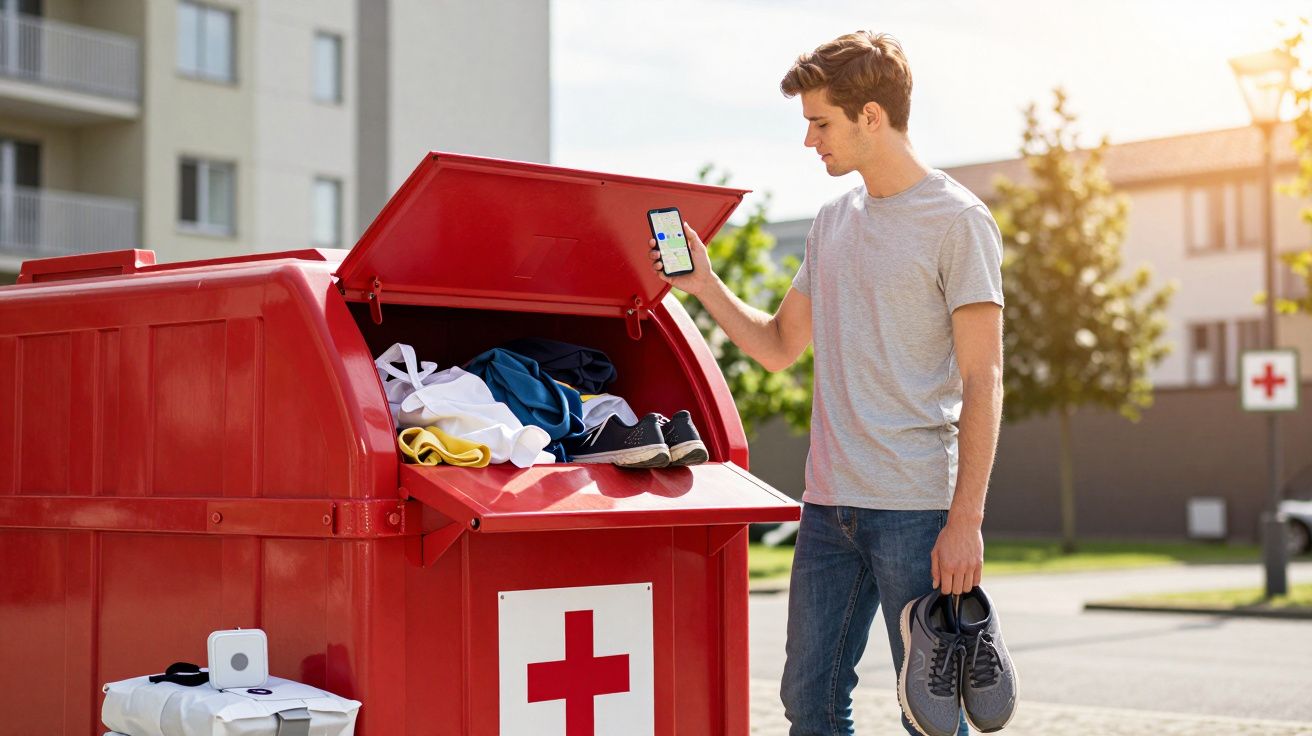
A German influencer set out to test what really happens to clothing donations by dropping his battered trainers into a German Red Cross donation container - after hiding an Apple AirTag inside the sole. That seemingly minor stunt triggered a long, data-driven chase across borders and offered a rare glimpse into the multi‑million‑pound world behind used‑clothing collections.
From worn trainers to a live tracking experiment
On countless street corners across Germany, metal used‑clothing containers are as familiar as bus stops. The German Red Cross alone operates around 25,000 of these collection banks across cities, suburbs and rural areas. The public message is straightforward: donated textiles are meant to help people in need or, at the very least, be reused for a good cause.
That promise is exactly what the influencer known as Moe.Haa wanted to verify. He took a pair of well‑worn trainers, carved out space in the sole, slipped in an Apple AirTag, sealed everything back up and deposited the shoes in a container in Starnberg, south of Munich in Bavaria.
He recorded the drop‑off for his audience, but the real point was what happened next. Using Apple’s Find My app, he tracked the donated shoes in near real time and watched their route unfold.
Apple AirTags explained: why a tiny tag can map huge journeys
AirTags are often described as “GPS trackers”, but that is not quite accurate. An AirTag broadcasts a Bluetooth signal which can be detected by nearby iPhones and other Apple devices. Those devices do know their location and then relay the AirTag’s position to Apple’s servers in an anonymised way.
The denser the network of iPhones, the more complete an AirTag’s travel diary becomes - including inside the used‑clothing collection system.
Because Apple devices are widespread across Europe, the system can work remarkably well. For Moe.Haa’s donation test, the AirTag was the perfect tool: discreet, robust, and capable of building a surprisingly detailed route map.
German Red Cross clothing donations tracked: the route from Bavaria to Bosnia and Herzegovina
At first, everything looked ordinary. The trainers stayed in Starnberg for a while. Then the AirTag location began to move and soon showed a stop in Munich, a city that hosts sorting operations and logistics sites linked to used‑textile flows.
Up to that point, the journey still matched the common assumption: collection, transport, sorting. The real surprise came when the AirTag crossed a national border.
- Stop 1: Starnberg - deposited in the donation container
- Stop 2: Munich - likely a collection hub or sorting point
- Stop 3: Austria - transit across the Alps
- Stop 4: Slovenia - onwards towards the Balkans
- Stop 5: Croatia - continued transport to the south‑east
- Final stop: Bosnia and Herzegovina - roughly 800 km from the original drop‑off point
In total, the shoes travelled about 800 km - far farther than many donors would expect. The AirTag ultimately remained in Bosnia and Herzegovina, in an area associated with textile businesses and second‑hand traders.
Why donations end up abroad: the used‑clothing trade behind the containers
The German Red Cross, like other non‑profit collectors, sorts donated textiles into quality grades. Only a relatively small share of the best items is given away free of charge to people in need, for example through clothing banks and community distribution points.
A much larger proportion is sold on - either through local second‑hand outlets or via wholesale channels. Commercial buyers then export the goods to other countries. The Balkans, Eastern Europe, parts of Africa and the Middle East are all significant markets for second‑hand clothing originating in Western Europe.
A typical breakdown looks like this:
| Category | What happens next |
|---|---|
| Very good quality | Second‑hand shops; export to stronger‑spending markets |
| Medium quality | Wholesale; export to lower‑income countries |
| Poor quality | Recycling into cleaning cloths, insulation, industrial fibres |
| Unusable | Incineration or landfill |
According to the organisations involved, proceeds from these sales help fund humanitarian projects, emergency response services and social programmes. Even so, the AirTag journey highlights how opaque the process can feel to the public when the route does not match donor expectations.
Added reality check: logistics, contracts and what “collection” can mean
One detail that is often missed is that the organisation named on a container does not always run every step itself. In many systems, charities work with commercial partners who handle collection rounds, bulk transport, sorting contracts and resale. That does not automatically imply wrongdoing - but it does mean “donated to charity” can quickly become “entered a global supply chain”.
It also explains why routes can look counter‑intuitive on a map. A donation may travel to where sorting capacity exists, to where buyers are based, or to where certain textile grades can be processed economically - not necessarily to where the donor imagines the item will be worn next.
The German Red Cross faces questions - not because of export, but because of expectations
Once Moe.Haa published the unexpected route, the online reaction followed a familiar pattern: many viewers felt misled. A common assumption is that donations remain in the country of origin or go directly to individuals in need.
The core frustration is often not the export itself, but the gap between what donors believe happens and how the market actually works.
The German Red Cross had to explain the mechanics of its collection model. In these situations, charities typically emphasise that domestic and international sales are an important funding stream; without that revenue, many services would be hard to sustain.
Critics, however, argue that containers rarely spell out - clearly and prominently - what will happen to donated items and what proportion is sold on. Many donors say they would accept resale and export more readily if labelling, routes and volumes were communicated with greater precision.
Between support and commerce: the ethical grey areas
Viewed objectively, selling second‑hand clothing is not inherently negative. Reuse extends a garment’s life, reduces waste and can generate income for charitable work without manufacturing anything new.
The discomfort tends to appear when used clothing is perceived as a near‑direct gift to people in need, but ends up as stock in an international trading network. Some charities collaborate with commercial operators who install containers, empty them and monetise the contents. When the division between charity and business is not made explicit, trust can suffer.
There is also a wider impact question. In some recipient countries, large inflows of cheap second‑hand clothing can put pressure on local textile production and small retailers. Research suggests outcomes vary by region - ranging from improved affordability for households to displacement of local suppliers.
What donors can take from the AirTag experiment
If you donate clothing via a container, it is worth assuming your items enter a value and recycling chain rather than a simple “hand‑to‑hand” gift. Donations can still do good - but sometimes in ways that look different from the wording on a container.
Three practical steps can help you donate more deliberately:
- Donate directly where possible: high‑quality items can go straight to local clothing banks, homelessness charities or community shops, where the path is often clearer.
- Sort by condition: heavily worn or damaged textiles are better suited to textile recycling than to a donation container.
- Check the organisation’s model: look up how the collector handles used textiles, what share is sold, and how the proceeds are used.
Charities can also learn from experiments like this. The more plainly containers and leaflets explain that some donations are exported or sold through trade channels, the less space there is for misunderstanding - and viral backlash.
Tracking, accountability and the risks of AirTags
This episode also underlines something bigger than clothing: digital consumer tools can now scrutinise systems that used to operate largely out of sight. AirTags can do more than locate lost keys; they can also document supply chains, recycling routes and donation flows.
At the same time, trackers have a darker side because they can be abused to monitor people. Apple has introduced safety measures designed to alert users to unknown AirTags travelling with them. Used on objects and goods, however, these small discs can provide powerful documentation.
It is easy to imagine environmental groups using similar methods more often to trace routes taken by e‑waste, plastic waste or used textiles. That kind of visibility creates pressure on organisations to run cleaner processes - and to communicate those processes honestly.
What if everyone tracked their donations?
Imagine one in ten clothing donations contained a tracker. Logistics networks would become visible as public patterns. Online maps could show real‑time flows of the used‑clothing trade: sorting facilities, intermediaries, ports and cross‑border routes - even when they span multiple continents.
That level of transparency could expose genuine abuses, such as illegal exports or questionable disposal. But it could also reveal sensitive operational data and risk painting legitimate systems with the same brush as bad actors.
Most people will never hide an AirTag in a shoe sole before donating. Yet Moe.Haa’s test still delivers a clear lesson: clothing donations do help, but their journey is often more complex, more international and more commercial than the label on a container might lead you to believe.






Comments
No comments yet. Be the first to comment!
Leave a Comment