
Two shopping bags in both hands, eyes briefly down, a hesitant step. People press in behind her, a bicycle bell rings, someone sighs under their breath. She needs only a fraction longer than everyone else, and yet it’s obvious: uncertainty is at play. Not in her thoughts, but in her hip, her pelvis - in that quiet centre of the body we barely notice during day-to-day life. We walk, we stand, we stumble - and we trust it will be fine. Until a fall happens. Or nearly happens. Then an ordinary step turns into a real question: how stable am I, really? And can that stability be trained, the way you train a muscle at the gym? The answer starts in a surprisingly overlooked place.
Why the hip decides how safe we feel in everyday life
If you ever watch people properly on a busy high street, you’ll see it straight away. Some move as if they’re on rails: calm, centred, almost unshakeable. Others wobble with every step, barely lifting their feet, looking a bit like a leaf in the wind. At first glance, it’s just different walking styles. In reality, the hip is speaking.
The hip reveals how well the deep muscles around the pelvis and lower back are working, how securely the leg is guided each time the foot lands, and whether someone trusts their body to carry them - or whether every kerb feels like a small gamble. The hip is less “just a joint” and more a navigation hub.
From a mechanical point of view, it makes perfect sense. When we walk, hip flexors, glute muscles, deep core muscles and the small stabilisers on the outside of the pelvis have to operate as a team. The moment one leg is in the air, the pelvis must be held steady; otherwise it drops to the side. That tiny, almost invisible sway can be the difference between a catch-and-recover and a full stumble. If you sit a lot, this is exactly where strength and control tend to fade. The hip stiffens, muscles react more slowly, and the body starts compensating with workarounds - the very workarounds that make us feel less secure on uneven ground, during quick turns, or when a dog suddenly cuts across your path.
That’s why hip exercises aren’t “just for older people”. They’re a practical safety net for any age group.
A physiotherapist in a rehabilitation clinic once told me about a patient: 72, formerly an enthusiastic hillwalker. After a fall on the stairs at home, she arrived with hip pain - and a huge fear of moving at all. Testing showed poor balance, weak hip muscles and an uncertain gait. Rather than simply telling her to “walk carefully”, he built a short programme of targeted hip exercises into her rehab. Two months later, the same woman walked down the corridor without a stick, turned mid-conversation as if it were nothing, and laughed while doing it. “I trust the stairs at home again,” she said - and added that she felt not only physically steadier, but mentally freer and less suspicious of every single step.
Hip stability and hip exercises: targeted drills that can genuinely change your gait
One of the most effective approaches starts surprisingly simply: standing at a kitchen worktop, a doorframe or a stair rail. One leg takes the weight; the other swings gently forwards and backwards, driven from the hip. The torso stays quiet, one hand offers light support. This easy pendulum motion wakes up the hip flexors and glutes, gives the joint room to move, and trains balance in the standing leg at the same time. With regular practice, many people notice after a few days that their step feels smoother and less heavy.
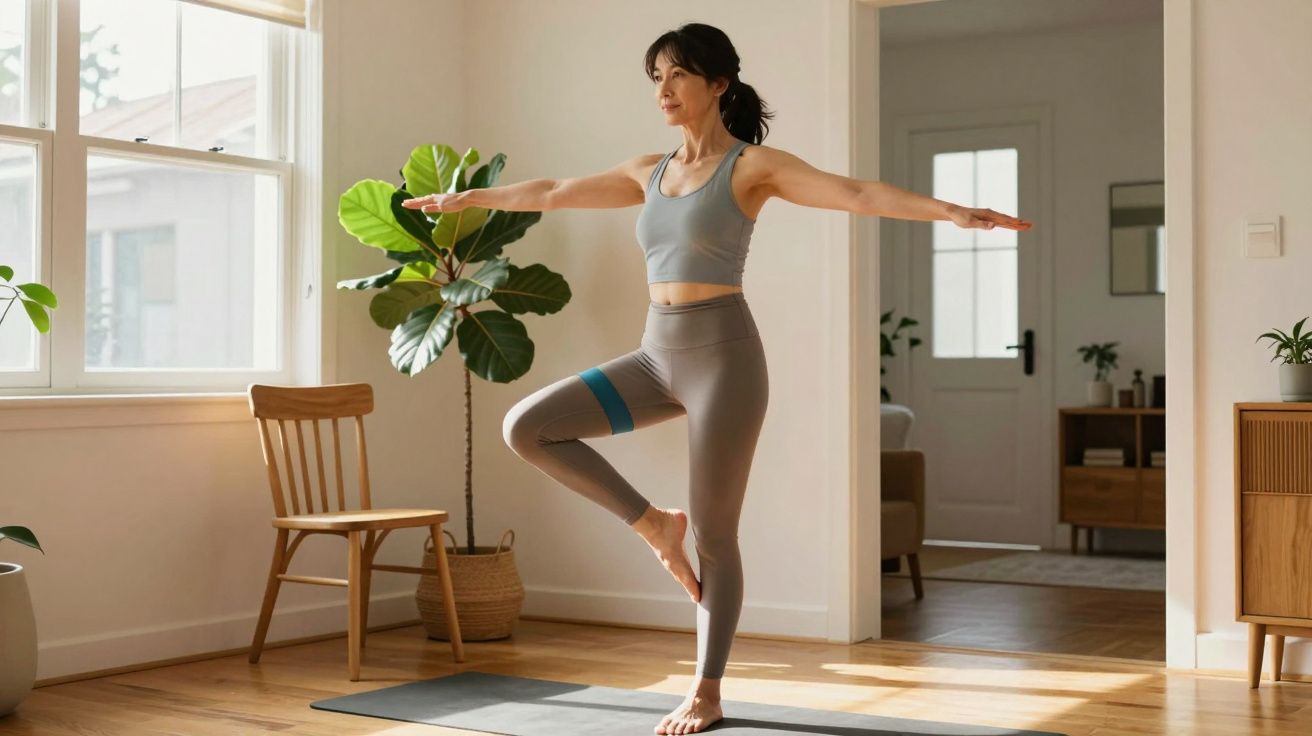
A second key piece is the side lift: raising the leg out to the side while standing, the foot turned slightly outwards, keeping the movement small and controlled. This targets the side hip stabilisers - the very muscles that stop the pelvis “dropping” when you walk.
Let’s be honest, though: hardly anyone does these exercises perfectly every single day, exactly as a textbook would like. We all know the moment you decide, “From tomorrow I’m training my hips,” and then life and a packed calendar take over. A kinder, non-perfectionist mindset makes this workable. Better to spend two minutes at the kitchen counter three times a week doing a few hip swings than to attempt a complex programme that collapses after three days.
Two common pitfalls show up again and again:
- Starting too fast and too hard, ending up with pain or frustration - and then giving up altogether.
- Focusing only on strength and forgetting balance. The hip responds best to small, gentle repetitions that give it time to re-coordinate with the foot, knee and trunk.
One understated sentence many physiotherapists repeat is worth remembering: the hip has to learn to trust you again.
“Many people assume they’ve simply become ‘clumsy’,” says an experienced physiotherapist. “But in reality, their body has forgotten what a safe step feels like. Hip exercises are like teaching the body a new language - sentence by sentence, step by step.”
- Exercise 1: Supported hip pendulum swings - 10–20 gentle forward-and-back movements per leg; let the foot brush the floor lightly; no swinging from the lower back.
- Exercise 2: Side single-leg stand - hold a chair back or wall; lift one leg; hold for 10–20 seconds; later progress by closing your eyes.
- Exercise 3: Mini squats with a hip focus - feet hip-width apart; send hips slightly back; load through the heels; lower only halfway; rise slowly; 8–12 repetitions.
When stability becomes emotional - and why the hip matters more than you think
Anyone who’s had a serious trip quickly learns this isn’t just a physical topic. Suddenly there’s a quiet caution on a slippery staircase, a tiny pause before crossing the road in the rain, an internal “please let this go right”. The body senses uncertainty, and the brain responds by braking. A loop forms: less movement, more stiffness, even more uncertainty.
This is where targeted hip exercises can be unexpectedly powerful. People often report that they walk with more spring, feel less anxious standing on a moving bus or train, and can turn quickly without instinctively reaching for support. Hip stability turns into a quiet, steady form of self-confidence.
If you pay attention in parks and supermarkets, you’ll see the shift. There’s the older man who no longer pushes the trolley like a walking frame, but guides it loosely while his pelvis stays calm. There’s the woman who no longer treats a kerb as an enemy, but steps up without breaking rhythm. And there are younger people who, after a ligament injury, suddenly realise how much the hip is involved in every compensatory movement. For many, it’s pain or a scare that finally makes this joint impossible to ignore - and then a new thought appears: I can do something active, rather than just hoping nothing happens. Daily life feels a little less random.
Small daily routines that retrain the system (without equipment)
The plain truth is that the body adapts to what you repeatedly ask of it. If you demand 10,000 steps a day in stiff, flat patterns - without ever waking up the side hip muscles - you may develop a gait that works on smooth indoor floors but falters on cobbles. If, instead, you build tiny rituals into the day - three exercises after brushing your teeth, 30 seconds of single-leg standing while the kettle boils, a few hip pendulum swings while the coffee machine runs - you gradually reprogramme the system.
Joints begin to move more freely, muscles react faster, and the nervous system relearns what “respond in time” feels like. It may look unimpressive, yet it can feel enormously liberating. Because in the end, feeling safe while walking isn’t a luxury - it’s a quiet prerequisite for a life where routes don’t turn into obstacles.
Two additional factors can make your hip stability work more effective without adding complexity. First, consider footwear and surfaces: shoes with decent grip and a stable heel counter can reduce unwanted wobble, while practising on a firm, even floor at first helps you build control before you challenge yourself on softer carpets or uneven paths. Second, pay attention to breathing and posture: slow, steady breathing and a “tall” torso (rather than a collapsed chest) can improve how the deep core supports the pelvis, which in turn makes hip exercises feel more controlled.
If you’ve had repeated falls, sudden giving-way, or significant pain, it’s also sensible to seek an individual assessment from a GP or physiotherapist. The goal is not to frighten you off movement, but to make sure you’re training the right thing in the right way - especially if arthritis, nerve symptoms or post-surgical changes might be involved.
| Key point | Detail | Reader benefit |
|---|---|---|
| Hip stability as a safety factor | The hip controls pelvic alignment, balance and step guidance with every footfall | Understand why unsteadiness when walking often comes from the hip - not “age” alone |
| Targeted mini-exercises in everyday life | Hip swings, side single-leg stand, mini squats, woven into existing routines | A low-barrier start that needs no equipment and is genuinely sustainable |
| Emotional impact of stability | More trust in your body, less fear of falls and uncertain situations | Regain a sense of control and move more confidently day to day |
FAQ
- How often should I do hip exercises for my gait to improve?
Even 3–4 times per week for 5–10 minutes can produce noticeable changes. Consistency beats intensity: small routines tend to work better than occasional “all-out” sessions.- From what age are targeted hip exercises worth doing?
Essentially from the point you sit a lot or sometimes feel unsteady when walking. Teenagers with lots of screen time can benefit just as much as people aged 70+.- I already have hip pain - can I still train?
Gentle, pain-free movement is often possible - and sometimes necessary. With acute or severe pain, an individual check with a doctor or physiotherapist is essential before you begin.- Isn’t walking enough to keep the hip fit?
Walking is excellent, but it’s more endurance than targeted stabilisation. The small side and deep muscles around the hip are often under-challenged during a normal stroll.- How will I know my hip is genuinely more stable?
Common signs include: you can stand safely on one leg for longer, kerbs feel less dramatic, you recover faster when you trip, and you feel more comfortable on buses and trains without a firm handhold.


Comments
No comments yet. Be the first to comment!
Leave a Comment