
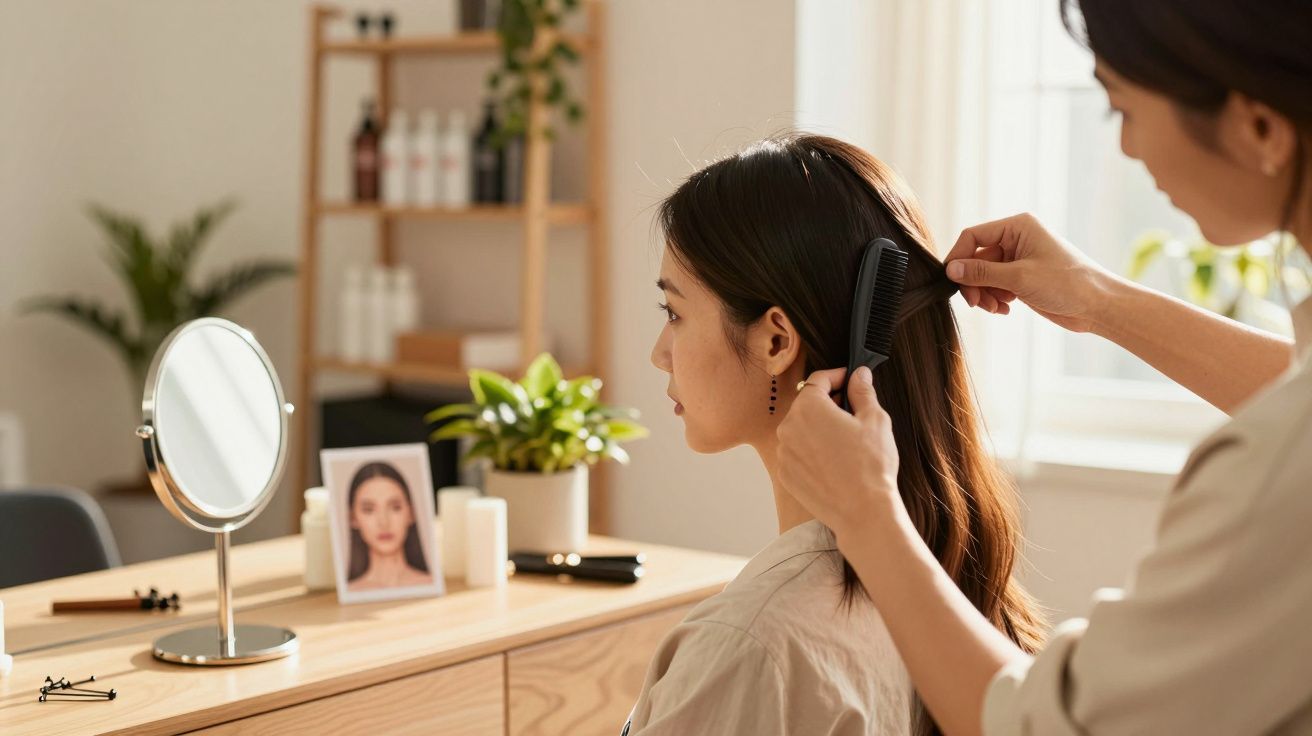
The salon smells of hairspray and fresh coffee while rain drums steadily against the window outside. In the swivel chair sits a woman in her mid-thirties, wearing that familiar expression: half intrigued, half doubtful. “Just a trim,” she says first-the classic opener when you suspect you want more, but don’t quite dare to ask for it. The hairdresser-dark shirt, calm hands-studies her face in the mirror, tilts his head slightly and smiles. “May I shift your parting? Just a touch.” One small comb, one quick movement, and suddenly she looks different: softer, brighter, unexpectedly assured.
She keeps staring as though someone has switched on a flattering filter. “Wow,” she mutters, “my face looks… different somehow.” The hairdresser nods like it’s the most ordinary thing in the world. For him, it is. For her-and for most of us-it isn’t. Because who really expects an understated side parting to change a face more than a pricey concealer ever could?
How a small side parting frames your whole face
There’s that moment we all know: a selfie that simply feels “off”, even though the make-up is fine, the lighting is decent and the angle should work. Something looks a bit harsh, a bit wide, or just tired. Then, almost absent-mindedly, you move your parting-and suddenly your face makes sense. It sounds like a social media fairy tale, but in salons it happens daily.
A side parting shifts proportions visually. It can make cheekbones appear more defined, break up the look of a high forehead, lengthen a rounder face, or take the edge off a sharply angular jaw. A few millimetres of hair placed differently, and the reflection tells a slightly different story. Not dramatic. Just… more harmonious.
I spoke to a hairdresser named Marco who has worked for 18 years in a small, always fully booked salon in a large German city. He told me about a client who had worn a strict middle parting for years “because that was what was trendy”. She had a round face, big eyes and generally soft features. “She always seemed a bit sad, even though she’s genuinely hilarious,” he said. One day, while blow-drying, her parting slipped by chance to the right. Marco paused, left it where it fell, and dried over it once more. “Suddenly her eyes became the focal point-not her forehead,” he recalled. That same evening she posted a selfie and got twice the usual likes. Not thanks to a filter, but thanks to a side parting.
Behind it all is not magic-just straightforward optics. A side parting redirects the viewer’s gaze. It pulls volume to one side and creates a diagonal line across the face. That diagonal works like a frame: it brings certain features forward and gently pushes others back. A broader face can appear narrower because the eye no longer travels symmetrically from left to right; instead it’s guided on a slight slant. A strong chin can read as softer when more volume sits near the cheeks. Let’s be honest: nobody calculates facial ratios while getting ready in the morning. But a good hairdresser does exactly that-silently, in seconds.
An extra detail worth knowing: where your hair naturally falls isn’t the only factor. Your crown pattern, density at the roots, and even how your hair behaves in damp British weather can change how a parting sits from morning to afternoon. What looks balanced straight after styling may drift once you’ve walked outside, worn a hood, or let your hair air-dry-so the “best” parting is often the one that still looks good when life gets in the way.
How to find the “right” side parting for your face (Marco’s method)
Marco starts every appointment with the same quiet routine: he looks before he cuts. He takes in forehead height, jawline, and the distance between the eyes. Then he uses a tail comb, placing it first at the exact centre of the forehead. From there, he shifts gradually left or right-often only by one to two finger-widths.
“People think a side parting means going wildly far over to the right,” he told me. In reality, a slightly offset middle parting is often enough to change how your face reads.
If you want to test it at home:
- Lightly dampen your hair.
- Stand in front of a mirror.
- Move the parting in tiny steps rather than one big leap.
- After each move, pause and look at your face first, not your hair.
A common mistake is drawing the side parting exactly where the hair “naturally” separates. It sounds sensible, but it isn’t always the most flattering option. Many people have cowlicks or flatter sections that push the parting in one direction. That may be convenient, but convenience doesn’t automatically equal balance. Marco says plenty of clients part their hair in the same spot for years because they assume they “don’t have a choice”. Yet many partings can be retrained if you give them a few days.
Yes, it can be irritating at first. A few strands may stick out, and you might feel slightly “unfinished”. But the awkward phase can be worth it if, all of a sudden, cheekbones appear that you’d almost forgotten you had.
“A parting is like a pair of glasses: it can open up your face or cover it. Most people are wearing the ‘wrong glasses’ simply because they’ve never tried anything else.”
He also advises choosing a side parting that suits your real routine-not just a trend or an influencer photo. If you regularly wear headphones, caps or a helmet, an extremely deep side parting may become a daily annoyance. Practical things to consider include:
- Try placing the side parting slightly above the highest point of your eyebrow
- Take photos in daylight-front-facing cameras often distort proportions
- Check how the parting “lives” morning and evening, when hair isn’t freshly styled
- Stick with it for one to two weeks before deciding it “isn’t you”
Another helpful angle: think about how you want your hair to behave around your hairline. A softer, slightly off-centre parting can reduce the spotlight on thinning at the temples, while a stronger side parting can help lift roots on one side if your hair tends to sit flat. If you use styling, choose lightweight products (a mousse or root spray) so the hair moves naturally-because stiff hold can exaggerate the diagonal and look less modern.
Why a side parting also affects how you feel about yourself
It sounds superficial, but anyone who has watched a tiny change in their parting shift their emotional response to the mirror knows it’s not just “hair moved from left to right”. Many people say a side parting makes them feel softer, more feminine, or more grown-up. Others feel they look more professional and less “baby-faced”. That reaction isn’t imaginary.
Our brains are highly sensitive to symmetry and asymmetry. A middle parting often reads as tidier and more severe. A side parting introduces movement-a small, imperfect detail that can make a face seem more alive.
We all have days when we look unfamiliar to ourselves. New make-up, new glasses, freshly coloured hair-and still it doesn’t quite “match”. A side parting can be a quiet adjustment knob in those moments, especially for anyone who doesn’t want a total reinvention. No extreme cut. No bold colour. Just a different parting. And yet the world looks slightly different when your reflection no longer seems stricter than everyone else is.
Marco says many clients tell him that once their side parting is placed well, they feel more confident wearing their hair down or sweeping a fringe away from the face.
You can dismiss it all as salon poetry, but one plain truth remains: nobody changes their entire life just by moving a parting. What changes is the small daily encounter with your own face-half-asleep in the bathroom, in a shop window reflection, on a video call with an unforgiving camera. If a simple side parting makes your features look more balanced, you may feel less irritated with yourself in those moments. It isn’t a miracle fix. It’s a subtle adjustment that quietly supports your self-image in the background.
| Key point | Detail | Benefit to the reader |
|---|---|---|
| Side parting changes proportions | Guides the eye diagonally, emphasises cheeks, disguises width or harshness | Helps you understand why your face can look “suddenly different” |
| A small shift is often enough | One to two finger-widths from the centre; no need to go extremely deep | Easy to test at home without a drastic makeover |
| Parting as an emotional adjustment | Asymmetry looks more lively, reduces severity, brings out character | Shows how a small detail can subtly improve self-perception |
FAQ
Does a side parting work with curls?
Yes-often brilliantly. With curls, a side parting places volume deliberately to one side and can soften the way the face is framed. Set the parting while the hair is wet, then let the curls dry without too much disturbance.Can I “train” my natural parting?
Often, yes. If you consistently create the new parting on damp hair and lightly set it, many hair types adapt within one to two weeks. Strong cowlicks won’t vanish, but they can often be managed with a blow-dry or styling.Which side parting suits a round face?
Slightly off-centre rather than extreme, paired with a little volume at the crown. This lengthens the look of the face and draws attention to the eyes and cheekbones rather than the widest point.Does a side parting always look softer?
Not necessarily. Depending on the cut, it can also make angular faces look sharper-especially if the ends sit right at jaw level. In a salon this can be used intentionally, or avoided on purpose.How do I test a new parting without going to the hairdresser?
Lightly dampen your hair, move the parting in small steps, then take a few selfies in daylight. You’ll see what the line and the light do to your face before committing.






Comments
No comments yet. Be the first to comment!
Leave a Comment